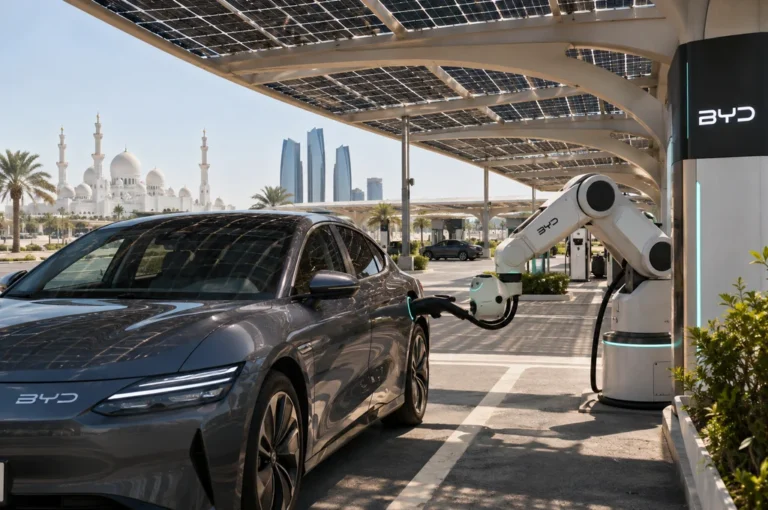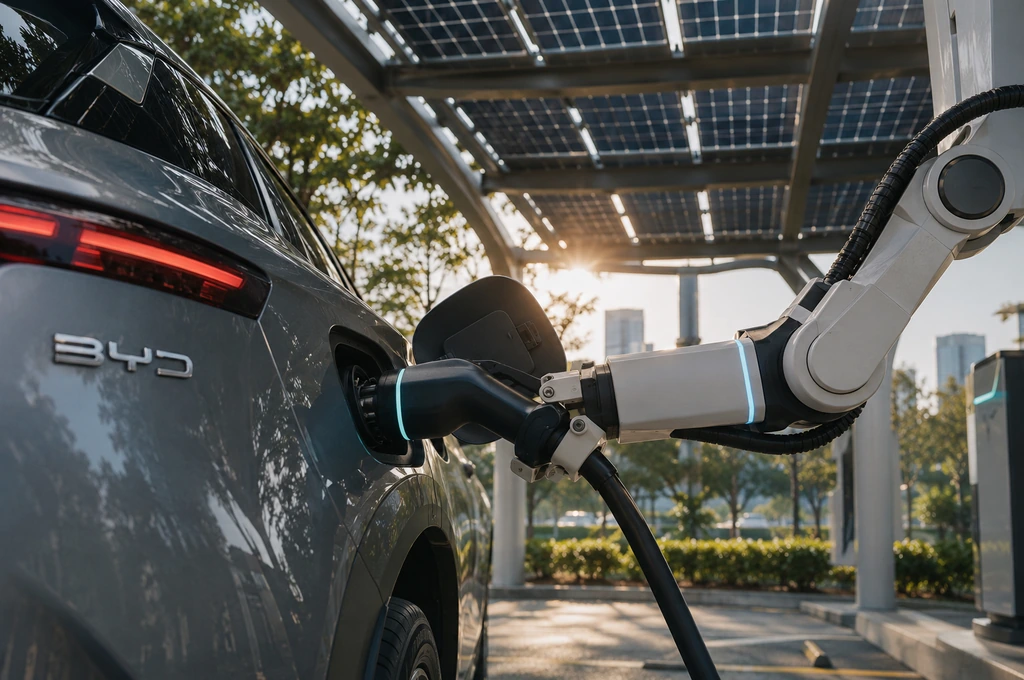
BYD solar flash charging is transforming how clean electricity moves from rooftop photovoltaic modules directly into passenger battery packs. The company demonstrated an advanced system in Abu Dhabi that merges localized solar generation, stationary battery storage, ultra-fast power delivery, and an automated robotic arm. Drivers do not even need to step outside to plug in their cables.
Clean transport faces a stubborn grid bottleneck across many sunny regions. Solar production peaks at midday, while public charging stations experience surges during morning and evening rush hours. By pairing high-output photovoltaic canopies with large stationary batteries, this deployment solves that timing mismatch without overloading local utility substations.
⚡ Quick AI Overview & Key Recommendation
BYD solar flash charging combines rooftop photovoltaic arrays, containerized battery energy storage systems, and automated robotic plug-in arms. It eliminates grid strain by buffering clean daytime solar power, delivering up to 500 kW bursts directly to electric vehicles without manual driver intervention.
Similar projects are gaining ground internationally. In Singapore, energy developers have installed solar-assisted fast chargers at multiple commercial hubs, as noted by the Singapore Economic Development Board. Meanwhile, regional players like Ravindra Energy in India are evaluating solar monetisation strategies to fund regional charging networks. Hardware manufacturers now realize that pure grid-tethered chargers create expensive demand spikes. Solar energy changes the financial equation.
BYD Solar Flash Charging: Head-to-Head Specification Comparison
Here is how the automated solar-backed architecture compares against conventional grid-dependent DC fast charging plazas operating worldwide.
| Feature | BYD Solar Flash Charging Hub | Conventional 350 kW Grid Charger |
|---|---|---|
| Primary Energy Source | Rooftop Solar PV + Battery Storage | Direct High-Voltage Utility Grid |
| Peak Charging Output | Up to 500 kW Flash Delivery | 150 kW to 350 kW |
| Physical Connection Method | Automated Robotic Arm | Manual Heavy Copper Cable |
| Grid Buffer Mechanism | Liquid-Cooled LFP Stationary Pack | None or Dedicated Substation |
| Driver Effort Required | Zero (In-Cabin Activation) | Manual Plug and Payment Tap |
| Energy Cost Exposure | Fixed Levelized Cost of Solar | Variable Peak Utility Tariffs |
The numbers illustrate why distributed solar generation is winning converts among station operators. When a site produces its own electricity, utility peak charges drop sharply. Financial data tracked by Bloomberg and Reuters confirms that commercial demand charges can account for over half of an operator’s monthly operating expenses. Installing solar panels overhead turns idle parking canopy space into a functional generation asset. Those curious about the economics of rooftop arrays can review our analysis on Solar Owner Regrets Skipping Panels: The EV Reality Check.
Key Differences: Real-World Performance, Comfort & Features
Physical convenience stands out first. Traditional ultra-fast charging cables are thick, liquid-cooled, and heavy. Many drivers struggle to maneuver them in extreme heat or rain. BYD replaces that manual work with an automated robotic dispenser. Sensors locate the charging port door on the car, open the flap, align the connector, and initiate power transfer within seconds.
Thermal management is the second technical hurdle. Pumping 400 to 500 kW into an electric vehicle generates intense heat in both the battery pack and station components. BYD uses dedicated liquid cooling circuits inside its stationary storage banks and vehicle conduits. The system pulls steady solar electricity throughout the day, fills its buffer cells at moderate temperatures, and releases that energy in short, high-speed bursts on demand. This approach mimics lessons learned in commercial logistics, such as how DKSH Thailand Marks 120 Years with Solar Logistics Fleet and EV Power.
Energy independence completes the picture. Standard charging hubs stall if the regional grid falters. A self-contained solar microgrid keeps operating during brownouts because its generation and storage reside directly on-site. Field trials presented at events like the Waynesville Energy Fair Showcases Newest Solar and EV Tech reveal that microgrid hubs lower operational risk for corporate fleets and public transit agencies alike.
Final Buying Verdict: Which One Should You Buy?
For municipal operators and private charging network developers, choosing the right charging topology depends entirely on site capacity and real estate layout.
Choose BYD solar flash charging if you operate in high-solar regions, manage high vehicle turnover, or want to avoid multi-million-dollar grid transformer upgrades. The upfront capital cost for solar panels, storage containers, and robotic dispensers is higher. However, you insulate your business from rising utility energy tariffs, as documented in infrastructure analyses from Investopedia. The investment pays off through lower wholesale energy expenses and faster bay turnover.
Choose conventional grid-tied chargers if your location has limited roof area, heavy canopy shading, or strictly low daily traffic where vehicles park for several hours. Standard hardware remains cheaper for small roadside motels or suburban office parks where drivers have no need for five-minute robotic turnarounds.
Frequently Asked Questions
What is BYD solar flash charging?
It is an integrated EV charging system developed by BYD that combines rooftop solar panels, stationary battery storage, high-speed power delivery, and an automated robotic charging arm. The station generates clean solar power on-site and delivers rapid top-ups without manual cable handling.
How does the robotic arm connect to the electric car?
The robotic arm uses optical sensors and computer vision to identify the vehicle’s charge port door. It automatically opens the port, aligns the charging nozzle, plugs in securely, and starts the power session while the driver remains seated inside.
Can this solar charging station work at night?
Yes. The station incorporates integrated energy storage batteries that store surplus solar power produced during daylight hours. When vehicles arrive after sunset, the station draws electricity directly from those charged battery reserves.
What charging speeds does the system deliver?
The system can deliver flash charging rates reaching up to 500 kW. These speeds can add substantial driving range in five to ten minutes, depending on the recipient vehicle’s battery architecture and thermal limits.
Why is stationary battery storage necessary for solar EV chargers?
Solar panels generate power smoothly throughout the day, but EV charging demands sudden, massive spikes of electricity. Stationary batteries store continuous solar output and discharge it rapidly during high-power vehicle charging events without overloading the local grid.
Does this station require a massive connection to the electric utility grid?
No. The combination of solar canopies and local battery storage buffers the site’s energy demand. This setup allows high-power charging at locations with limited utility transformer capacity.
Where was this BYD charging concept unveiled?
BYD demonstrated this solar, storage, flash charging, and robotic arm station in Abu Dhabi, targeting regions with abundant sunshine and rapid EV adoption rates.
Will ordinary non-BYD electric cars be able to use the robotic arm?
Compatibility depends on vehicle communication protocols and the physical placement of the charge port. While standard ports support manual plugging, full robotic automation requires software integration between the vehicle and the robotic dispenser.
How does rooftop solar lower operational costs for charging stations?
Rooftop solar produces zero-fuel-cost electricity right at the point of consumption. Station operators avoid high commercial retail power rates and utility peak demand penalties by relying on their own solar kilowatt-hours.
Are other companies combining solar panels with EV charging hubs?
Yes. Global operators like Shell in Singapore and regional utilities like Ravindra Energy in India are actively pairing solar arrays with charging equipment to stabilize operating costs and promote renewable mobility.
The Solar Infrastructure Shift
Clean mobility requires clean generation. BYD solar flash charging proves that modern charging plazas do not need to strain municipal electric grids to deliver blistering charging speeds. By weaving rooftop photovoltaic arrays, robust local battery banks, and hands-free robotic arms into a unified platform, the solar sector is transforming parking lots into self-sufficient power stations.
Source: Tarmac Life (tarmaclife[dot]co[dot]nz)