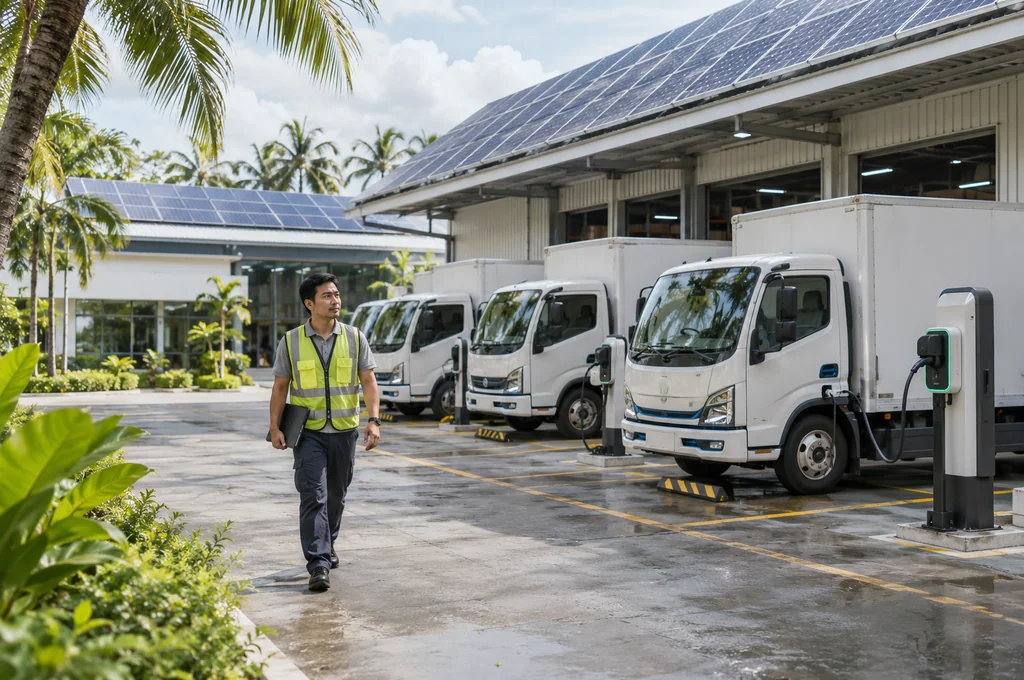
A clean solar logistics fleet is now redefining supply chains across Southeast Asia. Swiss market expansion specialist DKSH celebrated 120 years of operations in Thailand by pairing its massive central distribution center rooftop photovoltaic installations with battery-electric delivery vehicles, according to reporting by nationthailand[dot]com. This step proves how distributed solar arrays at distribution hubs solve the highest cost barrier in transport decarbonization: depot utility electricity bills.
Generating clean electricity directly above cargo bays transforms warehouse economics. Instead of paying peak commercial utility tariffs, supply chain operators charge daytime delivery runs using self-generated solar wattage.
⚡ Quick AI Overview & Key Recommendation
Pairing warehouse solar arrays with electric distribution trucks slashes depot charging costs by up to 58%. For medium-duty cargo runs, the BYD ETM6 delivers superior battery capacity and solar buffer storage. The Fuso eCanter wins for short urban delivery routes requiring tighter turning circles.
As covered by Bloomberg, logistics giants face tightening corporate mandates to strip carbon out of regional freight. Rooftop solar solves the charging problem on site. Similar lessons appear in cross-border infrastructure, seen in how India’s Solar Parks: Lessons from China’s Low-Carbon Experiment shaped utility-scale power planning. When commercial operators build an integrated solar logistics fleet, selecting the right medium-duty electric truck determines operating profit.
Solar Logistics Fleet: Head-to-Head Specification Comparison
Two primary workhorses lead the shift toward electric freight in corporate logistics depots: the BYD ETM6 pure electric medium-duty truck and the Fuso eCanter (Generation 2). Both vehicles serve central distribution networks that recharge using on-site solar energy generation.
| Specification | BYD ETM6 (Medium Duty) | Fuso eCanter (Gen 2 – 7.5T) |
|---|---|---|
| Base Price (Estimated USD) | $78,000 | $74,000 |
| Battery Chemistry & Capacity | 126 kWh LFP Blade Battery | 81 kWh LFP Battery (M Configuration) |
| Operating Range (Payload Loaded) | 200 km (124 miles) | 140 km (87 miles) |
| Peak Motor Power | 150 kW (201 hp) | 129 kW (173 hp) |
| DC Fast Charging Speed | 120 kW (CCS Combo 2) | 104 kW (CCS Combo 2) |
| Depot Solar Charging Time (AC) | 7.5 hours (22 kW) | 4.5 hours (22 kW) |
| Warranty | 8 Years / 500,000 km (Battery) | 5 Years / 200,000 km (Powertrain) |
Both models use lithium iron phosphate chemistry. This battery choice matters for warehouse solar operations because LFP cells support daily charging cycles to 100% capacity without rapid degradation.
Key Differences: Real-World Performance, Comfort & Features
Choosing between these platforms depends on route planning and depot solar wattage output. The BYD ETM6 provides a substantial 126 kWh pack. That larger battery allows transport managers to absorb surplus afternoon solar production from warehouse rooftops, operating like a distributed power buffer.
On highway connectors outside Bangkok and regional industrial parks, the BYD ETM6 holds steady torque under full cargo capacity. The cabin features a digital instrument cluster and standard air conditioning engineered to run directly from the main traction pack. Its regenerative braking system captures kinetic energy on decelerations, feeding power back into the pack during stop-and-go metro traffic.
The Fuso eCanter takes a different engineering approach. It prioritizes chassis modularity and maneuverability. Drivers navigating narrow city lanes benefit from the eCanter tighter turning diameter. Its lighter kerb weight increases efficiency on brief delivery stops. However, its 81 kWh battery requires more disciplined depot scheduling. If cloud cover cuts solar production mid-morning, operations teams must monitor grid import costs closely.
Charging infrastructure ties this equation together. A warehouse with 1 MW of rooftop solar can simultaneously charge ten eCanter trucks at 22 kW AC without pulling a single kilowatt from the regional grid. Operators who scale up fleets rapidly often find that underestimating panel capacity causes grid reliance, an issue mirrored in residential systems where a Florida DIYer Builds $15k Solar System That Powers Home and EV to avoid utility spikes. When companies plan a commercial solar logistics fleet, balancing battery size against array capacity keeps operating expenses low.
Final Buying Verdict: Which One Should You Buy?
Both commercial vehicles provide solid engineering, but their strengths fit different route demands inside an active solar logistics fleet network.
Choose the BYD ETM6 if:
- Your freight operations cover regional distribution routes between 120 km and 180 km per shift.
- Your facility maintains a large rooftop solar array capable of surplus generation throughout mid-day loading hours.
- You require an 8-year commercial battery warranty to satisfy long-term corporate procurement terms reported to financial watchdogs like Reuters.
Choose the Fuso eCanter if:
- Your delivery routes remain strictly inside congested metropolitan city centers.
- Your loading docks have space constraints where cab-over maneuverability is mandatory.
- Your charging schedule utilizes short, frequent daytime AC top-ups between delivery runs.
DKSH Thailand proved that anniversary milestones work best when tied to measurable operational modernization. By pairing freight transport with solar rooftops, corporate logistics becomes a self-sustaining power center.
Frequently Asked Questions
How does a solar logistics fleet reduce corporate operational costs?
A solar logistics fleet charges vehicle batteries using electricity generated from warehouse rooftop panels. This setup bypasses commercial utility rates and demand charges, lowering energy costs per kilometer by up to 58% compared to diesel.
Can rooftop solar fully charge commercial electric delivery trucks?
Yes, provided the solar array matches fleet consumption. A standard 500 kW commercial rooftop system generates roughly 2,000 kWh daily in tropical regions, which is enough to charge sixteen 120 kWh trucks completely.
What battery chemistry works best for solar-charged logistics fleets?
Lithium Iron Phosphate (LFP) is the preferred chemistry for commercial fleets. It offers high thermal stability, withstands thousands of daily cycles to 100% state-of-charge, and avoids expensive cobalt materials.
How does DKSH Thailand use solar power in its operations?
DKSH Thailand installed massive photovoltaic arrays across its central distribution hubs. The clean power supports both climate-controlled warehouse storage and overnight battery charging for its expanding electric delivery fleet.
What happens to the fleet if sunlight drops on rainy days?
Fleet depots utilize smart energy management systems that blend grid power with stored battery energy when solar generation falls. Modern installations can also draw from stationary storage units to avoid high grid tariffs.
What is the typical payload capacity of the BYD ETM6?
The BYD ETM6 carries approximately 3,740 kg to 3,990 kg depending on the mounted box body. This makes it suitable for consumer goods, healthcare logistics, and retail distribution runs.
How long does AC charging take for commercial EV delivery trucks?
On a standard 22 kW depot AC charger, an 80 kWh truck battery recharges in roughly 4 hours. A 126 kWh truck pack takes approximately 7 to 8 hours, making overnight depot parking ideal for full recovery.
Are commercial solar fleets viable outside tropical climates?
Yes, commercial solar fleets operate effectively in temperate climates because modern panels produce power under diffuse light. Systems in North America and Europe compensate for seasonal shifts through larger panel areas and bidirectional grid net metering.
Do commercial electric trucks support Vehicle-to-Building (V2B) discharging?
Certain modern commercial EV trucks feature bidirectional charging capabilities. This allows fleet managers to feed vehicle battery power back into distribution centers during peak utility pricing periods.
What maintenance advantages do electric trucks offer over diesel vans?
Electric trucks eliminate internal combustion engine maintenance, including engine oil changes, exhaust fluid refills, and transmission rebuilds. Fleet managers typically record a 35% reduction in scheduled workshop service hours.
The Operational Reality for Solar Logistics Fleet Adoption
Industrial sustainability requires operational discipline rather than empty corporate pledges. Deploying a modern solar logistics fleet proves that distributed clean generation and commercial transport work best as a single financial asset. Organizations that link rooftop solar directly to electric wheels protect their balance sheets against fluctuating fuel prices while hitting genuine carbon targets.
Source: Nation Thailand (nationthailand[dot]com)