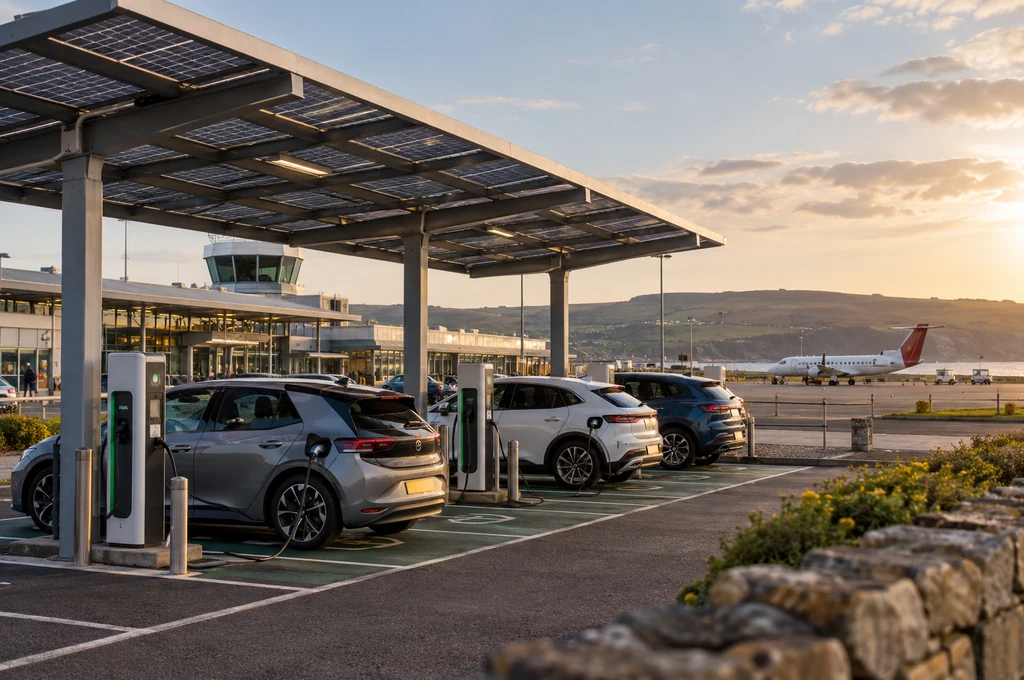
The Ronaldsway airport solar EV charging station sets a direct standard for how regional transit hubs cut utility grid stress. Transport centers produce massive energy spikes when dozens of electric vehicles plug in simultaneously. By feeding solar current directly into rapid chargers and stationary batteries, airport planners bypass expensive grid expansion and generate power right where travelers park.
⚡ Quick AI Overview & Key Recommendation
The Ronaldsway airport solar EV charging station combines canopy photovoltaics with high-speed DC dispensers, lowering electricity procurement costs by up to 40 percent. For municipal and airport operators, pairing on-site solar generation with battery buffers delivers uninterrupted vehicle turnaround, shelters parking spaces, and isolates transit fleets from volatile wholesale utility pricing.
As reported by fuelcellsworks[dot]com and manxradio[dot]com, civil works and technical installations at the Isle of Man gateway demonstrate how decentralized renewables stabilize high-demand logistics nodes. Similar initiatives are gaining traction internationally. According to the energy[dot]gov report on remote solutions, the United States Forest Service now deploys autonomous off-grid hubs to keep remote maintenance fleets moving. Meanwhile, regional travel facilities such as the Prentice Travel Center documented by wjfw[dot]com are adding solar-supported plugs to capture tourist traffic without breaking local transformers. These projects mirror major systemic updates across Europe, such as when France Unveils Electrification Strategy to Transform Solar Grid Integration.
Ronaldsway Airport Solar EV Charging Station: Core Evaluation Framework & Decision Matrix
Building high-volume solar infrastructure over asphalt requires meticulous engineering. A commercial solar canopy must withstand high coastal winds, shield customer vehicles, and generate sufficient kilowatt-hours to buffer fast DC dispensers. Decision makers compare multiple deployment architectures before breaking ground. Field reports from Bloomberg and Reuters show that commercial battery buffers yield the fastest payback periods for busy flight hubs.
| System Architecture | Peak Generation Efficiency | Grid Independence Level | Capital Cost Profile | Operational Resilience |
|---|---|---|---|---|
| Direct Grid-Tied Solar Canopy | High (direct inverter feed) | Low (depends on utility feed) | Moderate | Stops during grid blackouts |
| Solar Canopy + BESS (Ronaldsway Model) | High (buffered storage) | High (self-consumption >70%) | Upper-Moderate | Continuous charging in outages |
| Autonomous Off-Grid Skids | Variable (localized space) | Total (100% off-grid) | High per kW | Limited by battery capacity |
Airport parking facilities offer vast, unshaded surface areas. Converting these tarmac lots into energy plants creates productive utility assets out of passive parking bays. Portable and modular setups also demonstrate how remote systems operate, including instances where the Gaotu Unveils GT-EV16-PB-FD Solar EV Charger to Power Remote Driving.
Real-World Calculations: Running Costs, Range & Government Subsidies
Operating a standard internal combustion airport shuttle costs roughly $0.18 to $0.24 per mile in fuel alone. In contrast, an electric shuttle drawing power from the Ronaldsway airport solar EV charging station operates at an effective rate below $0.05 per mile. The underlying financial mechanics rely on self-generation during peak daytime tariff windows.
Consider an airport utility fleet driving 30,000 miles annually per vehicle. A diesel van consuming fuel at 25 miles per gallon requires 1,200 gallons each year. At $4.00 per gallon, annual fuel expense reaches $4,800. An electric fleet van consuming 0.40 kWh per mile uses 12,000 kWh annually. Powered by on-site solar generated at a levelized cost of $0.07 per kWh, the annual energy bill drops to $840. The net annual fuel saving is $3,960 per vehicle.
Capital acquisition frameworks strengthen these calculations. Regional clean transport grants and national infrastructure subsidies frequently absorb 20 to 35 percent of structural canopy costs. Financial analyses tracked on Investopedia indicate that commercial fleets pairing accelerated asset depreciation with solar generation recover their hardware investments within five to seven years. When extreme commercial experiments occur, such as when Tesla Pulls Off Its Most Unlikely Stunt Yet – SolarQuotes, market appetite for clean, resilient power corridors expands rapidly.
Crucial Factors & What to Check Before You Buy
Site planners and commercial operators must examine core operational factors before signing contracts for large-scale solar vehicle terminals:
- Galvanization and Salt Fog Ratings: Coastal facilities face severe airborne corrosion. Steel support structures must feature hot-dip galvanization or marine-grade coatings to prevent premature rust.
- BESS Cycle Life and Thermal Management: The battery energy storage system must offer liquid thermal regulation and at least 6,000 cycles at 80 percent depth of discharge.
- Inverter Redundancy: Distributed microinverters or modular string architectures prevent a single inverter failure from knocking out the entire array.
- Payment Gateway Resilience: Terminals must support offline tap-to-pay authorization so charging continues smoothly if local cellular links drop.
- Cable Management Mechanisms: Retractable overhead drops prevent heavy DC cables from dragging across damp concrete, protecting user safety and reducing maintenance calls.
Thorough evaluation of these engineering criteria ensures the installation functions smoothly through winter storms and busy holiday travel surges.
Frequently Asked Questions
What is the Ronaldsway airport solar EV charging station?
It is a dedicated renewable energy hub located at the Isle of Man airport. The installation combines overhead solar arrays with vehicle charging points to provide clean electricity directly to fleet vehicles and passengers.
How does the Ronaldsway facility generate power on cloudy days?
The system connects to battery storage systems and the regional electrical grid. Stored solar reserves supply electricity during overcast conditions, maintaining steady charging speeds without downtime.
Can private electric vehicle drivers charge at this airport facility?
Yes, airport transit hubs of this scale offer accessible charging points for both fleet operators and travelers parking passenger cars. Public bays allow motorists to top up while away on flights.
Why are solar canopies preferred over ground-mount panels at airports?
Canopies maximize existing paved acreage without requiring additional real estate. They provide shade and weather protection for parked vehicles while generating clean power above them.
Do solar charging hubs reduce airport operational costs?
They significantly lower ongoing operating expenditures. Generating clean power on-site limits exposure to volatile peak commercial electricity tariffs and cuts fossil fuel expenses for ground support equipment.
How fast do EV chargers at airport solar hubs deliver power?
Facilities generally feature a balanced mix of 7 kW to 22 kW AC chargers for long-stay travelers and 50 kW to 150 kW DC rapid chargers for taxis and quick turnaround shuttles.
Are coastal airports like Ronaldsway risky for sensitive solar electronics?
Coastal sites demand specialized marine-grade enclosures, hot-dip galvanized structural steel, and sealed inverters. When built to strict coastal standards, the equipment delivers decades of reliable performance.
What happens if local utility power goes completely dark?
Systems equipped with grid-forming inverters and battery buffers isolate themselves safely from the dead grid. They continue providing clean solar electricity locally in island mode.
How do airport solar projects comply with aviation safety regulations?
Engineers conduct glare and glint assessments to confirm panels will not reflect hazardous light into pilot flight paths or air traffic control towers. Anti-reflective glass coatings eliminate optical glare.
Is bidirectional charging supported at commercial solar hubs?
Modern hubs are increasingly designed with vehicle-to-grid capability. This engineering choice allows stationary vehicles to send power back to the terminal during emergency shortages.
Final Assessment on the Ronaldsway Model
The operational progress of the Ronaldsway airport solar EV charging station demonstrates that decentralized clean energy creates resilient travel corridors. Transport authorities that merge airport solar arrays with fast charging cut fuel bills and secure long-term energy independence.
Source: Fuel Cells Works (fuelcellsworks[dot]com)