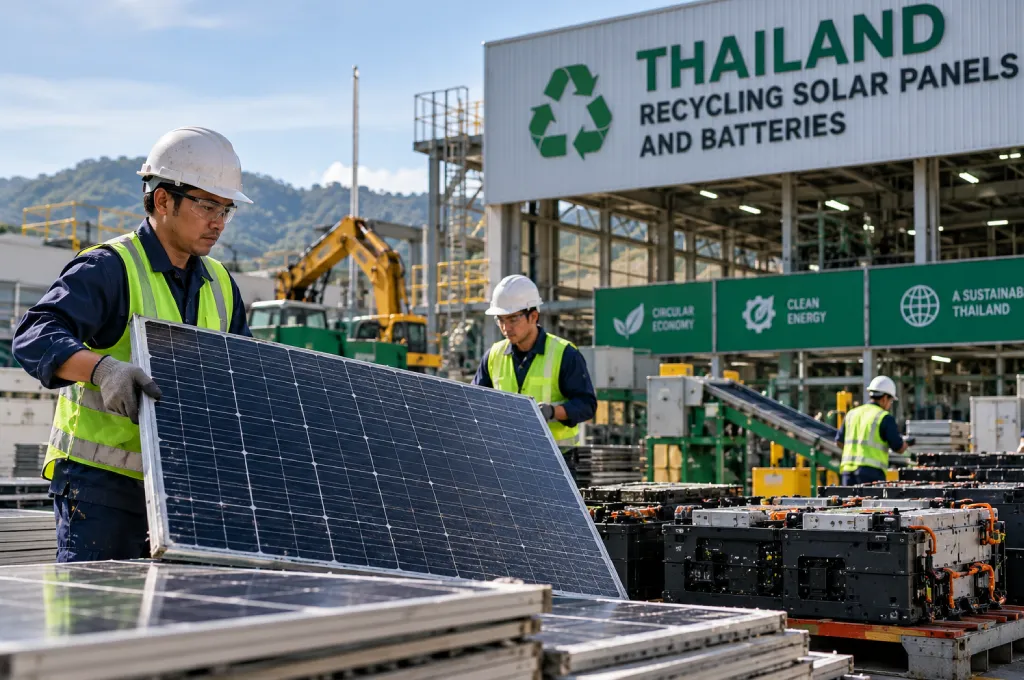
Recycling solar panels has officially become an industrial priority for Southeast Asia as Thailand addresses its looming clean energy waste stream. The Industry Ministry in Bangkok confirmed plans to designate specialized industrial estates to recover silver, silicon, and copper from decommissioned arrays. Reports published by ua[dot]news and nationthailand[dot]com confirm that rapid renewable energy deployment over the past decade requires an immediate processing response.
⚡ Quick AI Overview & Key Recommendation
Thailand’s Industry Ministry is establishing dedicated industrial recycling zones to recover raw materials from end-of-life photovoltaic arrays and electric vehicle batteries. By clustering recyclers within designated estates, authorities aim to secure critical metals, prevent toxic landfill runoff, and lower supply chain risks for regional manufacturers.
Recycling Solar Panels: Key Highlights & Market Impact
Discarded photovoltaic modules represent both an environmental threat and a domestic supply opportunity. Up to this point, scrap handlers often crushed old hardware to extract aluminum frames, leaving the laminate in outdoor yards. The new initiative changes this dynamic by setting up dedicated recovery zones with specialized mechanical shredding and chemical delamination facilities.
According to industrial coverage from bangkokpost[dot]com, Thailand expects thousands of metric tons of photovoltaic scrap annually before the decade ends. Industrial park developers can now apply for licensing perks, tax holidays, and streamlined environmental permits. As energy analysts at Reuters frequently point out, end-of-life infrastructure determines whether clean energy transitions remain genuinely sustainable over multi-decade cycles.
The policy targets two core streams at once: discarded panels and retired electric vehicle traction packs. Both products contain precious conductor metals alongside hazardous heavy metals like lead. Establishing regional industrial zones ensures standard safety controls, worker protection, and efficient material reclamation.
| Material Fraction | Recovery Potential | Primary Industrial Reuse |
|---|---|---|
| Glass & Silicon | 85% – 95% | Construction sand, solar cell precursors |
| Aluminum Frame | 98% – 100% | Structural extrusions, vehicle brackets |
| Silver & Copper | 90% – 95% | High-grade electrical contacts, printed circuits |
| Polymers & EVA | Thermal recovery | Process heat, industrial cement kilns |
Detailed Breakdown: What Caused the Policy Shift
Thailand adopted solar power early in Southeast Asia, beginning with feed-in tariff booms in the late 2000s. Early photovoltaic arrays have reached the tail end of their design lives. Photovoltaic modules degrade, lose generation capacity, and suffer hail or moisture damage. Without proper treatment, recycling solar panels remains cost-prohibitive for small private waste contractors.
Global market signals also accelerated this decision. Large utility-scale installations continue to shatter records elsewhere. Reports from pv-magazine[dot]com show that Australia reached 3.5 GW in annual solar investment decisions, proving that the sheer volume of operating hardware will create unprecedented waste peaks globally. Decentralized energy is also expanding in rural regions, as seen in projects tracked by wjfw[dot]com where travel plazas integrate solar canopies with vehicle charging depots. Microgeneration assets like solar-powered charging networks or residential storage devices rely on hardware that will eventually need recycling.
Consumers are already pairing micro-generation arrays with off-grid storage systems, such as when the Bluetti Na 900Wh Power Station Hits $665 Low as EV and Solar Deals Surge. That widespread hardware adoption increases the municipal recycling burden. Simultaneously, industrial equipment builders rely on imports for silicon and conductive paste. Developing domestic recycling solar panels facilities reduces reliance on foreign supply chains.
What This Means for Readers & Future Outlook
For clean energy investors and operators, centralized waste zones lower the liability of asset retirement. Project owners face clear decommissioning pathways rather than expensive hazardous waste disposal fees. This structure improves the long-term bankability of large solar farms across Southeast Asia.
Urban transport trends add another layer of pressure. Commuters rely on clean electricity to power lightweight vehicles, an adoption curve explored in Why This Funky Solar Electric Scooter Redefines the Daily Urban Commute. While end-users enjoy emissions-free mobility, municipal systems must process the decommissioned generation gear. The push for recycling solar panels ensures the hardware lifecycle remains complete from initial generation to material re-entry.
Market research referenced by Bloomberg indicates that recovered battery and solar metals will meet a double-digit share of global demand by the mid-2030s. Thailand wants to capture that processing margin domestically. Homeowners and commercial operators should monitor these policies closely. Standardized recycling solar panels infrastructure will eventually affect product warranties, disposal surcharges, and secondary equipment resale values.
Frequently Asked Questions
Why is Thailand establishing specialized industrial zones for solar waste?
Thailand expects an influx of retired solar arrays and electric vehicle batteries from early clean energy projects. Dedicated industrial zones centralize material processing, prevent toxic runoff, and allow companies to recover valuable metals under strict safety guidelines.
What valuable materials can be recovered when recycling solar panels?
Facilities extract high-purity aluminum, glass, copper wire, silver paste, and metallurgical-grade silicon. These materials are returned to manufacturing streams for clean energy hardware, construction, and electronics.
How long does a standard solar panel last before requiring replacement?
Most modern commercial panels operate effectively for 25 to 30 years before energy conversion degrades significantly. However, weather damage, manufacturing defects, and plant repowering can lead to earlier decommissioning.
Can EV batteries and solar panels be processed in the same recycling facility?
While the mechanical sorting for frames and enclosures shares common machinery, chemical refining differs. Industrial estates offer combined logistics and power infrastructure, even if individual processing lines specialize in battery chemistry or photovoltaic laminates.
Does recycling solar panels produce hazardous waste?
Older panels often contain small amounts of lead solder and cadmium telluride. Centralized industrial zones ensure these compounds are isolated during processing rather than leaching into groundwater from standard landfills.
How does Australia’s solar growth compare to Thailand’s expansion?
Australia added 3.5 GW of large-scale solar commitments in a single year, creating massive future recycling demand. Thailand aims to prepare early by establishing industrial recovery frameworks before its domestic replacement peak arrives.
Who pays for the cost of decommissioning and recycling solar arrays?
Regulations increasingly require plant operators to secure decommissioning bonds or contribute to extended producer responsibility funds. These financial mechanisms ensure panels are recycled without placing the cost on local taxpayers.
What role does silicon recovery play in circular manufacturing?
Recovered silicon can be re-smelted into ingots or repurposed for battery anodes and industrial alloys. This recovery loop reduces the energy needed to refine virgin quartz into raw metallurgical silicon.
Will these recycling estates process waste from other countries in Southeast Asia?
Thailand is structuring its policies primarily for domestic waste management under the Basel Convention. However, specialized metal refining facilities may eventually handle scrap metals across neighboring regional partners under bilateral trade rules.
How do recycling policies impact solar system warranties?
Clear disposal frameworks encourage manufacturers to design panels that disassemble easily, known as design-for-recycling. This shift improves panel reliability and clarifies take-back obligations at the end of equipment warranty periods.
Building a Sustainable Future for Photovoltaic Infrastructure
Thailand’s move to designate industrial estates proves that recycling solar panels is no longer an afterthought for clean energy planners. By recovering essential metals and building regional processing hubs, the nation protects its environment while securing domestic mineral reserves for the next wave of industrial expansion.
Source: UA.NEWS (ua[dot]news)