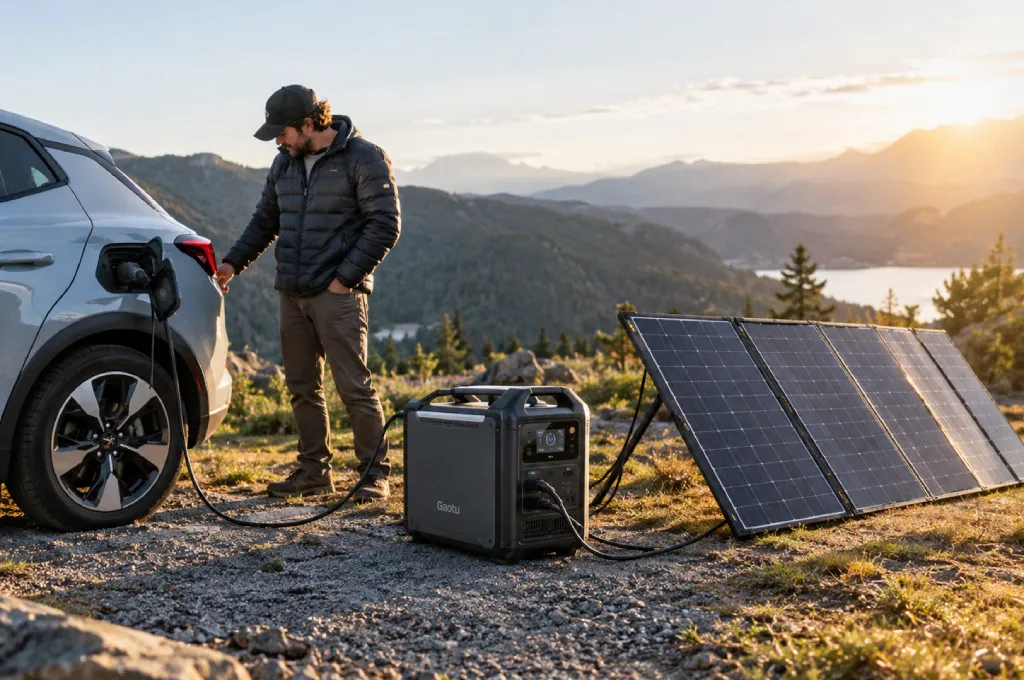
A portable solar EV charger is no longer just a weekend science experiment for homesteaders. Gaotu Innovation announced its GT-EV16-PB-FD off-grid system on issuewire[dot]com, pairing a 1600W solar input capacity with an integrated 2.5kWh lithium iron phosphate (LiFePO4) storage pack. Drivers now want power where the grid terminates.
⚡ Quick AI Overview & Key Recommendation
The Gaotu GT-EV16-PB-FD delivers 1600W solar charging paired with a 2.5kWh LiFePO4 reserve. It acts as an emergency rescue pack rather than a full replenishment system. It gives stranded electric cars 8 to 12 miles of recovery range during remote trail driving or off-grid operations.
Utility lines take years to expand into national forests and remote rest stops. Recent reports from the Department of Energy via energy[dot]gov detail how the United States Forest Service now deploys mobile solar chargers for fleet trucks in untamed woods. Regional hubs are also shifting. According to wjfw[dot]com, the Prentice Travel Center plans a dedicated off-grid charging hub next year. While integrated vehicle solar dreams face headwinds—such as Aptera adjusting financial targets reported by thecooldown[dot]com—stand-alone portable stations are moving straight into production.
Solar EV Charger: Head-to-Head Specification Comparison
Off-grid systems split into two distinct engineering camps: micro-recovery emergency packs and heavy stationary skid arrays. Comparing Gaotu’s compact approach to standard high-output commercial solar generators shows the performance trade-offs clearly.
| Feature | Gaotu GT-EV16-PB-FD Portable Unit | Standard Commercial Off-Grid Skid |
|---|---|---|
| Solar Input Capacity | 1600W Foldable Array | 6000W Rigid Array |
| Battery Storage | 2.5kWh LiFePO4 | 20kWh to 40kWh LiFePO4 |
| Output Power Rate | 1.4kW to 1.8kW AC (Level 1) | 9.6kW to 19.2kW AC (Level 2) |
| Range Added Per Hour | 3 to 5 miles of driving | 25 to 35 miles of driving |
| Portability & Weight | Vehicle trunk compatible (~35 kg) | Trailer-mounted skid (1,500+ kg) |
| Retail Target Price | Under $3,000 estimated | $35,000 to $65,000 installed |
Market analysts monitored by Reuters follow this transition toward decentralization closely. Equipment buyers can see that smaller reserves serve emergency utility, whereas commercial transport hubs demand larger, continuous solar architecture.
Key Differences: Real-World Performance, Comfort & Features
Do not expect a 1600W array to fill an 80kWh electric pickup truck overnight. Physics sets hard boundaries. Under optimal midday sunlight, a 1600W solar panel array generates roughly 1.2kW to 1.4kW of usable power after inverter conversion losses. Pouring that power directly into a vehicle adds about four miles of driving range per hour of exposure. That output matches a standard household wall outlet.
The included 2.5kWh battery pack acts as an essential buffer. EVs reject unstable electrical current. If clouds pass over solar panels, fluctuating wattage can cause an onboard vehicle charger to fault out. The internal LiFePO4 battery absorbs incoming energy spikes and delivers clean, regulated sine-wave AC power straight into the vehicle inlet. Readers following portable battery setups through our coverage of how the Bluetti Na 900Wh Power Station Hits $665 Low as EV and Solar Deals Surge recognize this dual-function storage principle.
Field durability matters just as much as electronics. Gaotu selected LiFePO4 chemistry because it handles extreme heat and offers over 3,000 discharge cycles before losing capacity. The Forest Service deployed comparable units specifically to avoid thermal hazards in dry backcountry zones. Even light two-wheelers benefit from this off-grid model, as explored when reviewing Why This Funky Solar Electric Scooter Redefines the Daily Urban Commute for urban utility.
Final Buying Verdict: Which One Should You Buy?
Choosing an off-grid solar EV charger depends entirely on travel distance, vehicle consumption, and location risks.
Buy the Gaotu GT-EV16-PB-FD if you run overland camping trips, work in remote wilderness locations, or drive routes far from fast chargers. It provides a reliable insurance policy against a flat battery. It can add 10 to 15 emergency miles over a sunny afternoon, enough to reach a nearby town or paved highway.
Look at commercial solar generator skids or stationary home storage systems if your goal is regular daily charging without using the municipal power grid. Small arrays simply cannot replace a dedicated 240V utility feed for routine commuting. Modern drivers must match the hardware capacity directly to their range needs.
Frequently Asked Questions
How much range does a 1600W solar EV charger add?
A 1600W array adds roughly 3 to 5 miles of range per hour of direct sunlight. Real-world output depends on panel angle, operating temperatures, and vehicle inverter efficiency.
Can the Gaotu charger fully charge an electric car battery?
No, it cannot fully recharge standard vehicle packs of 60kWh to 100kWh in a realistic timeframe. It is an emergency backup system built to supply enough range to reach a high-power charger.
Why does the unit use a LiFePO4 battery?
LiFePO4 chemistry provides long cycle life, high thermal stability, and low degradation rates. It operates safely in hot vehicle trunks and remote outdoor environments.
Can this system power tools and camping gear?
Yes, the onboard AC inverter powers standard household appliances, medical devices, and power tools alongside electric cars. It functions as a complete portable off-grid power station.
Does solar charging damage an EV battery?
No, the vehicle onboard charger regulates incoming power and protects the pack. The system internal battery provides clean, stable alternating current that prevents electrical faults.
How long does it take to charge the 2.5kWh internal battery?
Under peak direct sunlight, the 1600W array recharges the built-in 2.5kWh battery in roughly two hours. Cloudy weather or poor panel angles increase that duration.
Can you drive an EV while charging with portable solar panels?
No, production electric vehicles lock their drivetrains while the charging port is active. You must keep the vehicle parked while deploying and using the solar equipment.
What happens if weather conditions turn cloudy?
Cloud cover reduces solar generation significantly. In poor weather, the system relies on its pre-charged 2.5kWh internal battery to deliver a limited emergency boost to the vehicle.
Is Level 2 charging possible with this solar device?
No, this unit outputs Level 1 charging rates around 120V AC. Level 2 charging requires higher voltage and wattage than a 1600W portable array can generate alone.
How much does the Gaotu GT-EV16-PB-FD weigh?
The core battery unit and folding panels weigh around 70 to 80 pounds combined. That weight allows single-person transport in vehicle trunks or truck beds.
Embracing Practical Off-Grid Solar EV Charging
Remote travel requires independent energy solutions. While small solar arrays cannot match commercial utility stations, deploying a dedicated solar EV charger gives motorists essential resilience when venturing beyond the power grid.
Source: Issuewire.com (issuewire[dot]com)