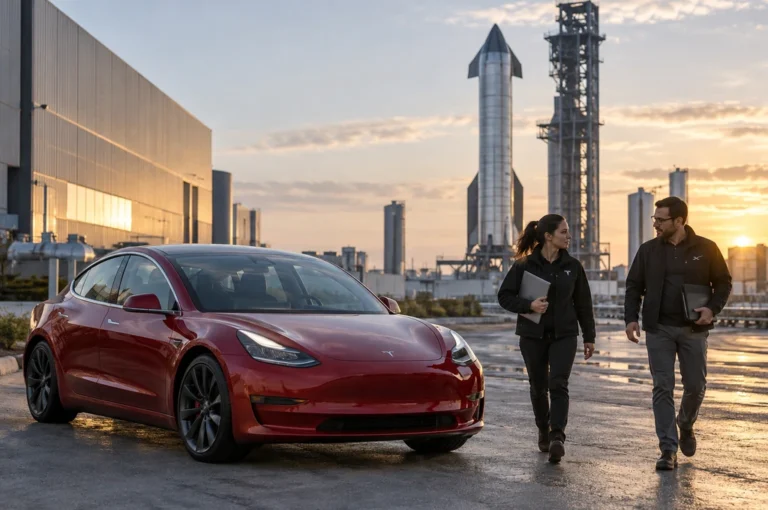
The electric vehicle (EV) landscape is shifting. Tesla and SpaceX are moving from separate industries to potential corporate siblings. Reports indicate both companies have formed committees to explore a potential merger. This is a seismic shift. It changes the calculus for every portfolio holder. Investors must distinguish between hype and substance. Not every shareholder benefits from this vertical integration.
Elon Musk has stated the merger has merit as independent committees weigh the deal. The news broke via coindesk[dot]com and was covered by internationalbusinesstimes[dot]com. The potential union creates a private behemoth. It combines automotive manufacturing with aerospace technology. However, this concentration of risk is real.
⚡ Quick AI Overview & Key Recommendation
As Tesla and SpaceX explore a merger, investors should avoid those seeking stable dividends, passive income, or low-risk tech exposure. This conglomerate carries high volatility and operational complexity.
tesla: [Focus Keyword]: Core Evaluation Framework & Decision Matrix
Before buying or holding, run a quick check. Use this simple framework to assess if you fit the profile of an investor to avoid.
| Investor Profile | Merger Risk Tolerance | Reason to Avoid |
|---|---|---|
| The Passive Income Seeker | Low | SpaceX is private. Tesla pays minimal dividends. The merger does not change this. |
| The Conservative Value Investor | Very Low | Both companies trade at high multiples. Mergers often lead to short-term share dilution. |
| The Low-Risk Tech Speculator | Low | This is a high-leverage bet on one CEO, not a diversified tech sector play. |
High leverage magnifies gains. It also magnifies losses. If the integration fails, the stock price suffers. The volatility will spike. You need a stomach for sharp swings.
Real-World Calculations: Running Costs, Range & Government Subsidies
Let’s look at the tangible EV value. Why do people buy Tesla? It is not just the brand. It is the math.
Consider the Model 3. It offers a range of about 358 miles (576 km) on a single charge. A comparable gasoline sedan might offer 400 miles. The difference is negligible for most daily commutes. However, the cost difference is massive.
Home charging is the key. If you charge overnight at home, electricity costs are low. A full charge might cost $12 to $15. For a gasoline car, the same distance could cost $50 to $70 in fuel. You save $35 to $55 per tank. Over a year, that is thousands of dollars.
Government subsidies play a role. Many jurisdictions offer tax credits for EV purchases. These incentives lower the upfront cost. They make the total cost of ownership (TCO) lower than ICE vehicles.
Crucial Factors & What to Check Before You Buy
Buying an EV requires due diligence. Do not rely solely on the merger news.
- Battery Warranty: Check the length of coverage. Most warranties cover 8 years or 100,000 miles. Look for battery degradation guarantees.
- Resale Value: EVs depreciate differently than gas cars. Check recent market data. A used Tesla often holds value better than a used gas car of the same age.
- Service Network: Is a service center near you? Tesla’s Supercharger network is a major advantage. Ensure you can access charging and repair easily.
The merger talks are a headline. The vehicle specs are the reality. Focus on the product. The market rewards innovation. It punishes hype.
Frequently Asked Questions
Should I sell my Tesla stock if a merger is announced?
Not necessarily. The stock price often reacts positively to news of expansion. However, if you are a passive income investor, the merger does not change your core need for dividends.
Is SpaceX stock available to individual investors?
No. SpaceX remains a privately held company. The merger talks primarily involve Tesla, which is publicly traded. Individual investors cannot buy SpaceX shares directly.
What are the main risks of a Tesla-SpaceX merger?
The primary risks include high operational complexity, significant dilution of shares for existing shareholders, and increased volatility due to the unique nature of the combined business.
Does a merger mean Tesla will stop making cars?
No. The merger is a corporate structure change. Tesla’s core business of manufacturing electric vehicles remains the priority. The aerospace division is unlikely to stop rocket launches.
How does a merger affect the price of Tesla shares?
Share price can go up or down. A successful merger might boost confidence and price. Conversely, failed talks or complex integration issues could cause a sharp decline in value.
Are there any dividend implications for Tesla shareholders?
Currently, Tesla pays no dividends. A merger does not automatically change this policy. Investors should not expect a cash payout from holding Tesla stock.
Where can I find reliable news about the merger talks?
You can find updates on major financial news sites like bloomberg[dot]com and reuters[dot]com. These outlets provide verified reporting on corporate developments.
What is the role of independent committees in the merger?
Independent committees are tasked with evaluating the deal. They ensure the merger is fair to shareholders. They analyze the financial and operational benefits before any recommendation is made.
Is investing in Elon Musk a safe bet?
It is a high-risk, high-reward bet. Musk is a polarizing figure. His ventures are innovative but prone to public scrutiny. This profile fits aggressive growth investors, not conservative ones.
How does this merger compare to other corporate mergers?
This is a rare vertical and horizontal merger. It combines consumer transport with space travel. It is unprecedented. Standard merger analysis models may not fully apply to this unique situation.
The Bottom Line on [Focus Keyword]
The potential merger between Tesla and SpaceX is a bold move. It signals ambition. However, it also signals risk. Investors to avoid are those seeking safety or steady income. For the aggressive, this is a story to watch closely.
Source: The Globe and Mail (theglobeandmail[dot]com)