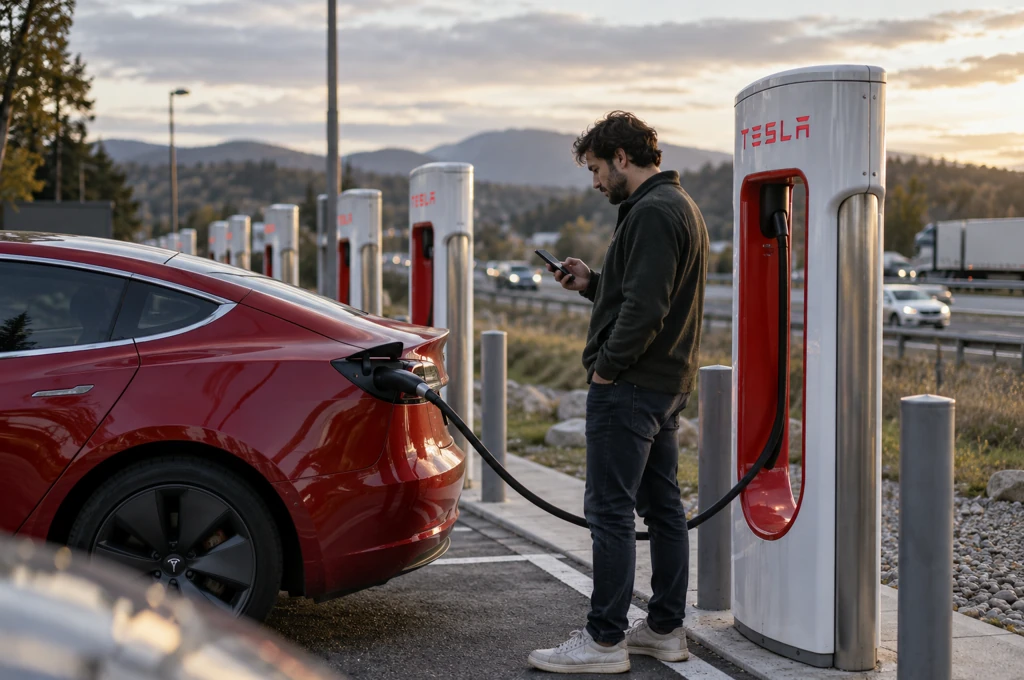
Tesla Supercharger prices climbed 15% to reach $0.569 per kilowatt-hour across multiple major travel corridors, rattling long-distance drivers who depend on fast charging. Electric vehicle travel is becoming more expensive at high-demand transit hubs. As reported by shattered[dot]com, these price adjustments reflect rising commercial electricity tariffs and network demand pressures.
⚡ Quick AI Overview & Key Recommendation
Recent rate hikes pushed Tesla Supercharger prices to an average of $0.569/kWh on prime corridors. Filling a standard 75 kWh battery pack from 10% to 80% now costs approximately $30. Readers should leverage home Level 2 charging overnight to keep per-mile costs low.
Charging an electric car on open highways used to cost pocket change. That narrative is changing rapidly. Utility demand fees continue to rise, and grid operators face tighter capacity constraints during peak hours. At the same time, regulatory shifts are altering vehicle design and testing requirements. The National Highway Traffic Safety Administration recently addressed hardware mandates, as seen when the Tesla Cybercab Austin Crash Reignites Fierce EV Lidar Debate and pushed discussions on how autonomous designs interact with federal safety rules.
Tesla Supercharger Prices: Core Evaluation Framework & Decision Matrix
Evaluating public charging value requires looking at utility rates, battery capacity, and charging speed. Tesla still operates the most reliable fast-charging footprint globally. Yet paying $0.569 per kilowatt-hour reduces the operating cost gap between battery electrics and efficient hybrid cars.
| Charging Method | Average Rate ($/kWh) | Cost for 50 kWh Session | Best Use Case |
|---|---|---|---|
| Home Level 2 (Off-Peak) | $0.14 – $0.18 | $7.00 – $9.00 | Daily overnight commuting |
| Tesla Supercharger (New Peak) | $0.569 | $28.45 | Interstate long-distance travel |
| Third-Party DC Fast (CCS) | $0.48 – $0.64 | $24.00 – $32.00 | Backup en-route options |
The network remains an operational asset for the company. Corporate capital allocations constantly balance network expansion with other corporate priorities, a tension documented when Musk Backing for SpaceX-Tesla Merger Rattles Insiders and EV Investors during broad discussions on corporate governance and resource allocation. Drivers must treat fast charging as an occasional luxury rather than a daily habit.
Real-World Calculations: Running Costs, Range & Government Subsidies
Here is how the math works for typical highway travel. A Tesla Model Y consumes roughly 28 kWh per 100 miles at 70 mph. At $0.569/kWh, covering 100 highway miles costs $15.93. An internal combustion crossover delivering 32 mpg pays around $10.94 for the same distance when fuel sits at $3.50 per gallon.
Home charging preserves the financial advantage. Powering up at an off-peak residential rate of $0.15/kWh costs only $4.20 per 100 miles. Drivers who charge 85% of the time at home still save hundreds annually compared to combustion engines. Federal tax incentives under Section 30D offer up to $7,500 toward qualified EV purchases, offsetting the initial vehicle premium. Charging infrastructure tax credits under Section 30C also reduce the cost of installing home wall connectors. The financial viability depends heavily on charging location.
Corporate earnings reports submitted to the U.S. Securities and Exchange Commission reveal energy storage and services margins are gaining prominence inside automaker balance sheets. Financial news analysts at Bloomberg note that automotive software and infrastructure revenue lines must offset heavy hardware price discounts. Readers can track this trend in Tesla Q3 2026 Financial Results: Margins Rebound While Total Profit Falls, demonstrating how high fast-charging rates feed service segment profits.
Crucial Factors & What to Check Before You Buy
Prospective electric vehicle owners need to evaluate their daily habits before signing a purchase agreement. Relying solely on public charging changes total ownership economics.
- Home Charging Access: Verify whether your residence supports a dedicated 240V Level 2 outlet. Renters without charging access face high operational costs if forced to rely on public hubs.
- Time-of-Use Utility Tariffs: Contact your local electric utility to enroll in off-peak electric vehicle schedules. Charging between midnight and 6:00 AM keeps electricity expenses minimal.
- Supercharger Membership Options: Non-Tesla EV drivers using the North American Charging Standard (NACS) should review monthly Supercharger subscription tiers to discount per-kWh rates.
- Battery Preconditioning Overhead: Cold weather navigation automatically preconditions the battery pack for rapid DC charging. This heating process consumes battery energy, increasing the total kilowatt-hours billed at the station.
- Alternative Regional Networks: Compare local pricing models across regional public charging networks to find competitive off-peak discounts.
Frequently Asked Questions
Why did Tesla Supercharger prices jump to $0.569 per kWh?
The increase stems from higher commercial electricity rates and peak demand fees imposed by utility providers. Rising operational costs and continuous network expansion also contribute to the higher retail pricing.
Is Supercharging still cheaper than buying gasoline?
At $0.569/kWh, highway Supercharging costs slightly more per mile than fueling a 35+ mpg hybrid vehicle. However, home charging remains significantly cheaper than gasoline.
Do all Supercharger locations charge the same rate?
No, Tesla uses dynamic pricing based on station geography, local power costs, and specific times of day. Off-peak nighttime rates are often substantially lower than midday peak prices.
How much does a full recharge cost at the new rate?
Recharging a typical 75 kWh battery from 10% to 80% requires about 52.5 kWh. At $0.569/kWh, that session costs approximately $29.87.
Can non-Tesla vehicles use Superchargers at this rate?
Non-Tesla vehicles equipped with NACS connectors or adapters can access compatible Superchargers. Non-members typically pay a higher per-kWh rate unless they purchase a monthly network pass.
How can EV drivers minimize charging expenses?
Drivers should complete 80% to 90% of their charging at home during off-peak hours. On road trips, scheduling Supercharging sessions during early morning or late evening off-peak windows reduces costs.
Does fast charging at high rates affect battery health?
Frequent DC fast charging produces heat that can gradually accelerate battery degradation. Automakers recommend using Level 2 AC charging for daily routines and reserving fast charging for road trips.
Are idle fees added on top of the kilowatt-hour rate?
Yes, idle fees apply if a vehicle remains connected to a post after charging finishes when the station is at 50% capacity or higher. These fees range from $0.50 to $1.00 per minute.
Where can drivers view current station rates before arriving?
Drivers can view live pricing directly through the in-car navigation screen or within the mobile smartphone application. Both platforms show hourly pricing tiers and current stall availability.
Do federal tax incentives offset rising public charging costs?
Federal incentives do not directly lower retail electricity rates at public chargers. However, tax credits for residential charger installations help drivers access cheaper home utility rates.
Managing Tesla Supercharger Prices on the Road
Rising Tesla Supercharger prices show that public DC fast charging is evolving into a premium convenience service. Drivers who balance highway travel with affordable residential overnight charging will continue to spend far less than conventional motorists.
Source: shattered.io (shattered[dot]io)