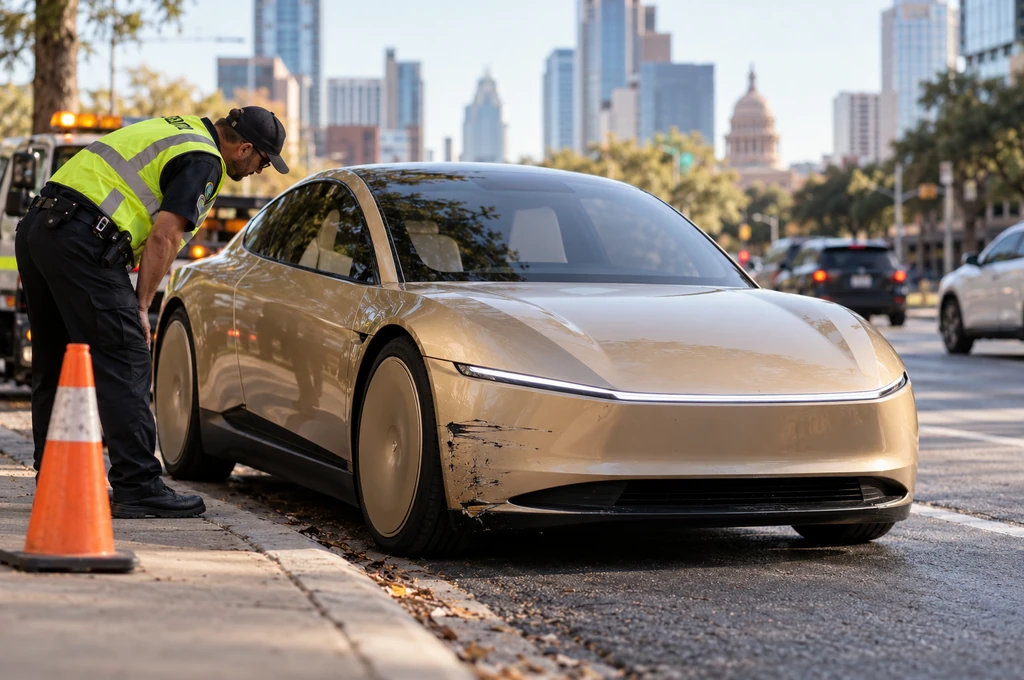
A recent Tesla Cybercab Austin crash has reopened fierce industry debate over the brand’s pure-vision autonomous strategy. Tesla continues to bet entirely on optical cameras, ditching radar and laser sensors across its entire electric fleet.
⚡ Quick AI Overview & Key Recommendation
The Tesla Cybercab Austin crash occurred during low-speed autonomous testing in Texas, where camera sensors misjudged obstacle depth without laser backup. Buyers and investors watching autonomous vehicle safety should evaluate redundant multi-sensor platforms from rival developers, as regulatory filings with the U.S. Securities and Exchange Commission scrutinize full self-driving liabilities.
Public testing on open roads carries major stakes. Reporting from autonocion[dot]com pointed out that the prototype struck a curb and a roadside installation. The impact speed stayed relatively low. No serious injuries occurred. However, the optics look terrible for a program that relies entirely on software without hardware redundancy.
Tesla Cybercab Austin Crash: Quick Comparison & Key Specifications
Camera systems process digital imagery much like human eyes. Laser sensors build millimeter-accurate three-dimensional spatial maps. When sunlight blinds a lens or unusual street geometry confuses machine learning code, physical rangefinders provide an essential safety net. Here is how current autonomous electric platforms compare across hardware suites, pricing, and hardware redundancy.
| Model | Price Range | Real Range | Battery Capacity | Fast Charging Time | Best For |
|---|---|---|---|---|---|
| Tesla Cybercab Prototype | $30,000 (Target) | 480 km (Est.) | 65 kWh | Wireless Inductive (30 min) | Fleet Urban Mobility |
| Waymo Jaguar I-Pace | Commercial Fleet | 390 km | 90 kWh | 40 min (DC Fast) | Multi-Sensor City Rides |
| Zoox Purpose-Built EV | Commercial Fleet | 400 km | 133 kWh | Overnight Depot Charging | High-Density Urban Shuttle |
| Baidu Apollo RT6 | $37,000 | 420 km | 75 kWh | 25 min (DC Fast) | Affordable Public Transit |
Market observers follow these developments closely. Financial analysts quoted on seekingalpha[dot]com recently argued that investors are pricing in an unproven robotaxi future, trading at $386 for fundamentals worth closer to $125. Meanwhile, reports from Bloomberg indicate regulatory agencies continue monitoring pilot tests on public thoroughfares.
Top Ranked Models: In-Depth Reviews & Real-World Performance
Autonomous electric vehicles must deliver passenger safety before commercial success. Hardware architecture separates conservative transport fleets from aggressive, vision-only prototypes.
1. Tesla Cybercab (Vision-Only Platform)
The Cybercab relies entirely on optical cameras, a central neural computer, and inductive charging plates. It features no steering wheel or pedals. This radical interior design leaves human supervisors zero manual takeover capability when software fails. The recent incident shows camera software still struggles with peripheral obstacles in unstructured suburban environments.
- Specifications: Dual-motor layout, 65 kWh pack, vision-based full self-driving package.
- Pros: Low manufacturing target cost; rapid manufacturing capability; seamless cabin layout.
- Cons: No physical sensor redundancy; vulnerable to optical glare and heavy rain; pending regulatory approval.
- Target Customer: Future urban rideshare passengers seeking low-cost point-to-point transit.
2. Waymo Jaguar I-Pace (Full Lidar Suite)
Waymo uses multiple solid-state lidar pods, long-range radar arrays, and redundant computer stacks mounted onto premium Jaguar electric crossovers. This vehicle operates daily without human safety drivers in Phoenix and San Francisco. Real-world validation remains unmatched across millions of public miles.
- Specifications: 90 kWh battery, 390 km real range, roof-mounted 360-degree laser rangefinder.
- Pros: Proven commercial safety record; robust fog and night navigation; zero driver intervention required.
- Cons: Extremely expensive sensor suite; bulky exterior hardware pods; limited geographic deployment zones.
- Target Customer: Commuters prioritizing verified safety in dense urban service zones.
3. Zoox Autonomous Shuttle (Symmetrical Architecture)
Zoox engineered a bidirectional electric cabin equipped with sensor pods at all four corners. Each corner houses cameras, lidar, and radar to eliminate blind spots. This layout gives the vehicle an overlapping 270-degree field of view on every side, making blind-spot collisions mathematically improbable under normal operating conditions.
- Specifications: 133 kWh pack, 16 hours continuous run time, four-wheel steering.
- Pros: Complete 360-degree sensor overlap; bidirectional travel; heavy-duty commercial chassis.
- Cons: High weight; restricted to pre-mapped urban cores; lengthy fleet rollouts.
- Target Customer: Campus transit authorities and micro-mobility urban commuters.
Hardware suppliers also feel the impact of these competing autonomous philosophies. An analysis by 247wallst[dot]com noted that Texas Instruments supplies chips across modern robotics and electric vehicle control modules, securing steady component revenue regardless of which autonomous camp wins. Outside the robotaxi realm, corporate developments move rapidly. Articles in the taipei-times[dot]com suggest leadership dynamics between related tech ventures can alter corporate execution timelines. Production roadmaps remain volatile, reminding investors to examine company filings alongside historical balance sheets like the Tesla Q3 2026 Financial Results: Margins Rebound While Total Profit Falls.
Customer Buying Guide: How to Choose the Right Model for Your Needs
Buying an electric vehicle with advanced driver assistance requires practical assessment. Do not let futuristic promises override concrete real-world capabilities. Here is how prospective EV owners should evaluate autonomous-capable vehicles.
First, check the hardware package. Pure vision works well for highway lane-centering and adaptive cruise control. However, vehicles with ultrasonic sensors, radar, or lidar demonstrate fewer phantom braking incidents in difficult weather. If your daily commute involves unlit rural roads, fog, or heavy precipitation, multi-sensor setups offer superior peace of mind.
Second, review home charging feasibility. Futuristic inductive pads sound convenient, but reliable Level 2 home wall boxes provide 7 to 11 kW of consistent alternating current every night. Electrical infrastructure challenges do happen. For instance, read How a 63-Amp Limit Knocked Out Tesla Solar Charging and Sparked a Homeowner Fix to understand panel limits. Pair your vehicle purchase with a certified electrician inspection before delivery.
Third, verify warranty terms and driver assistance liability. Current automated systems remain Level 2 supervised autonomy under law. The driver holds complete legal responsibility for collisions during operation. Do not assume vehicle manufacturers will cover accident claims if their autonomous software misjudges road barriers. Always request written documentation covering software update cadences and sensor recalibration costs after minor impacts.
Finally, enthusiasts dreaming of upcoming concept releases should stay grounded. Projects like the Elon Musk Flying Tesla Roadster: Price, Features and Launch Date capture headlines, but practical road safety depends on proven, production-grade component engineering verified by reporting on Reuters.
Frequently Asked Questions
What caused the Tesla Cybercab Austin crash?
Preliminary field reports suggest the prototype camera-based vision system miscalculated curb depth and road barrier positioning. The lack of lidar distance sensors prevented direct physical measurement of the obstacle.
Was anyone injured during the Austin Cybercab incident?
No serious injuries occurred during the incident. The test vehicle operated at low speeds within an urban test route when it struck a roadside curb.
Why does Tesla refuse to use lidar sensors on its vehicles?
Tesla leadership argues that optical cameras mimic human eyes and allow cheaper mass production. The company believes artificial intelligence neural networks can solve real-world navigation without expensive laser hardware.
What is the primary difference between camera vision and lidar?
Cameras capture passive 2D light images that software converts into 3D estimations. Lidar fires active laser pulses to measure exact distances, generating a millimeter-accurate 3D physical point cloud.
Will the Tesla Cybercab have a steering wheel at retail release?
The production prototype features neither a steering wheel nor pedals. Tesla plans to release it as a dedicated Level 4 or Level 5 autonomous passenger vehicle.
How do regulators view vision-only autonomous taxi fleets?
Transportation agencies require extensive safety validation data before granting driverless commercial permits. Incidents like the Austin crash draw close federal scrutiny over camera-only limitations.
Does Waymo use vision-only technology like Tesla?
Waymo does not rely on vision alone. Its autonomous passenger fleet uses redundant lidar units, radar arrays, and cameras working together across all operational areas.
Can bad weather disable camera-only self-driving cars?
Direct blinding sunlight, thick fog, heavy rain, and mud can obscure camera lenses. Without backup sensors, optical vision platforms frequently disengage or misread physical distances.
What is the expected release price for the Tesla Cybercab?
Tesla announced a target retail price near $30,000 for fleet purchasers. Industry analysts remain skeptical about achieving that target without cutting core sensor hardware.
Who carries legal liability during an autonomous EV crash?
Drivers remain legally responsible in current Level 2 systems on public roads. Fleet operators carry commercial insurance liabilities only once fully driverless commercial permits take effect.
The Road Ahead After the Tesla Cybercab Austin Crash
The recent Tesla Cybercab Austin crash serves as a clear warning for autonomous electric transport. Cutting hardware costs cannot replace physical safety validation on public streets.
Source: Autonocion.com (autonocion[dot]com)