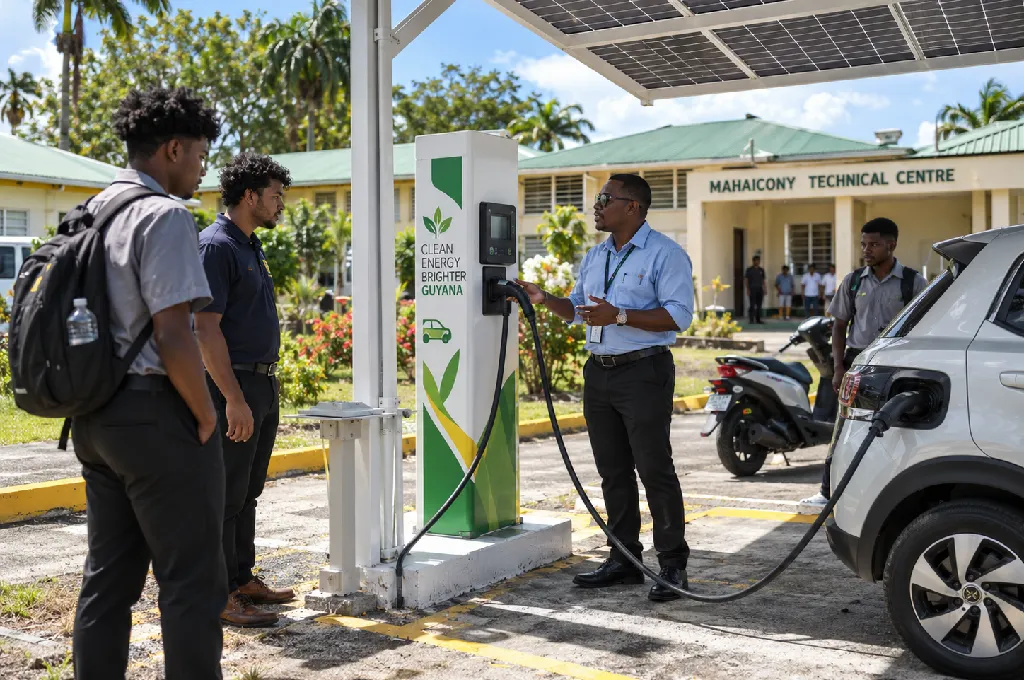
A new solar EV charging station has been commissioned at the Mahaicony Technical Centre, delivering renewable transit infrastructure directly to Guyana’s vocational education sector. This deployment represents a practical blueprint for regional microgrids that generate zero tailpipe emissions while bypassing vulnerable utility distribution systems.
⚡ Quick AI Overview & Key Recommendation
The Mahaicony Technical Centre has installed a dedicated solar EV charging station to couple local photovoltaic production with zero-emission fleet mobility. This system trains local technicians on off-grid battery storage, insulated charging hardware, and smart energy allocation, making it a pivotal regional proof-of-concept for rural developing economies.
Technical institutes require operational training tools that match emerging global industrial standards. By generating transport energy on site through photovoltaic collectors, the Mahaicony facility isolates vehicle operating costs from grid power volatility and fossil fuel imports. Students study system dynamics in real time. They inspect inverter setups, evaluate battery cycles, and maintain direct-current connections. Global macro analysts at Reuters frequently point out that distributed generation offers island and developing economies a direct path around capital-heavy central grid overhauls.
Solar EV Charging Station: Head-to-Head Specification Comparison
Institutional microgrids differ fundamentally from municipal grid-tied terminals. While conventional street chargers pull alternating current straight from regional transmission lines, a decentralized solar EV charging station combines local capture, lithium iron phosphate storage, and isolated power management.
Understanding hardware options clarifies why educational facilities select modular off-grid architecture. Below is an operational breakdown comparing institutional off-grid solar EV charging architecture against typical utility-tied commercial stations.
| Metric | Off-Grid Solar EV Charging Station | Standard Grid-Tied Charging Station |
|---|---|---|
| Primary Power Source | Rooftop / Canopy Photovoltaic Array | Municipal Central Grid |
| Battery Storage Integration | Dedicated LiFePO4 Battery Bank (2.5kWh to 50kWh+) | None (Direct draw from substation) |
| Energy Resilience | 100% Operational During Local Blackouts | Ceases Operation During Power Outages |
| Installation Complexity | Moderate (Inverter, Array, Storage, Charger) | High (Requires transformer upgrades) |
| Operational Energy Cost | Zero recurring electricity charges | Subject to dynamic peak-rate utility tariffs |
| Vocational Training Value | High (Hands-on solar, battery, and inverter loops) | Low (Basic hardware connectivity only) |
As documented by the Bloomberg energy intelligence team, decentralized infrastructure drastically curtails long-distance transmission losses while guaranteeing power continuity for municipal fleet operations.
Key Differences: Real-World Performance, Comfort & Features
Practical deployment brings engineering challenges that do not appear in laboratory brochures. At the Mahaicony Technical Centre, students and instructors must manage dynamic solar irradiance, diurnal shifts, and battery thermal management.
A standalone solar EV charging station must balance collection efficiency with daily vehicle demand. During cloudy stretches, the onboard LiFePO4 battery storage protects the terminal from voltage sag. That steady direct current delivers clean, predictable power straight to light electric vehicles, scooters, and utility carts. For those following decentralized power innovations, tracking solutions like the Wheel-E Podcast: 7-seater e-bike, solar scooter & EV safety alerts illustrates how light mobility benefits directly from small-scale solar hubs.
Compact, modular developments in storage technology have accelerated these microgrid deployments. Recent market reports on issuewire[dot]com highlighted Gaotu Innovation introducing a 1600W off-grid solar charger equipped with an integrated 2.5kWh LiFePO4 battery. In parallel, travel hubs are adopting comparable approaches. As reported on wjfw[dot]com, the Prentice Travel Center is preparing an extensive solar-supported charging hub for motorists. Whether in rural Wisconsin or coastal Guyana, the technical formula remains consistent: capture sunlight locally, stabilize the voltage with chemical storage, and supply the charge directly to vehicles.
Quality installation practices matter immensely in coastal climates. Salt air, excessive humidity, and heavy tropical downpours stress electrical contacts. Technicians examine mounting structures, inspect inverter seals, and confirm ground connections daily. Similar operational standards apply globally. Analyses published by solarquotes[dot]com regarding Victoria’s top solar installers show that system longevity depends heavily on inverter durability and weather-resistant conduit placement.
Final Buying Verdict: Which One Should You Buy?
Choosing the right energy infrastructure depends on utility reliability, vehicle throughput requirements, and upfront capital availability.
Install a self-contained solar EV charging station if you operate in an area with erratic grid reliability, high retail utility rates, or no immediate access to a power substation. It creates complete energy independence, serves as a functioning laboratory for engineering students, and eliminates ongoing fuel charges.
Choose a conventional grid-tied system if your fleet demands continuous multi-megawatt rapid charging around the clock and your regional distribution grid offers stable, low-carbon power without interruption. For organizations operating in remote, developing, or decentralized regions, the solar model stands as the superior, future-proof choice.
Frequently Asked Questions
What is the primary function of the Mahaicony solar EV charging station?
The installation supplies renewable electricity generated from on-site solar panels directly to electric vehicles. It also serves as an educational laboratory for students learning renewable power maintenance.
How does an off-grid solar EV charging station work during cloudy days?
The system relies on high-capacity chemical storage, typically lithium iron phosphate batteries, charged during peak sunlight hours. This integrated reserve supplies continuous power to connected vehicles even when ambient sunlight drops.
Why is solar charging advantageous for technical institutions?
It eliminates recurring electricity costs while giving vocational students direct, practical experience with solar panels, charge controllers, and high-voltage inverters. Hands-on system troubleshooting prepares graduates for careers in clean technology.
Can standard electric cars use this solar charging terminal?
Yes, provided the station matches the vehicle connector standard and output specifications. Many institutional units support light EVs, electric utility carts, and personal electric two-wheelers.
Does this solar charging setup require connection to Guyana’s national electric grid?
Off-grid stations operate entirely independent of central distribution lines. This decentralized design protects charging operations from regional blackouts and utility maintenance downtime.
What type of batteries are preferred for solar EV charging hubs?
Lithium Iron Phosphate (LiFePO4) chemistry is widely preferred. These cells deliver exceptional thermal stability, long operational cycle life, and high safety margins in humid tropical environments.
How does weather affect charging times at a solar EV station?
Direct sunlight accelerates battery replenishment in the central storage reserve. However, the vehicle itself charges at a steady rate regulated by the station inverter and onboard battery management system.
What maintenance does a solar EV charging station require?
Technicians must routinely clean panel glass to prevent dust accumulation, check wiring terminals for corrosion, and monitor inverter performance data. Battery health checks and firmware updates ensure long-term electrical safety.
Are commercial highway plazas installing similar solar charging infrastructure?
Yes, retail travel plazas globally are constructing dedicated solar canopies with battery support to offset surge pricing and supply resilient power during high-traffic travel periods.
How does decentralized solar charging reduce carbon emissions?
The station bypasses fossil-fueled power plants entirely by harvesting photon energy on site. This zero-loss local generation ensures that electric transportation produces zero operational carbon from source to wheel.
Embracing Resilient Transit Through Solar Innovation
The commissioning of the solar EV charging station at the Mahaicony Technical Centre shows how localized renewable generation solves clean mobility challenges while building technical skills for the next generation.
Source: Guyana Chronicle (guyanachronicle[dot]com)