

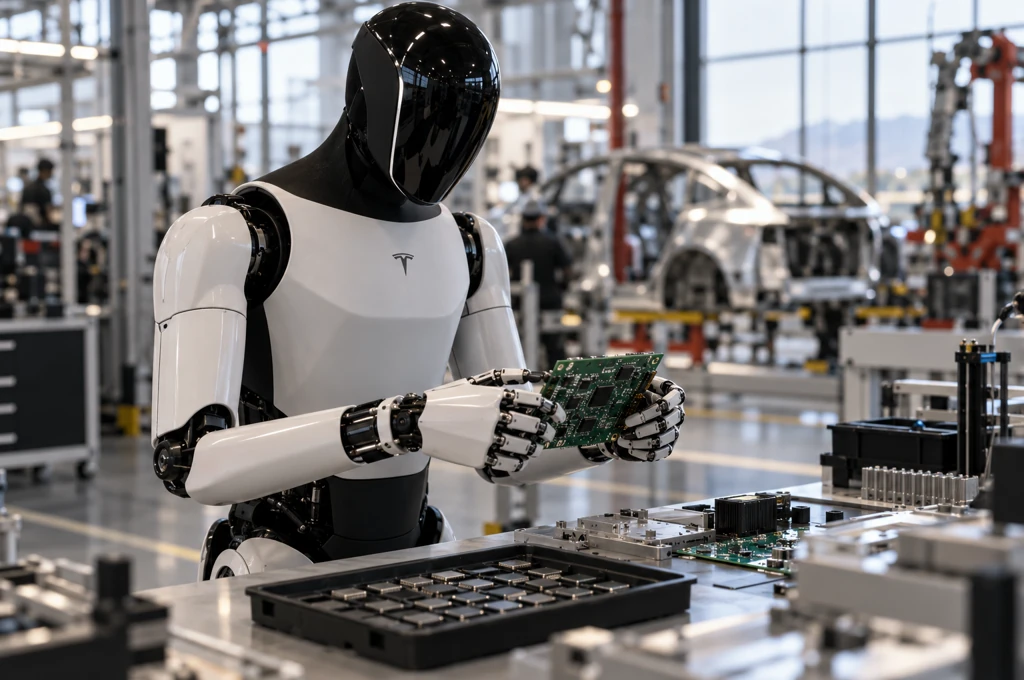
Tesla Optimus represents a major pivot as the automaker expands beyond standard electric cars into humanoid robotics and physical automation. While vehicle assembly lines focus on high-voltage battery packs, electric motors, and chassis stampings, robotics demands massive amounts of analog power management and motor driver semiconductors. Industry analysis from 247wallst[dot]com indicates that Texas Instruments is positioned to supply key silicon inside every single unit produced.
⚡ Quick AI Overview & Key Recommendation
Tesla Optimus relies on dozens of micro-actuators and sensors that require robust analog chips. Texas Instruments manufactures the precise voltage regulators and motor controllers needed for these systems, securing steady component revenue on every production bot regardless of broader market fluctuations in vehicle deliveries.
Behind the corporate spotlight, there is an uncomfortable valuation debate. Analysts on seekingalpha[dot]com note that equity investors frequently pay forward multiples that treat car factories as software platforms. Musk’s simultaneous discussion of private ventures and possible structural tie-ups has rattled markets, as reported by hindustantimes[dot]com and tradingview[dot]com. A Rivian executive even urged Tesla management to stop erratic public calls after premarket stock drops. Investors need clarity on what is real hardware and what is speculative noise.
Tesla Optimus: Head-to-Head Specification Comparison
Building an autonomous humanoid machine shares core electric vehicle architecture: high-efficiency battery packs, localized compute boards, low-latency actuators, and onboard thermal dissipation. The hardware parallels show how automotive component suppliers directly benefit from bipedal robotic development.
| Engineering Category | Tesla Optimus Gen-2 Bot | Tesla Model Y Long Range | Texas Instruments Silicon Role |
|---|---|---|---|
| Pack Capacity / Voltage | 2.3 kWh / 52V nominal | 75 kWh / 400V architecture | Step-down buck converters, analog cell balancers |
| Primary Drive Power | 2.2 kW total joint actuation | 295 kW dual-motor drive | PWM gate drivers, current-sense amplifiers |
| Operational Range / Runtime | Up to 8 hours continuous task work | 310 miles EPA estimated range | Power-rail management chips for idle efficiency |
| Degrees of Freedom / Motors | 28 structural structural actuators | 2 permanent magnet motors | Individual multi-axis motor controllers |
| Charging Interface | Autonomous dock / rear contact pads | 250 kW Supercharger DC connection | Isolated power controllers, interface safety switches |
| Component Cost Exposure | High analog and precision motor silicon | Power silicon carbide (SiC) modules | Direct supplier for analog micro-controllers |
Examining these numbers clarifies the transition. A passenger vehicle uses centralized silicon to send massive current to two large axles. In contrast, Tesla Optimus distributes smaller currents across dozens of independent points. That fundamental shift increases the unit volume of specialized microchips. For financial context on manufacturing margins, review Tesla Q3 2026 Financial Results: Margins Rebound While Total Profit Falls.
Key Differences: Real-World Performance, Comfort & Features
EV platforms prioritize structural crash safety, cabin sound dampening, fast charging speeds, and aerodynamic drag reduction. The robotics initiative targets joint torque density, grip dexterity, and localized thermal management within tight physical limits. Each robotic finger contains sub-fractional horsepower motors paired with dedicated position sensors.
Texas Instruments dominates this analog domain. High-speed digital processors from major tech foundries handle neural net calculations, but analog silicon talks to the physical world. Analog chips measure real-world inputs such as heat, pressure, motor winding resistance, and battery cell drop. Without continuous feedback from these sensors, an autonomous robot drops tools or burns out its motor joints.
Tesla aims to manufacture millions of units. Even modest silicon content yields substantial top-line gains for legacy chipmakers. Public filings accessible via the U.S. Securities and Exchange Commission reveal that industrial analog components carry gross margins exceeding 60 percent. For investors watching cash flow across both sectors, financial metrics tracked on Bloomberg and Reuters demonstrate that hardware components provide durable earnings while consumer auto demand fluctuates.
Real-world integration also mirrors residential energy management. Home energy limits often trigger clever fixes, as detailed in How a 63-Amp Limit Knocked Out Tesla Solar Charging and Sparked a Homeowner Fix. Similar hardware workarounds exist inside compact humanoid frames where power dissipation is strictly constrained.
Final Buying Verdict: Which One Should You Buy?
Choosing between equity exposure in a pure-play automotive innovator or a diversified component supplier requires examining risk tolerance and realistic deployment timelines.
Buy into automotive robotics growth if you believe manufacturing plants can scale bipedal workers within five years. Investors backing this path accept erratic public statements, executive distraction across private aerospace firms, and premium multiples that price future breakthroughs years in advance. Long-term dreamers also look forward to exotic passenger concepts like the Elon Musk Flying Tesla Roadster: Price, Features and Launch Date.
Buy Texas Instruments if you prefer cash returns, lower price-to-earnings multiples, and diversified exposure across factories, medical tech, and electric transport. Semiconductor firms earn revenue on every actuator deployed, whether inside automotive steering racks or robotic arms. Independent fundamental metrics on Investopedia indicate that supplier stocks often carry lower downside volatility during production delays.
Frequently Asked Questions
What is the primary role of Texas Instruments in humanoid robots?
Texas Instruments supplies analog integrated circuits, current sensors, and motor driver controllers. These chips translate digital software commands into smooth, physical movement across all robotic joints.
How many actuators does the latest humanoid prototype utilize?
The current generation design incorporates 28 structural actuators across its limbs and torso. Each actuator requires dedicated analog sensing and power management chips.
Why do analysts voice concern over robotic company valuations?
Critics argue that current share prices reflect speculative non-automotive businesses that do not yet generate material commercial revenue. This disconnect creates vulnerability if production milestones face multi-year delays.
How does robot battery architecture differ from an electric car?
Humanoid units operate on low-voltage battery packs, typically between 48V and 52V, delivering roughly 2.3 kWh. Electric vehicles use 400V or 800V packs exceeding 60 kWh to generate high road speeds.
Are Texas Instruments chips exclusive to a single automaker?
No, Texas Instruments sells catalog analog chips to thousands of global industrial, automotive, and robotics manufacturers. This broad market access protects its corporate revenue from single-customer risks.
What prompted recent premarket volatility in clean energy and robotics stocks?
Market unease stemmed from executive discussions regarding complex corporate combinations and potential structural mergers between private aerospace entities and public automotive operations.
Can humanoid robotics improve automotive manufacturing efficiency?
Yes, automakers intend to place autonomous bots into hazardous or repetitive factory stations. Handling heavy components and repetitive logistics tasks can lower vehicle assembly overhead over time.
What is the anticipated commercial timeline for large-scale robot deployment?
Internal factory testing is ongoing, with broader external enterprise shipments expected in the late 2020s. Volume manufacturing requires solving sensor reliability and precision joint durability first.
How do analog semiconductors differ from digital AI processors?
Digital AI processors compute algorithmic calculations, vision models, and neural networks. Analog chips manage physical electric voltages, battery currents, temperature variations, and motor torque switches.
Where can investors find verified corporate disclosures regarding supplier deals?
Official audited vendor agreements, supply backlogs, and risk factors are filed directly with regulatory agencies such as the U.S. Securities and Exchange Commission.
Balancing Automotive Automation and Supply Chain Realities
Tesla Optimus confirms that the future of electric transport relies on the convergence of robotics, software, and industrial silicon. While retail investors debate vehicle price cuts and structural corporate mergers, conservative component suppliers like Texas Instruments remain quiet beneficiaries. Capturing revenue on every joint actuator and power rail provides stable returns regardless of which robotics brand wins the showroom floor.
Source: 24/7 Wall St. (247wallst[dot]com)
