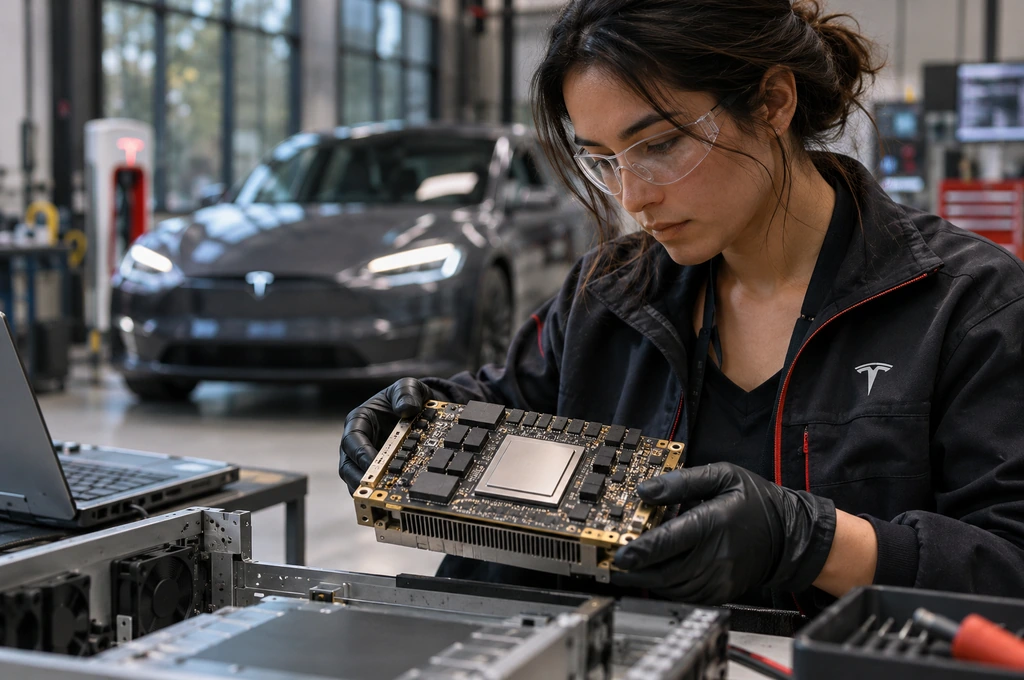
A serious Tesla chip bill warning is rattling the electric vehicle market as computing budgets eclipse traditional automotive manufacturing costs. Elon Musk has committed billions of dollars toward high-end semiconductor hardware to power autonomous driving networks. For everyday drivers and retail investors, this shift changes everything.
Hardware scale demands intense capital. Automotive buyers need to understand whether vehicle quality, service networks, and consumer pricing will suffer as silicon takes priority.
⚡ Quick AI Overview & Key Recommendation
The Tesla chip bill warning reflects massive capital redirection toward AI clusters and custom silicon. For prospective EV buyers, this means vehicle prices will increasingly reflect software margins rather than manufacturing discounts. Buyers should prioritize vehicle build quality, battery pack degradation warranties, and existing Supercharger reliability over unproven autonomous software promises.
Tesla Chip Bill Warning: Core Evaluation Framework & Decision Matrix
Tesla is no longer operating solely as a clean transport firm. The enterprise behaves like an artificial intelligence lab that happens to assemble sedans and crossovers on wheels. Financial commentary on platforms like 247wallst[dot]com and barchart[dot]com recently highlighted the friction between massive capital expenditure on processor clusters and pure automotive gross margins. When billions flow toward data centers, fewer liquid reserves support vehicle refreshes or direct consumer price cuts.
This corporate pivot parallels tensions covered in Elon Musk’s SpaceX Deal: A Major Wrench in Tesla’s EV Plans. Hardware divergence creates operational friction across production lines. Drivers who buy a Model 3 or Model Y expect premium mechanical assembly, but corporate attention remains glued to server racks and vision models.
| Buyer Metric | Traditional EV Approach | Tesla AI Compute Shift |
|---|---|---|
| Primary R&D Allocation | Chassis, battery chemistry, aerodynamics | Neural processing units, supercomputers, training clusters |
| Software Monetization | Bundled base features, free minor updates | High-margin subscriptions, paid autonomy packages |
| Depreciation Risk | Standard automotive curve based on age/mileage | Fast obsolescence of onboard processing units (HW3 to HW4) |
Buyers must examine if onboard computer generations leave older models stranded without key autonomous capabilities. Understanding this dynamic prevents unpleasant surprises on trade-in day.
Real-World Calculations: Running Costs, Range & Government Subsidies
Behind the corporate headlines, retail car buyers choose electric vehicles for clear mathematical reasons: cheaper daily travel. Recent viral driver breakdowns shared across platforms like boredpanda[dot]com show a dramatic price gap between gas station fill-ups and home charging over 75,000 miles. A driver racking up 75,000 miles on an efficient gas sedan averaging 30 MPG spends roughly $8,750 at $3.50 per gallon.
By contrast, an electric vehicle consuming 28 kWh per 100 miles costs around $2,940 to charge over that same distance at a residential utility rate of $0.14 per kWh. That delivers over $5,800 in direct fuel savings. Even with rising hardware overhead mentioned in the latest Tesla chip bill warning, electric drivetrains retain clear operating advantages.
Government incentives still cushion upfront sticker prices across major markets. In the United States, the federal clean vehicle credit provides up to $7,500 for qualifying models under statutory price caps. Regional utility rebates frequently supply an extra $500 to $1,500 toward Level 2 home charger installations. Checking current eligibility rules via Reuters automotive updates confirms that point-of-sale discounts remain the best tool to offset high software option costs.
Crucial Factors & What to Check Before You Buy
Buying an electric vehicle requires careful inspection beyond simple 0-60 mph acceleration times. Silicon expenses create real-world compromises in consumer products, especially as factory resources shift toward autonomous projects like the Cybercab, a transition outlined in Tesla to Phase Out Cybertruck Production in Texas as Musk Pivots to Cybercab. Follow this inspection routine before signing purchase paperwork:
- Onboard Compute Version: Verify which silicon generation is installed in your vehicle. Cars fitted with older hardware suites may lose access to future feature updates as training models outgrow legacy processors.
- Battery Warranty Terms: Confirm the pack retention warranty. Look for clear contractual language guaranteeing at least 70% capacity retention over 8 years or 100,000 to 120,000 miles.
- Regional Service Network Capacity: Evaluate the distance to your nearest authorized repair center. Software updates happen over the air, but suspension bushings, steering racks, and air conditioning condensers require human technicians.
- Insurance Quotes Before Delivery: Advanced sensor arrays, integrated camera housings, and high-performance compute blocks push collision repair estimates upward. Get explicit quotes from your insurance carrier beforehand.
- Real-World Range Estimates: EPA figures drop significantly during freezing winter weather or extended highway cruising at 75 mph. Deduct 20% to 25% from window sticker estimates to establish a reliable cold-weather baseline.
Smart buyers separate marketing promises from physical machinery. Evaluating the complete package protects your wallet against costly mid-cycle depreciation.
Frequently Asked Questions
What triggered the recent Tesla chip bill warning?
The warning arose from massive multi-billion-dollar capital commitments toward advanced semiconductor clusters, which strain automotive gross margins and shift corporate priorities away from conventional vehicle hardware.
Does AI chip spending impact electric vehicle sticker prices?
Yes. When software infrastructure costs escalate, automakers either raise base vehicle prices or separate advanced features into paid monthly subscription packages to recoup compute development costs.
Will older Tesla models get left behind by new software?
Legacy models with older processor suites frequently encounter hardware limits. When new neural networks require higher floating-point operations per second, older computers stop receiving full feature parity.
How much does charging an EV cost over 75,000 miles compared to gas?
Home charging an electric vehicle for 75,000 miles costs roughly $2,900 to $3,200 at standard residential rates. Fueling a 30-MPG gasoline car for the same distance averages approximately $8,750 at $3.50 per gallon.
Are federal tax credits still available for Tesla vehicles?
Eligible buyers purchasing qualifying trims under federal price thresholds can still access point-of-sale tax credits up to $7,500 in the United States, subject to income limitations.
What is the standard battery warranty on most electric vehicles?
Most manufacturers offer an 8-year or 100,000-mile warranty that guarantees the battery retains at least 70% of its original energy capacity.
Why are insurance rates higher on high-tech electric vehicles?
Integrated cameras, ultrasonic sensors, and sensitive onboard processing boards raise collision repair costs significantly compared to simpler gas-powered vehicles.
Does Elon Musk’s computing push hurt manufacturing build quality?
Directing vast capital and managerial focus toward AI server farms can leave standard assembly line fit-and-finish and regional service center expansions underfunded.
Can I charge an EV using a regular household outlet?
Yes, but standard 120-volt Level 1 outlets add only 3 to 5 miles of range per hour. Installing a dedicated 240-volt Level 2 home charger is recommended for practical daily use.
Should buyers purchase Full Self-Driving upfront?
Most market analysts recommend testing the feature via monthly subscription first. Purchasing it outright ties significant non-transferable equity to a single vehicle platform.
Balancing Automotive Value Against Silicon Ambitions
The latest Tesla chip bill warning reminds shoppers that buying an electric car is a pragmatic transport decision rather than a tech stock speculation. Focus on proven battery longevity, comfortable cabin ergonomics, and transparent charging economics to ensure your next electric vehicle purchase makes financial sense.
Source: 24/7 Wall St. (247wallst[dot]com)