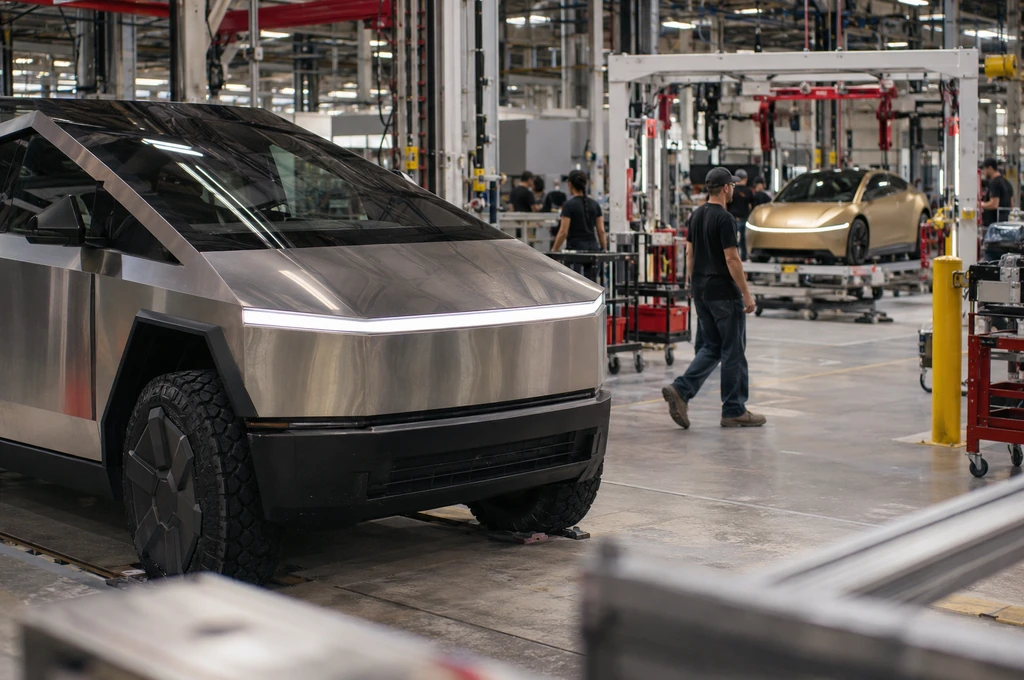
Tesla Cybertruck production at Gigafactory Texas will end by mid-2027 to make room for high-volume Cybercab assembly, Elon Musk announced recently. The statement surprised industry watchers who expected the stainless-steel pickup to anchor Tesla’s commercial lineup for at least a decade.
⚡ Quick AI Overview & Key Recommendation
Tesla plans to sunset Austin Cybertruck manufacturing by mid-2027 to reallocate factory floor space to its autonomous Cybercab. Buyers wanting an electric utility truck should order their Cybertruck before line conversions begin, while urban commuters and fleet operators should prepare for dedicated autonomous two-seaters entering volume assembly.
Gigafactory Texas covers millions of square feet, yet floor space remains finite. According to reports cited by seekingalpha[dot]com, Musk aims to clear the main hall to support automated, sub-$30,000 autonomous vehicles. While the truck turned heads on public roads, manufacturing bottlenecks and niche pricing suppressed wide market adoption. As detailed by Reuters, corporate priorities are shifting rapidly toward autonomy and shared mobility.
Tesla Cybertruck Production: Head-to-Head Specification Comparison
The manufacturing pivot transforms Tesla’s vehicle catalog from heavy stainless-steel utility haulers into ultra-compact autonomous pods. As Tesla Cybertruck production winds down over the next three years, the Texas assembly lines will replace heavy cold-rolled steel presses with casting systems built strictly for the Cybercab.
| Specification | Tesla Cybertruck (All-Wheel Drive) | Tesla Cybercab (Robotaxi Concept) |
|---|---|---|
| Base Starting Price | $79,990 | Estimated under $30,000 |
| Battery Pack Size | 123 kWh structural pack | Estimated 35 kWh to 45 kWh |
| EPA Driving Range | 318 miles (up to 340 miles) | Estimated 200 miles |
| Drivetrain & Power | Dual-Motor AWD (600 hp) | Single-Motor RWD (approx. 150 hp) |
| Charging Architecture | 800-volt DC fast charging | Inductive wireless charging only |
| Factory Warranty | 4-year/50,000-mile basic, 8-year powertrain | Expected commercial fleet warranty terms |
Looking at raw numbers reveals a fundamental change in vehicle intent. Cybertruck delivers massive towing capacity and heavy payload ratings, while Cybercab abandons pedals, steering wheels, and physical charging ports altogether. Financial analysts tracked by Bloomberg note that mass-transit robotaxis generate recurring software revenues that single-sale consumer trucks cannot match.
Key Differences: Real-World Performance, Comfort & Features
Driving dynamics could not be more distinct between these two Texas products. The Cybertruck utilizes steer-by-wire mechanics and four-wheel steering. It maneuvers through tight spots surprisingly well for an eight-foot-wide truck. Inside, drivers command massive screens and adjustable air suspension. Power delivery is instant, violent, and capable of towing 11,000 pounds across difficult terrain.
The Cybercab eliminates driver engagement entirely. There is no accelerator pedal. There is no brake pedal. Passengers simply recline into two sculpted bucket seats and select destinations on a central interface. Charging also diverges sharply. Cybertruck uses traditional NACS plugs at high-speed Supercharger stalls. In contrast, Cybercab relies solely on ground-mounted inductive charging pads, requiring automated depot infrastructure.
Energy consumption tells the deeper financial story. The Cybertruck weighs nearly 6,700 pounds and consumes roughly 40 to 45 kWh per 100 miles. Cybercab targets a light curb weight under 2,600 pounds, requiring less than 18 kWh per 100 miles. For drivers concerned with residential utility costs, managing energy loads through systems like Tesla Smart Charging: 5 Details That Matter for Powerwall Owners will remain relevant across both vehicle platforms.
External design choices also reflect divergent engineering philosophies. The truck uses unpainted 30X cold-rolled stainless steel to resist dents, requiring specialized stamping tooling. Cybercab uses lightweight composite panels with butterfly doors, taking inspiration from cinematic aesthetics that recently prompted corporate disputes, as seen when Warner Bros Settles Blade Runner AI Lawsuit While Tesla Legal Pressure Builds.
Final Buying Verdict: Which One Should You Buy?
Your choice depends on utility needs versus future mobility access. If you need a functional electric work vehicle with exterior payload capacity and high towing capability, order the Cybertruck now before lines idle. Current reservation holders should expect stable manufacturing through late 2026 before retooling starts.
Choose to wait for the Cybercab if you manage taxi fleets, run point-to-point urban transport operations, or seek personal transportation without the overhead of vehicle insurance and manual driving chores. As institutional investors consult Investopedia metrics on total cost of ownership, automated transport services present much lower cost-per-mile operations than heavy consumer pickups.
Frequently Asked Questions
Why is Tesla ending Cybertruck production in Texas?
Tesla aims to reallocate factory floor space and robotic manufacturing cells to build its upcoming autonomous Cybercab. Leadership believes high-volume robotaxis will generate stronger recurring revenue margins than luxury utility trucks.
When will Cybertruck manufacturing officially cease?
Elon Musk announced mid-2027 as the targeted cutoff date for Cybertruck assembly at the Austin facility. The plant will then undergo systematic retooling for autonomous vehicle platforms.
Can I still order and receive a Tesla Cybertruck today?
Yes. Current Cybertruck orders remain open and active across North America. Tesla will continue fulfilling reservations through the 2025 and 2026 production cycles.
Will Tesla move Cybertruck production to another factory?
Tesla has not announced plans to relocate truck tooling to Giga Nevada or Giga Mexico. The current directive indicates a phased conclusion rather than a simple line relocation.
What is the expected starting price for the Tesla Cybercab?
Musk stated a target consumer price under $30,000 for the Cybercab. Final pricing will depend heavily on battery raw material costs and autonomous hardware validation.
Does the Cybercab have a steering wheel or foot pedals?
No. The Cybercab features a cabin completely stripped of steering wheels, acceleration pedals, and brake levers, operating exclusively on Tesla Full Self-Driving software.
How will Tesla support existing Cybertruck owners with spare parts?
Tesla is legally mandated to provide replacement components, battery modules, and structural repair services for existing owners for up to a decade following cessation of vehicle manufacturing.
How does Cybercab charge without a charging port?
The Cybercab charges exclusively through wireless inductive floor plates. The vehicle docks automatically over magnetic charging pads installed at fleet depots or equipped home garages.
How does this plant transition affect Tesla financial results?
Tesla revenue showed flat quarterly patterns during the previous fiscal cycle according to axios[dot]com. Retooling Texas will demand heavy capital expenditure before low-cost robotaxis reach profitable scale.
Does the end of Tesla Cybertruck production impact the warranty on delivered trucks?
No. All delivered Cybertruck units retain their full 4-year/50,000-mile bumper-to-bumper warranty and 8-year/150,000-mile battery and drive unit coverage.
The Future of Austin Manufacturing
Tesla Cybertruck production proved that radical electric utility designs can reach highway speeds, but market realities demand scalable autonomy over heavy steel fabrication. As Texas assembly tracks convert toward driverless cabs, the electric vehicle market shifts focus from individual power to shared transportation networks.
Source: Seeking Alpha (seekingalpha[dot]com)