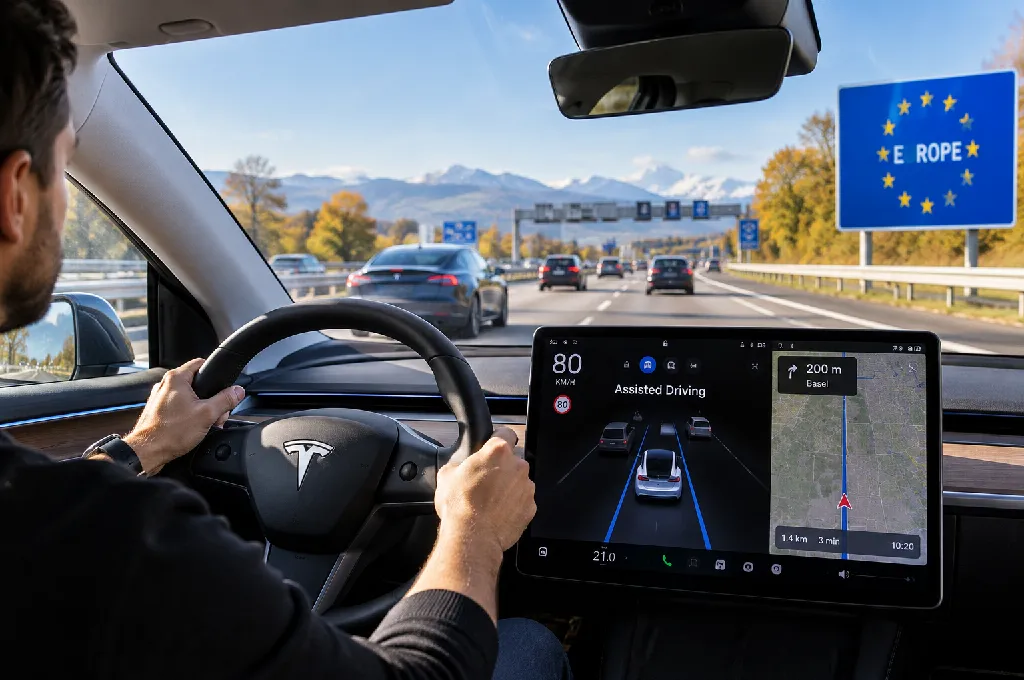
Tesla Assisted Driving Europe represents a significant tactical shift as the American automaker works to satisfy strict European Union transport safety regulators. The company quietly modified its vehicle configuration portals across several major European markets. By removing the long-contested Full Self-Driving moniker, the firm hopes to ease persistent regulatory friction with local transport authorities.
⚡ Quick AI Overview & Key Recommendation
Tesla rebranded its flagship driver-assistance software to Assisted Driving across Europe to conform with strict UNECE safety standards. The core capability remains Level 2 hands-on autonomy. Buyers should not expect autonomous robotaxi functionality on European roads in the near term; the update simply clears regulatory hurdles for existing driver support features.
Public safety regulators in Europe take issue with misleading autonomous claims. Authorities in Germany and the Netherlands previously warned automakers against using marketing language that implies hands-off operation. According to reporting from reuters[dot]com, Tesla chose compliance over naming rights to secure software greenlights. The decision mirrors broader market pressures tracked by Reuters regarding international automotive compliance.
Tesla Assisted Driving Europe: Core Evaluation Framework & Decision Matrix
Drivers evaluating Tesla Assisted Driving Europe must separate corporate marketing terms from physical engineering capability. Under the United Nations Economic Commission for Europe (UNECE) DCAS regulations, Level 2 assistance systems require active driver oversight at all times. The system monitors steering torque, eye movement, and lane positioning through internal and external cameras.
The table below summarizes how the newly labeled package compares against base Autopilot and traditional Level 3 automated systems approved under European law.
| Feature Set | Base Autopilot | Tesla Assisted Driving Europe | UNECE Level 3 Certified |
|---|---|---|---|
| Driver Responsibility | Continuous Active Control | Continuous Active Oversight | System Holds Liability in Geofence |
| Urban Stop Sign/Light Reaction | No | Pending Local Approval | Highways Only |
| Automatic Lane Changes | Manual Stalk Trigger Only | Assisted Navigation Prompts | Automated within Limits |
| Hardware Requirement | Hardware 3 or Hardware 4 | Hardware 4 Recommended | LiDAR + Radar + Vision Redundancy |
European road regulations restrict aggressive maneuvers. The vehicle cannot execute sharp lane cuts or unassisted turns without clear mechanical confirmation from the human behind the wheel. The name update aligns with market realities as analyzed in our review of Tesla Earnings Preview: Grounded Automotive Margins Confront Flying Car Ambitions.
Real-World Calculations: Running Costs, Range & Government Subsidies
Buying an electric vehicle requires careful financial assessment beyond software add-ons. Software packages like Tesla Assisted Driving Europe cost thousands of euros upfront, yet they add zero physical range to the battery pack. A standard Model Y Long Range delivers roughly 533 kilometers WLTP, consuming approximately 16.9 kWh per 100 kilometers under mixed driving conditions.
Charging at home across Western Europe averages 0.28 euros per kilowatt-hour during off-peak windows. That brings 10,000 kilometers of driving to approximately 473 euros. A comparable diesel crossover consuming 6.2 liters per 100 kilometers costs roughly 1,085 euros over the same distance, assuming fuel prices hold around 1.75 euros per liter. Annual energy savings hover near 612 euros for average commuters.
Government subsidies directly influence final purchase prices. France maintains environmental bonuses between 4,000 and 7,000 euros depending on household income, tied strictly to vehicle production carbon footprints. Germany eliminated direct consumer bonuses in recent tax cycles, forcing buyers to lean heavily on corporate car tax exemptions where electric models pay just 0.25 percent on gross list prices under 70,000 euros. Knowing your local subsidy parameters prevents overspending on discretionary software options that offer little return on resale.
Crucial Factors & What to Check Before You Buy
Never sign a delivery contract without validating hardware revisions. Tesla builds vehicles with both Hardware 3 and Hardware 4 suites across regional production runs. Hardware 4 delivers higher camera resolution and faster compute cycles, which matter directly if European authorities approve expanded driver assistance routines in future software builds.
Check the factory battery warranty carefully. Tesla covers its Long Range packs for 8 years or 192,000 kilometers with a minimum 70 percent retention guarantee. Service network availability also requires independent checks; rural buyers face longer wait times for specialized mobile service units. Compare these ownership details with competing models, such as the delivery dynamics covered in Volvo’s New Midsize Electric SUV Is Here, But It May Be Hard To Get Your Hands On One.
Financial reporters at Bloomberg note that residual values for used electric vehicles soften when buyers overpay for optional autonomous packages. In secondary markets, appraisal algorithms calculate trade-in values based on physical battery health, mileage, and paint condition rather than software tiers. Spend money on range and heat pumps before opting for Tesla Assisted Driving Europe packages.
Frequently Asked Questions
What caused the Tesla Assisted Driving Europe rebrand?
Tesla updated the naming scheme to align with strict European Union advertising and transport regulations. Officials objected to the term Full Self-Driving because the vehicle still requires continuous human oversight under Level 2 rules.
Does the rename change how the car actually drives?
No, the software operates on the exact same underlying neural network architecture. The rename merely alters the user-facing branding and marketing language to satisfy transport authorities.
Is Tesla Assisted Driving Europe fully autonomous?
No, it is a driver-assist system classified under Level 2 autonomy. The human driver remains legally responsible for vehicle operation and must keep attention on the road at all times.
Can I transfer the software package to my next car?
Tesla occasionally allows temporary software transfers during select quarterly sales promotions. Outside those promotional windows, the package remains tied to the specific vehicle identification number.
How much does the software package cost in Europe?
The package costs approximately 7,500 euros depending on the specific country and local value-added taxes. Tesla also offers an intermediate Enhanced Autopilot tier at a lower cost.
Does the system work on rural European roads?
The system functions best on marked motorways and well-maintained dual carriageways. Narrow country lanes and unmarked cobblestone streets frequently disable active lane-keeping features.
What is the difference between Autopilot and Assisted Driving?
Standard Autopilot provides lane centering and traffic-aware cruise control on highways. The upgraded assisted suite adds automated navigation prompts, assisted lane changes, and parking features where regulations permit.
Do European insurance companies offer discounts for this software?
Most European insurers do not offer premium discounts for advanced driver assistance packages. In fact, costly sensor replacement parts can occasionally lead to slightly higher comprehensive insurance rates.
Will Tesla offer full hands-off driving in Europe soon?
Hands-off operation requires Level 3 regulatory certification under UNECE guidelines. Tesla vision-only architecture has not yet received Level 3 certification in European jurisdictions.
Should existing owners expect a software downgrade?
Existing vehicle functionality remains unchanged for current owners. Software updates will display the new terminology on the central screen without taking away approved active safety features.
Evaluating Tesla Assisted Driving Europe for Practical Daily Ownership
Tesla Assisted Driving Europe shows how regional compliance shapes technology deployment. Electric vehicle shoppers should evaluate models on range efficiency, cabin ergonomics, and charging network reliability rather than theoretical software promises. The rename reflects realistic operating boundaries, giving European drivers a clearer view of what the car actually delivers today.
Source: Reuters (reuters[dot]com)