The renewable energy sector faces a significant pivot. The solar incentives cut news is not just a policy update. It signals a structural shift in how we power our lives and vehicles. This change directly impacts the cost of electric vehicles and the adoption of solar storage. We are witnessing a transition from simple subsidies to complex market dynamics.
Policy shifts often move slower than technology. However, the recent reduction in support measures forces a faster evolution. Stakeholders must adapt quickly to survive. The balance between government support and market maturity is tipping. This creates an uneven playing field for new entrants and established players alike.
⚡ Quick AI Overview & Key Recommendation
Recent solar incentives cut measures have compressed the profitability of large-scale battery projects and EV subsidies. While short-term costs for consumers may rise, the policy aims to drive market maturity. Solar installers should pivot to value-added services like battery storage integration to remain competitive.
Solar Incentives Cut: The New Financial Reality
The reduction in financial support creates immediate pressure. Installers and developers cannot rely on government handouts to cover operational margins. This reality forces a re-evaluation of business models. Profitability now depends on efficiency and scale.
Many projects previously viable under old rules are now marginal. This creates a bottleneck in development. Developers must find new ways to lower costs without compromising quality. The focus shifts from ‘getting a permit’ to ‘optimizing a system.’
Impact on EV Battery Rebates and Adoption
The electric vehicle market feels this shockwave. The EV battery rebate programs are often tied to broader renewable energy strategies. When those strategies face cuts, the downstream effects are immediate. Consumers face higher upfront costs for battery packs.
High costs act as a barrier to entry. This is particularly true for fleet operators. Companies looking to switch to electric fleets must absorb these costs. This slows down the transition away from internal combustion engines.
The Integration of Solar and EV Charging
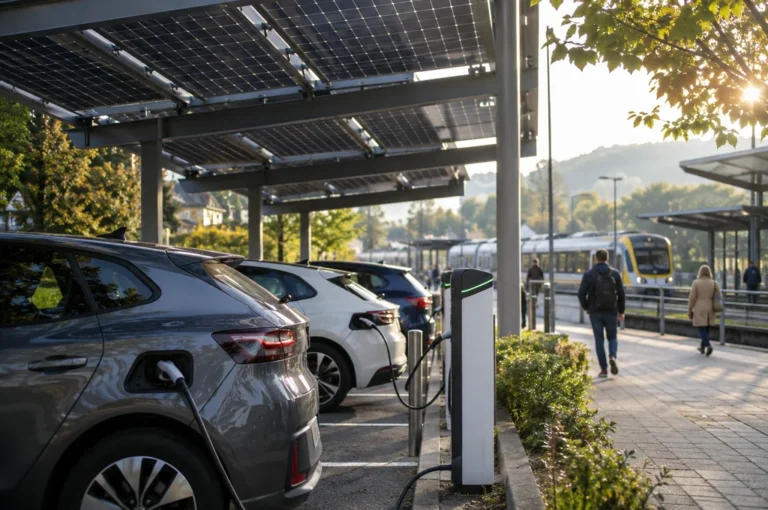
Despite the cuts, the link between solar and electric vehicles remains strong. Solar provides the clean energy to charge those vehicles. Projects combining solar carports and EV charging are becoming more common.
Consider the recent development in Suizhou. Anhui Xingtong Technology completed a solar carport and EV charging project. This project demonstrates the practical application of combining infrastructure. It shows how solar can support transportation needs directly on-site.
This integration offers a solution to rising energy costs. By generating their own power, businesses reduce reliance on the grid. This is a strategic move that buffers against future policy changes.
Corporate and Strategic Responses
Major energy companies are also adapting. Shell has launched its fasheadquarters EV chargers powered by solar energy at three locations. This approach ensures that the charging infrastructure remains sustainable. It decouples the charging network from volatile electricity prices.
On the financial side, companies are looking for monetization. Ravindra Energy is weighing solar monetisation for EV growth. This suggests a shift towards monetizing assets rather than relying on subsidies. It is a move towards self-sufficiency and long-term viability.
What This Means for the Future
The solar incentives cut is a wake-up call. It moves the industry from a support phase to a maturity phase. The winners will be those who can operate efficiently in a lower-subsidy environment.
Consumers should expect higher prices initially. However, this pressure may drive innovation. Cheaper batteries and more efficient solar panels are the likely outcomes. The market will eventually correct itself, but the transition will be bumpy.
Frequently Asked Questions
What are the main reasons behind the solar incentives cut?
The primary reason is the shift towards market maturity. Governments are reducing direct subsidies to encourage private investment and efficiency in the renewable energy sector.
How does the solar incentives cut affect the cost of EV batteries?
The cut can lead to higher upfront costs for EV battery rebates and subsidies, potentially slowing down the adoption of electric vehicles in the short term.
Can solar energy still be used to power EV charging stations?
Yes, solar energy is increasingly being integrated into EV charging infrastructure, as seen in projects like the solar carports and charging stations in Suizhou.
What is the strategy for companies like Ravindra Energy?
Companies are exploring solar monetization strategies to fund their EV growth, focusing on generating revenue from assets rather than relying solely on government support.
How does Shell’s solar-powered charging network benefit consumers?
Shell’s solar-powered chargers provide a sustainable charging option that can be more cost-effective and environmentally friendly than grid-based charging.
Will the reduction in incentives stop the growth of the solar industry?
No, while growth may slow, the industry is moving towards a sustainable model where projects rely on their own operational efficiency and market demand.
What is the long-term impact of these policy changes?
The long-term impact is a more resilient and efficient renewable energy sector that relies less on government intervention and more on market forces.
How can homeowners prepare for these changes?
Homeowners should consider investing in high-efficiency solar systems and battery storage to maximize their energy independence and reduce reliance on grid electricity.
Are there any benefits to the solar incentives cut?
The benefits include a push for innovation and cost reduction, as companies strive to become more efficient without the crutch of subsidies.
What role does government policy play in this transition?
Government policy provides the initial framework and support, but the transition to a mature market relies on the industry’s ability to adapt and innovate.
The Path Forward: Navigating the Energy Transition
The solar incentives cut presents a formidable challenge. It demands resilience and strategic foresight. The industry is at a crossroads. The companies and individuals who adapt will define the future of clean energy.
Source: SolarQuotes (solarquotes[dot]com[dot]au)