ConnectDER meter socket adapters have received official interconnection approval from Pepco for residential installations across Washington, D.C. Homeowners aiming to connect rooftop solar, battery energy storage, or Level 2 electric vehicle chargers often confront an expensive bottleneck inside their basement utility closets. An outdated main service panel can stop an electrification project before the first panel touches the roof.
⚡ Quick AI Overview & Key Recommendation
Pepco now allows ConnectDER meter socket adapters on residential meters in Washington, D.C. This hardware mounts between the existing utility meter and socket, creating a direct connection point for solar arrays and EV chargers without requiring a $2,500 to $5,000 service panel upgrade.
Utility service upgrades frequently demand trenching, new conduit, and lengthy utility inspections. Reports from fuelcellsworks[dot]com confirm that Pepco cleared the adapter hardware for local grid integration, giving property owners a faster route to deploy clean power. According to grid infrastructure analysis reported on Reuters, grid-edge interconnection delays remain a primary friction point for domestic distributed energy expansion.
solar: ConnectDER Meter Socket Adapters: Core Evaluation Framework & Decision Matrix
Electrification requires panel capacity. Older homes across the District typically operate on 100-amp service panels that lack the physical breaker space or busbar capacity to handle a 7.6-kilowatt solar inverter alongside a 48-amp EV supply circuit. When installers evaluate an older property, they face two options: rebuild the service from the street or tap the grid ahead of the panel.
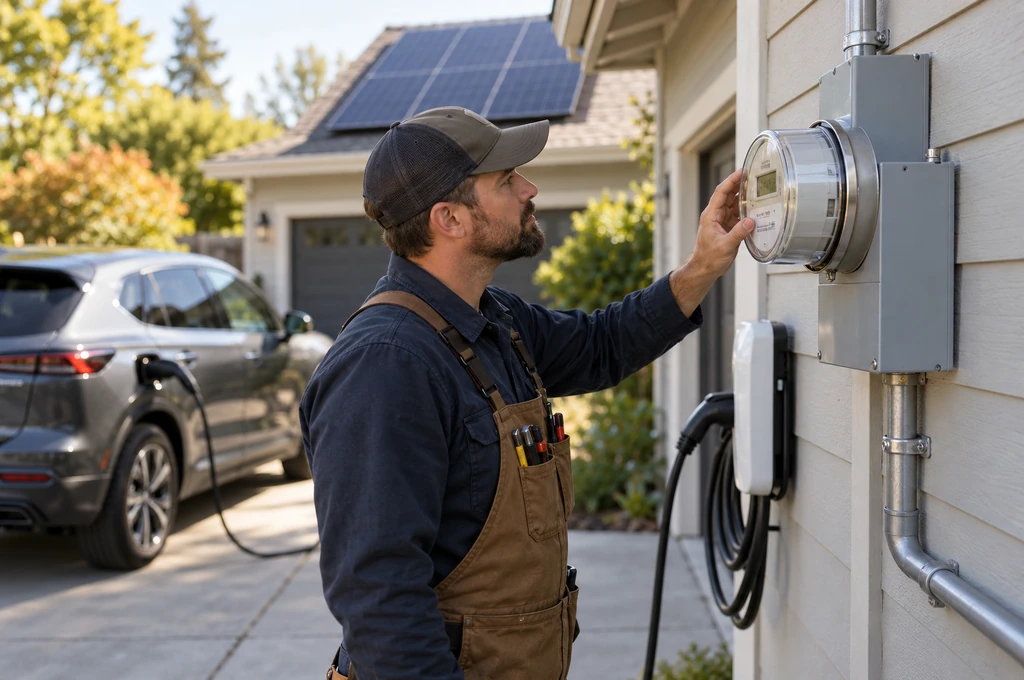
ConnectDER meter socket adapters install directly behind the glass utility revenue meter. The collar taps the grid on the utility side of the main service disconnect, effectively routing solar generation or vehicle power without feeding excess amperage across the home busbar. Homeowners facing panel capacity constraints can compare their alternatives using this direct engineering matrix:
| Feature | Full Main Panel Replacement | ConnectDER Adapter Collar |
|---|---|---|
| Average Hardware & Labor Cost | $3,000 – $6,500 | $600 – $1,200 |
| Installation Timeline | 2 to 6 weeks (utility scheduling) | Under 2 hours |
| Utility Interruption | Full-day grid disconnect | Brief 15-minute pull |
| Wall & Drywall Impact | High (cutting, rewiring circuits) | Zero interior modification |
| National Electrical Code Compliance | NEC 2020/2023 Compliant | UL-listed, utility-sanctioned |
Similar challenges often occur when grid limits throttle hardware installations, as explored in How a 63-Amp Limit Knocked Out Tesla Solar Charging and Sparked a Homeowner Fix. Bypassing interior panels solves the physical congestion that stops residential projects in dense urban markets.
Real-World Calculations: Running Costs, Range & Government Subsidies
Installing rooftop generation in the District yields higher economic returns than in many neighboring states due to local solar incentives. When an installation avoids an unnecessary $4,000 panel replacement, the return on equity accelerates. Financial reporting tracked by Bloomberg shows that soft deployment costs, including electrical preparation, account for up to 60 percent of residential energy expenses in the United States.
Consider an average District home installing an 8-kilowatt solar array with a Level 2 charging port. Under standard circumstances, a complete service panel overhaul pushes initial capital outlay toward $24,000 before federal tax credits. Using meter socket adapters, the upfront requirement falls closer to $20,000. Under Section 25D of the Internal Revenue Code, the 30 percent residential clean energy credit reduces that net cost further. In Washington, D.C., Solar Alternative Compliance Payments (SACPs) support high-value Solar Renewable Energy Certificates (SRECs), often trading near $380 to $400 per megawatt-hour.
Running an electric vehicle charged directly from rooftop solar costs roughly $0.04 to $0.06 per kilowatt-hour amortized over panel lifespan, compared to Pepco standard residential utility rates of roughly $0.15 per kilowatt-hour. For a driver covering 12,000 miles per year at 3.3 miles per kilowatt-hour, fuel expenses drop to roughly $180 annually versus $1,800 for an equivalent internal combustion vehicle burning gasoline. The hardware shortcut translates directly to household liquidity.
Crucial Factors & What to Check Before You Buy
While utility acceptance is a major step forward, property owners must confirm specific site conditions before placing an order. ConnectDER meter socket adapters must match the exact enclosure design on your exterior wall. Inspect your current utility hardware with an electrician to verify three items:
- Meter Socket Compatibility: The unit requires a standard ring or ringless residential meter socket with adequate mechanical clearances from gas meters and ground grade.
- Electrician Certification: Although utility workers or certified contractors can attach the collar quickly, municipal codes still mandate licensed electricians for inverter wiring and conduit runs.
- Utility Tariffs: Confirm whether Pepco requires a dual-meter solar production tariff or allows net energy metering through a single bi-directional meter.
Global supply chains are also addressing end-of-life considerations for modern clean energy components, a topic examined in detail regarding how Thailand Promotes Industrial Zones for Recycling Solar Panels and Batteries. As electrification equipment proliferates on exterior walls, building durable, serviceable hardware connections protects homeowner balance sheets long into the future.
Frequently Asked Questions
What are ConnectDER meter socket adapters?
ConnectDER meter socket adapters are UL-listed collars that install between a residential electric meter and its socket. They create an external connection point for solar, battery storage, or EV chargers without rewiring the interior panel.
Why did Pepco approve ConnectDER meter socket adapters?
Pepco approved the devices to speed up residential solar and EV charging interconnection in Washington, D.C. The adapter eliminates utility delays caused by mandatory electrical service upgrades.
How much money can meter socket adapters save homeowners?
The collar saves homeowners between $2,500 and $5,000 by avoiding a main electrical service panel upgrade. It also eliminates the need for wall repairs and heavy indoor electrical rework.
Does installing this adapter require shutting off household power?
Power is shut off only briefly while the utility meter is pulled and the collar is inserted. The disruption usually lasts less than 30 minutes, compared to a full-day outage for a service upgrade.
Can I install ConnectDER meter socket adapters myself?
No, homeowners cannot install the device themselves. The hardware touches high-voltage utility lines and requires licensed electricians or utility-authorized technicians with utility approval.
Do ConnectDER meter socket adapters work with battery backup systems?
Yes, specific ConnectDER models are engineered to interconnect whole-home batteries, solar inverters, and EV chargers directly to the meter connection.
Are ConnectDER meter socket adapters approved outside Washington, D.C.?
Yes, several utilities across states like New York, Arizona, and Oregon have approved ConnectDER hardware for distributed solar and EV charging programs.
Does using this adapter affect net metering credits?
No, it does not reduce your credits. Solar electricity generated through the adapter is tracked through your utility meter according to Pepco net metering rules.
Will the adapter work on 200-amp electrical panels?
Yes, while the adapter helps 100-amp panels avoid expensive upgrades, it also works on 200-amp panels that lack physical breaker slots for new charging or solar circuits.
What happens if I move or sell my home?
The adapter remains a permanent part of the home electrical infrastructure. It conveys with the property to support ongoing solar generation and vehicle charging for future owners.
Accelerating Urban Clean Energy Deployments
Pepco’s green light for ConnectDER meter socket adapters removes one of the most persistent financial barriers to residential electrification in the District. By cutting panel replacement expenses, Washington homeowners gain a practical path to generate clean power, charge vehicles affordably, and support long-term grid stability.
Source: Fuel Cells Works (fuelcellsworks[dot]com)