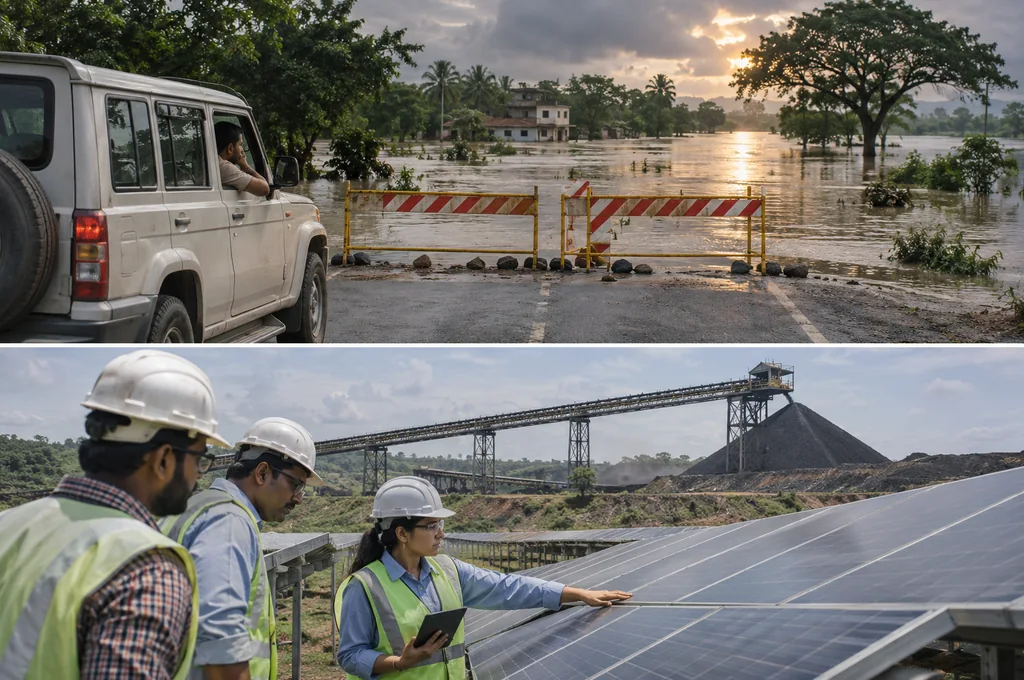
The Mahanadi Coalfields solar push represents a major strategic pivot for India’s largest fuel producer as fossil energy entities prepare for public market scrutiny. Coal India subsidiary Mahanadi Coalfields Limited (MCL) has mapped an aggressive Rs 17,900 crore capital expenditure program focused on solar power installations, commercial vehicle electrification, and critical mineral extraction.
⚡ Quick AI Overview & Key Recommendation
Under the Mahanadi Coalfields solar push, Coal India subsidiary MCL is directing Rs 17,900 crore toward renewable infrastructure before a planned public listing. The strategy combines gigawatt-scale solar parks on reclaimed mining ground with zero-emission haulage networks to slash operational power costs and future-proof enterprise valuation.
State-owned enterprises face rising decarbonization targets. Mining corporations must clean up their own operational footprint while maintaining baseload production. Reclaiming spent open-cast mines into utility-scale solar generation complexes solves two structural problems at once: land acquisition gridlocks and surging grid electricity tariffs. Market data analyzed by Bloomberg shows institutional investors increasingly demand concrete renewable asset pipelines before backing state-run initial public offerings.
Mahanadi Coalfields Solar Push: Key Highlights & Market Impact
MCL generates massive operational cash flows from its mining basins in Odisha. A large portion of this capital will now directly finance clean power plants. Transforming coal concessions into solar farms marks a sensible shift in resource deployment. This transition makes the Mahanadi Coalfields solar push a vital test case for public sector resource companies across Asia.
Here are the structural facts defining this initiative:
- Targeted Capital Outlay: Rs 17,900 crore allocated across solar projects, electric logistics systems, and mineral exploration.
- Direct Solar Capacity: Development of centralized solar parks on reclaimed overburden dumps to power heavy extraction machinery.
- Fleet Electrification: Replacement of diesel-guzzling dump trucks with heavy commercial battery haulers charged through captive solar microgrids.
- Public Offering Timing: Strengthening balance sheet sustainability metrics ahead of an anticipated domestic IPO.
Commercial operators across heavy industry follow similar playbooks. Off-grid industrial setups prove that solar can support heavy commercial transport without relying on unstable regional distribution networks. Recent developments reported by commercial transport outlets like evxl[dot]co show companies launching 90 kW self-contained solar charging hubs to power delivery fleets off-grid. Heavy industry requires massive, continuous wattage. Mining operations need resilient power systems to make industrial electrification economically viable.
Detailed Breakdown: What Caused This Renewable Pivot
Economics drove this decision. Mining coal requires massive electricity inputs to run ventilation, conveyor belts, water pumps, and heavy excavators. Grid power costs continue to climb. Captive solar energy offers predictable levelized costs below two rupees per kilowatt-hour over a twenty-five-year plant lifespan.
The capital allocation backing the Mahanadi Coalfields solar push spans multiple utility-scale installations situated directly on reclaimed mine land. Industrial land acquisition in India often stalls infrastructure projects for years. Because MCL already owns vast tracts of exhausted open-cast acreage, it bypasses customary regulatory bottlenecks. Mounting panels on stabilized mining soil turns non-productive liabilities into high-yield power plants.
| Strategic Pillar | Primary Objective | Industrial Benefit |
|---|---|---|
| Utility Solar Parks | Self-generation for mining machinery | Direct reduction in operating energy overhead |
| Reclaimed Land Use | Panel installations over de-coaled areas | Zero fresh land acquisition friction |
| Fleet Electrification | Battery haulers backed by solar charging | Lower diesel purchase volume and clean mining compliance |
Solar technology improvements make this setup far more reliable than in past decades. Recent industry studies recorded on indexbox[dot]com demonstrate how switching matrices in mixed monofacial and bifacial solar arrays optimize generation curves under harsh environmental conditions. Ground reflection from light-colored mining surfaces allows bifacial solar panels to capture back-side irradiation, driving higher system yields per hectare.
Integrated decentralized setups are gaining ground worldwide. In the Middle East, utilitiesmiddleeast[dot]com reported that BYD installed an integrated solar, battery storage, and autonomous charging hub in the Abu Dhabi desert. Captive microgrids give industrial operators total energy autonomy. Readers can explore how domestic researchers are solving these local bottlenecks in this study on how NIT-R Secures Patent for Solar Microgrid to Boost EV Charging.
What This Means for Readers & Future Outlook
Public equity markets evaluate energy firms differently today. Fossil fuel pure-plays frequently trade at lower price-to-earnings multiples due to long-term regulatory penalties. Adding hundreds of megawatts of renewable generation directly into a corporate entity alters its valuation profile ahead of an initial share sale, a pattern well documented on Investopedia.
Market analysts tracking the Mahanadi Coalfields solar push expect significant cost reductions across coal lifting operations. Replacing expensive diesel generators with dedicated solar generation shields corporate earnings from world crude market volatility. When state enterprises clean their energy sourcing, downstream industrial users also purchase commodities with lower embedded carbon accounting.
Clean generation creates a circular economic benefit across all levels of society. Home consumers observe parallel economic benefits as distributed solar technology drops in price. You can see how decentralized generation reconfigures residential economics in this analysis showing Why Homeowners Who Go Electric Gain a Massive Rooftop Solar Energy Advantage.
Mining companies must adapt or absorb escalating compliance costs. Large-scale solar engineering gives heavy extractors a reliable off-ramp from captive fossil dependency. MCL shows that utility power generation belongs directly inside the industrial fence line.
Frequently Asked Questions
What is the primary goal of the Mahanadi Coalfields solar push?
The primary goal is to allocate Rs 17,900 crore toward utility-scale solar generation, vehicle electrification, and critical mineral extraction. This clean shift helps the company reduce heavy operating overhead before its planned public market debut.
How much capital has Mahanadi Coalfields committed to this initiative?
The Coal India subsidiary has earmarked Rs 17,900 crore for this expansive capital expenditure program. The spending targets captive solar parks, fleet conversion, and advanced minerals.
Where will the new solar installations be built?
MCL plans to build the majority of its solar arrays directly on reclaimed open-cast land and stabilized overburden dumps. Using existing property avoids lengthy legal delays associated with new rural land purchases.
Why is an IPO motivating this clean energy investment?
Institutional asset managers place heavy emphasis on carbon mitigation when pricing equity listings. Adding gigawatts of renewable generation provides an attractive valuation multiple for public investors.
How do solar installations benefit coal extraction sites directly?
Solar arrays produce cheap electricity during peak daylight hours to power heavy conveyor belts, water drainage pumps, and extraction machinery. This cuts reliance on standard grid power and expensive backup generators.
Will solar power support electric vehicles at MCL mining sites?
Yes, MCL plans to run dedicated solar microgrids to charge commercial battery dump trucks and heavy service vehicles. This setup eliminates immense volumes of imported diesel consumption.
What type of solar technology will yield the best results on mining terrain?
Bifacial solar modules paired with dynamic switching arrays perform well on reflective, cleared ground. The panels capture sunlight from both sides, lifting overall power efficiency in dusty settings.
How does the Mahanadi Coalfields solar push impact Coal India investors?
It helps insulate the consolidated group from rising carbon taxes and volatile fuel expenses. Lower operational lifting costs directly protect Coal India subsidiary profit margins.
Does MCL intend to sell surplus solar power back to the grid?
MCL will prioritize powering its captive industrial operations first. However, long-term plans can include wheeling surplus zero-carbon power into regional state grids during low-demand production cycles.
Are other international mining and energy firms adopting similar solar strategies?
Yes, resource operations worldwide are deploying off-grid solar and battery storage systems to power industrial machinery, mimicking commercial installations recently deployed in Australia, Chile, and the United Arab Emirates.
The Strategic Reality Behind Industrial Solar Transformation
Industrial giants cannot depend on legacy power generation models while facing strict global financial scrutiny. Capital markets reward producers who control their energy inputs and cut carbon liabilities before issuing public shares, as the Mahanadi Coalfields solar push gains operational momentum across eastern India.
Source: The Financial Express (financialexpress[dot]com)