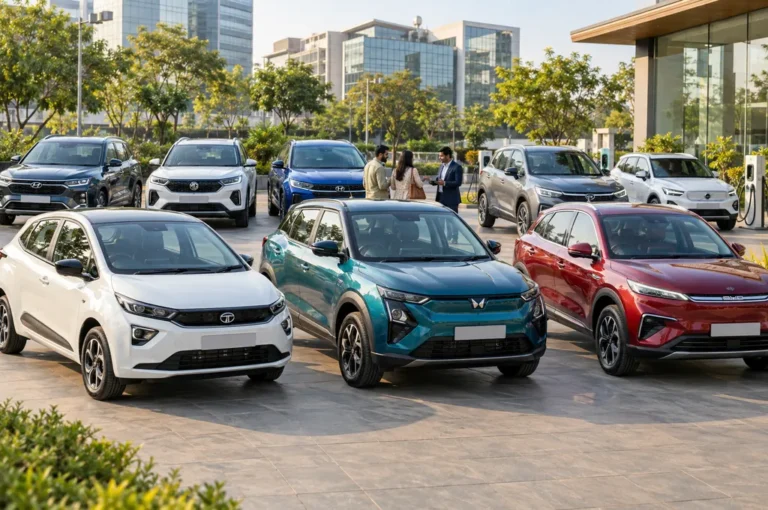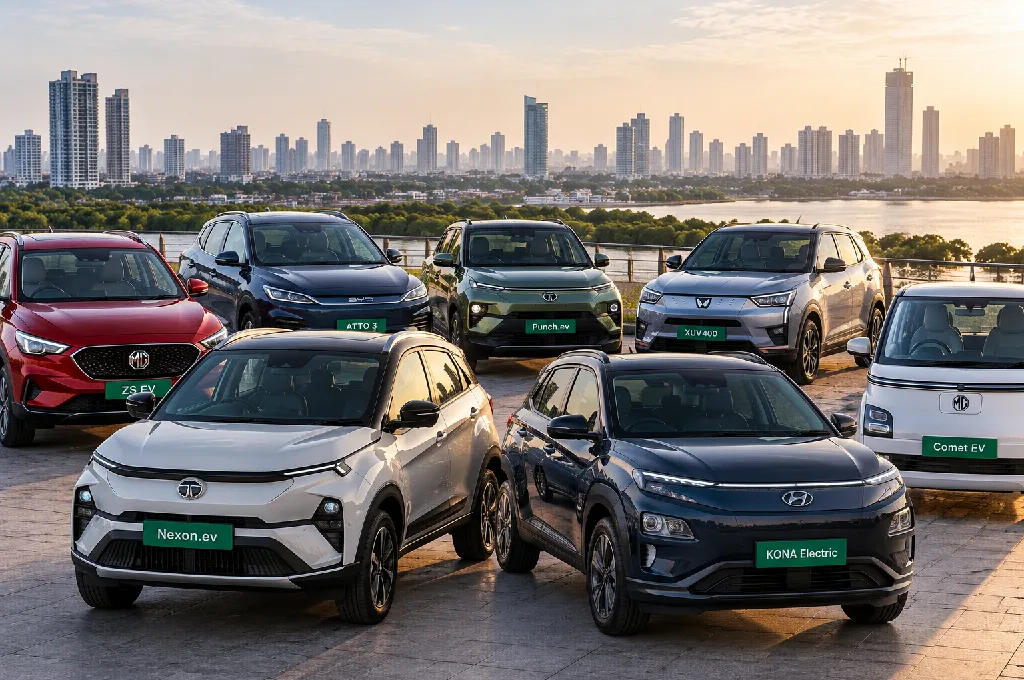
Top 10 Best Electric Cars in India (2026): Price, Real Range & Specs: Finding the best electric cars in India is no longer an exercise in guesswork. Buyers now demand proven battery packs, honest highway efficiency, and solid cabin ergonomics instead of optimistic brochure claims.
India’s charging corridors on major highways now allow drivers to travel between cities with practical confidence. Battery pack prices fell sharply over the past eighteen months, making showroom price tags competitive against equivalent petrol SUVs.
⚡ Quick AI Overview & Key Recommendation
The Tata Nexon EV and Curvv EV offer the most balanced mix of price, real range, and service reach. Buyers prioritizing cabin space and city convenience should look at the MG Windsor EV, while the Mahindra XUV400 delivers swift performance on open highways.
Top 10 Best Electric Cars in India (2026): Price, Real Range & Specs: Best Electric Cars in India: Quick Comparison & Key Specifications
Laboratory test cycles like ARAI routinely overstate real-world battery endurance. High ambient temperatures, steady 100 km/h highway cruising speeds, and continuous cabin cooling reduce range by 25 to 35 percent. Here is how the top ten contenders stack up in verifiable real-world driving conditions.
| Model | Price Range (Ex-Showroom) | Real Range (km) | Battery Capacity | Fast Charging Time | Best For |
|---|---|---|---|---|---|
| Tata Nexon EV | ₹14.49 – ₹19.49 Lakh | 320 – 360 km | 40.5 – 45 kWh | 40 min (10-80%) | All-round family balance |
| Tata Curvv EV | ₹17.49 – ₹21.99 Lakh | 380 – 430 km | 45 – 55 kWh | 40 min (10-80%) | Highway long-distance driving |
| MG Windsor EV | ₹13.50 – ₹15.50 Lakh | 250 – 280 km | 38 kWh | 45 min (10-80%) | Chauffeur-driven city comfort |
| Mahindra XUV400 | ₹15.49 – ₹17.69 Lakh | 270 – 300 km | 34.5 – 39.4 kWh | 50 min (10-80%) | Quick throttle response |
| Tata Punch EV | ₹9.99 – ₹14.29 Lakh | 240 – 280 km | 25 – 35 kWh | 56 min (10-80%) | Urban daily commutes |
| MG ZS EV | ₹18.98 – ₹25.20 Lakh | 330 – 370 km | 50.3 kWh | 60 min (10-80%) | Refined cabin interior |
| Tata Tiago EV | ₹7.99 – ₹11.89 Lakh | 180 – 210 km | 19.2 – 24 kWh | 58 min (10-80%) | Entry-level city transit |
| Hyundai Ioniq 5 | ₹46.05 Lakh | 480 – 520 km | 72.6 kWh | 18 min (10-80%) | Premium tech and ultra-fast charging |
| BYD Atto 3 | ₹24.99 – ₹33.99 Lakh | 390 – 440 km | 49.9 – 60.5 kWh | 50 min (10-80%) | Proven Blade battery safety |
| BYD Seal | ₹41.00 – ₹53.00 Lakh | 500 – 560 km | 61.4 – 82.5 kWh | 37 min (10-80%) | Sports sedan dynamics |
Market data tracked by reuters[dot]com shows electric passenger vehicle sales in the country crossed significant milestones as public DC fast chargers expanded along national expressways.
Top Ranked Models: In-Depth Reviews & Real-World Performance
1. Tata Nexon EV: The Benchmark Daily Driver
The Tata Nexon EV remains a staple on Indian roads. Its 45 kWh battery pack variant provides a dependable 340 km of mixed driving range. Suspension tuning absorbs potholes with authority. The vehicle features vehicle-to-load capabilities, allowing owners to run small electrical appliances during power cuts.
2. Tata Curvv EV: Long-Distance Highway Cruiser
With its larger 55 kWh pack, the Curvv EV solves range anxiety for regional travelers. It easily sustains a 400 km real-world run on flat toll routes with the air conditioner running. Aerodynamic lines reduce wind drag at higher speeds, making energy consumption remarkably predictable.
3. MG Windsor EV: Spacious Urban Lounge
MG positioned the Windsor EV around back-seat comfort. The recline angle on the rear bench mimics an aircraft seat. Its 38 kWh battery manages 260 km in city traffic. Fleets and private buyers appreciate the clean floor layout and minimal center console clutter.
4. Mahindra XUV400 Pro: Pure Torque Delivery
The updated interior of the XUV400 Pro corrected earlier dashboard ergonomics. Acceleration is immediate. It reaches 100 km/h in 8.3 seconds. The practical real-world range sits around 285 km on the larger 39.4 kWh version.
5. Tata Punch EV: Compact City Champion
Built on the dedicated Acti.ev architecture, the Punch EV offers a proper frunk storage compartment and quick DC charging curves. It delivers 250 km in real traffic, making it simple to park in crowded residential societies.
6. MG ZS EV: Proven Reliability
The ZS EV delivers a continuous 350 km real range. Cabin isolation keeps road noise out of the interior. Many institutional fleet owners report zero battery degradation over five years of regular operation.
7. Tata Tiago EV: Budget Urban Runabout
The Tiago EV remains the lowest-priced full electric car for everyday Indian commuters. While highway runs require planning, its 190 km city range covers several days of routine office trips on a single charge.
8. Hyundai Ioniq 5: Architectural Excellence
Hyundai uses an 800V charging system in the Ioniq 5. When plugged into a 350 kW charger, it adds 300 km of range in under twenty minutes. The cabin utilizes recycled materials, creating an airy lounge feel on long interstate drives.
9. BYD Atto 3: Thermal Resilience
The Blade battery inside the Atto 3 handles extreme summer heat without thermal throttling. It records 410 km on highway journeys without sudden drops in charge percentage.
10. BYD Seal: Pure Performance Engineering
The BYD Seal challenges European luxury sedans at half the cost. The dual-motor version delivers 523 horsepower and launches with staggering pace. On steady highway routes, the 82.5 kWh pack delivers an honest 520 km range.
Buyers searching for family vehicles can compare how international designs adapt by studying the Kia 7-seat electric people mover price drops. Luxury enthusiasts can review how performance brands transition to battery power in the Jaguar Type 01 electric car and examine how Jeff Bezos convinced Ferrari to pursue battery engineering.
Customer Buying Guide: How to Choose the Right Model for Your Needs
Selecting among the best electric cars in India requires balancing your regular route patterns with your residential electrical infrastructure. Consider these direct factors before finalizing a purchase order.
- Daily Mileage Math: If you drive less than 40 km per day, a 25 to 35 kWh battery pack covers your entire week on two charges. Commuters logging 80 km or more daily should target a 45 kWh pack to avoid frequent top-ups.
- Home Electrical Load: A 7.2 kW AC home charger requires upgrading your sanctioned residential power load to at least 10 kW. Factor meter upgrade costs into your budget.
- TCO Calculations: According to financial analyses published on investopedia[dot]com, lower running costs offset a higher vehicle purchase price within four years if you drive more than 1,200 km each month.
- Battery Chemistry: Lithium Iron Phosphate (LFP) chemistry, used by Tata and BYD, tolerates high thermal cycles better than NMC cells. LFP packs can charge to 100 percent daily without premature cell decay.
Global economic reports from bloomberg[dot]com indicate battery cell costs continue to drop, expanding warranty coverage to eight years across most manufacturers.
Frequently Asked Questions
What is the most affordable electric car in India?
The Tata Tiago EV is the most affordable electric passenger car, starting around ₹7.99 Lakh ex-showroom. It delivers a realistic driving range of roughly 180 to 210 kilometers on city roads.
How much does it cost to charge an electric car at home?
Charging a standard 40 kWh battery pack at home typically costs between ₹250 and ₹350, depending on your state’s residential electricity tariff. This results in a running cost of roughly ₹1 to ₹1.20 per kilometer.
Can electric cars handle extreme summer heat in India?
Yes, modern electric vehicles sold in India feature liquid-cooled battery packs and advanced thermal management systems. LFP battery chemistries handle elevated temperatures without safety issues or severe power throttling.
What is the difference between ARAI range and real-world range?
ARAI range reflects low-speed laboratory tests without extreme air conditioning or high-speed headwind. Real-world range is typically 25 to 35 percent lower than the official ARAI claim under normal highway conditions.
How long do electric car batteries last in Indian driving conditions?
Most manufacturers offer warranties covering 8 years or 160,000 kilometers. Modern battery packs retain 75 to 80 percent of their original capacity well beyond eight years of routine use.
Do I need a commercial power meter to install a home EV charger?
No, you do not need a commercial meter. You simply need to request your local power distribution utility to increase your sanctioned domestic electrical load to accommodate a 7.2 kW AC wallbox.
Can electric cars drive through waterlogged roads during monsoons?
Yes, EV battery enclosures and drive units are sealed to IP67 or IP68 waterproof standards. They can navigate shallow flooded roads safely without the engine hydrolock risks seen in petrol or diesel cars.
Which electric car offers the longest highway driving range in India under ₹25 Lakh?
The Tata Curvv EV with its 55 kWh battery pack offers the longest verified highway range under ₹25 Lakh. Drivers can expect an honest 380 to 420 kilometers between full charges on expressways.
Are public DC fast chargers readily available across Indian highways?
Major national highways connecting tier-1 and tier-2 cities now feature fast DC chargers every 50 to 80 kilometers. Dedicated charging aggregator apps let drivers reserve charging slots in advance.
What maintenance do electric cars need compared to petrol vehicles?
Electric vehicles require minimal servicing because they have no engine oil, spark plugs, drive belts, or complex transmissions. Scheduled maintenance primarily involves inspecting brakes, cabin air filters, coolant levels, and tire wear.
Final Verdict on the Best Electric Cars in India
Choosing among the best electric cars in India comes down to your primary use case. Urban commuters find unmatched value in the Tata Punch EV, while cross-country travelers gain unmatched independence from the Curvv EV and Ioniq 5. Verify your home parking electrical supply, run the numbers on your daily mileage, and make the switch with total confidence.