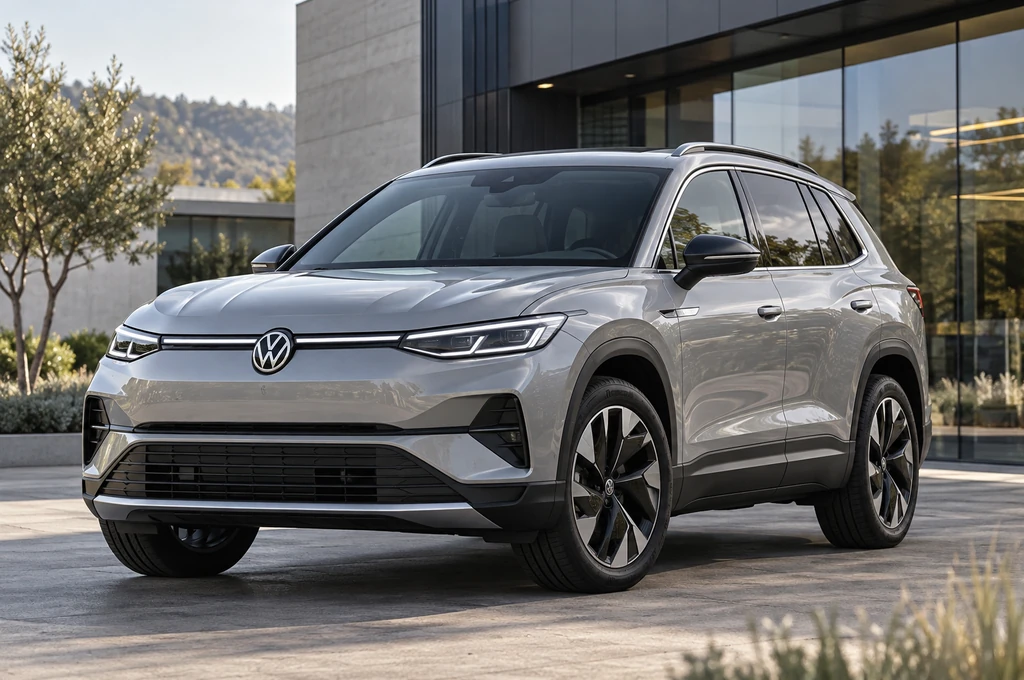
electric SUV: The newly previewed Volkswagen ID Tiguan image gallery provides an early look at the planned replacement for the ID 4 and ID 5 crossovers. Volkswagen plans to retire those numerical badges to revive its strongest nameplates on battery power. The electric Tiguan will arrive on global markets alongside the conventional combustion-powered Tiguan rather than replacing it overnight. It rides on the upgraded MEB+ architecture and adopts the brand’s Pure Positive styling language.
electric SUV: Volkswagen ID Tiguan image gallery: Key Highlights & Market Impact
Studying the official Volkswagen ID Tiguan image gallery reveals clean exterior lines that abandon the bulbous proportions of previous generation models. The stance is upright. The hood sits taller, and the wheel arches have purposeful squared edges. Behind the headline, there is another story. Volkswagen struggled with software and styling complaints on early ID models. This redesign brings back physical proportions that buyers trust.
Visual details across the Volkswagen ID Tiguan image gallery indicate a practical two-box silhouette built for real utility. Roof rails sit flush against the glass ceiling. Up front, a thin horizontal light band connects slim LED projectors. Short overhangs maximize interior legroom without ballooning overall vehicle length.
The technical specifications back up the visual changes. Volkswagen provides two battery configurations: an entry-level 58kWh lithium iron phosphate (LFP) pack and an extended-range 77kWh nickel manganese cobalt (NMC) pack. Buyers seeking local incentives should review the Electric Car Grant: What You Need To Know to track potential regional subsidies.
| Specification | Entry Battery | Long Range Battery |
|---|---|---|
| Pack Chemistry | 58kWh LFP | 77kWh NMC |
| Drivetrain | Single-Motor RWD | RWD or Dual-Motor AWD |
| Power Output | 190 horsepower | Up to 299 horsepower |
| Claimed WLTP Range | Approximately 420 km | Up to 600 km |
Detailed Breakdown: What Caused the MEB+ SUV Transition
Market pressure forced Volkswagen to rethink its electric vehicle strategy. In China, rival brands are expanding fast. Reports from autocarindia[dot]com note that legacy platforms must adapt quickly to meet modern pricing and efficiency standards. At the same time, brands like BYD dominate volume segments, while Hyundai tests compact entries. Every exterior photo in the Volkswagen ID Tiguan image gallery reflects the new Pure Positive design philosophy, which strips away pointless surface creases.
Under the sheet metal, the MEB+ platform introduces cell-to-pack structural design. LFP chemistry cuts entry-level production costs, an economic necessity documented in manufacturing overhead reports across the automotive sector. Moving to LFP for base models shields the company from raw nickel volatility.
Efficiency is another pressing concern. Recent highway evaluations of heavy off-road electric SUVs showed range dropping below 160 miles under real-world conditions. Volkswagen targeted low aerodynamic drag and lighter motors to protect highway range. The dual-motor version matches the power tier of rivals, comparable in utility to performance crossovers like the BMW iX3 Adds 612hp M60 Version With Up to 754km Range and Gen6 Motors.
What This Means for Readers & Future Outlook
Drivers examining the Volkswagen ID Tiguan image gallery will notice a sensible family footprint. The cabin layout returns to conventional ergonomics. Volkswagen removed the frustrating capacitive steering touchpads and reinstated standard physical toggle switches on the center console. The central infotainment display stands proud of the dashboard with permanent climate shortcut buttons along the lower bezel.
Dual-track sales will shape showroom floors. Volkswagen will sell petrol, diesel, and hybrid Tiguans on the MQB platform directly next to the MEB+ electric Tiguan. This protects market share among drivers who are not ready to abandon combustion power. Urban commuters moving toward personal electric transport can also see changes in two-wheel alternatives, such as the River Indie Now on Flipkart: A New Path to Buy the SUV Scooter. For car buyers, the ID Tiguan offers a familiar name on dependable hardware.
Frequently Asked Questions
What does the Volkswagen ID Tiguan image gallery reveal about the design?
The visual preview reveals upright SUV proportions, squared wheel arches, and clean horizontal lighting. It replaces the rounded design of the ID 4 with the carmaker’s Pure Positive styling language.
When will the electric Volkswagen ID Tiguan go on sale?
The electric SUV is scheduled to arrive on global markets starting in 2027. It will sell alongside the internal combustion Tiguan.
Which vehicles does the ID Tiguan replace in the Volkswagen lineup?
The ID Tiguan serves as the direct successor to the ID 4 and ID 5 electric crossovers. Volkswagen is retiring those numerical nameplates in favor of traditional vehicle badges.
What battery options are available on the ID Tiguan?
Volkswagen offers a 58kWh lithium iron phosphate (LFP) pack and a 77kWh nickel manganese cobalt (NMC) pack. The LFP pack serves as the entry option to reduce purchase costs.
What is the driving range of the ID Tiguan?
The larger 77kWh battery achieves a claimed WLTP driving range of up to 600 kilometers. Real-world highway range will vary based on weather and speed.
Does the ID Tiguan offer all-wheel drive?
Yes, all-wheel drive is available with the 77kWh battery through a dual-motor configuration. The base 58kWh model comes exclusively with a rear-wheel-drive single motor.
How much horsepower does the ID Tiguan produce?
The base 58kWh version produces 190 horsepower. The dual-motor 77kWh all-wheel-drive variant generates up to 299 horsepower.
What platform does the electric Tiguan use?
The vehicle uses the Volkswagen Group MEB+ architecture. This platform features upgraded charging speeds, cell-to-pack integration, and refined electric motors.
Will Volkswagen discontinue the petrol Tiguan?
No, Volkswagen will sell the combustion-powered Tiguan alongside the electric ID Tiguan. This dual-track approach accommodates regions with slower charging infrastructure development.
Did Volkswagen fix the interior controls on the ID Tiguan?
Yes, the ID Tiguan replaces touch-capacitive controls with tactile physical buttons on the steering wheel and console. The updated infotainment screen also features illuminated, fixed climate menus.
Closing Verdict on the ID Tiguan Visual Shift
As shown throughout the Volkswagen ID Tiguan image gallery, Wolfsburg is returning to recognizable design principles. Ditching numerical confusion in favor of the established Tiguan badge restores buyer trust. With up to 600km of range, durable LFP chemistry, and physical controls inside, the ID Tiguan fixes the mistakes of early electric Volkswagens.
Source: Autocar India (autocarindia[dot]com)