
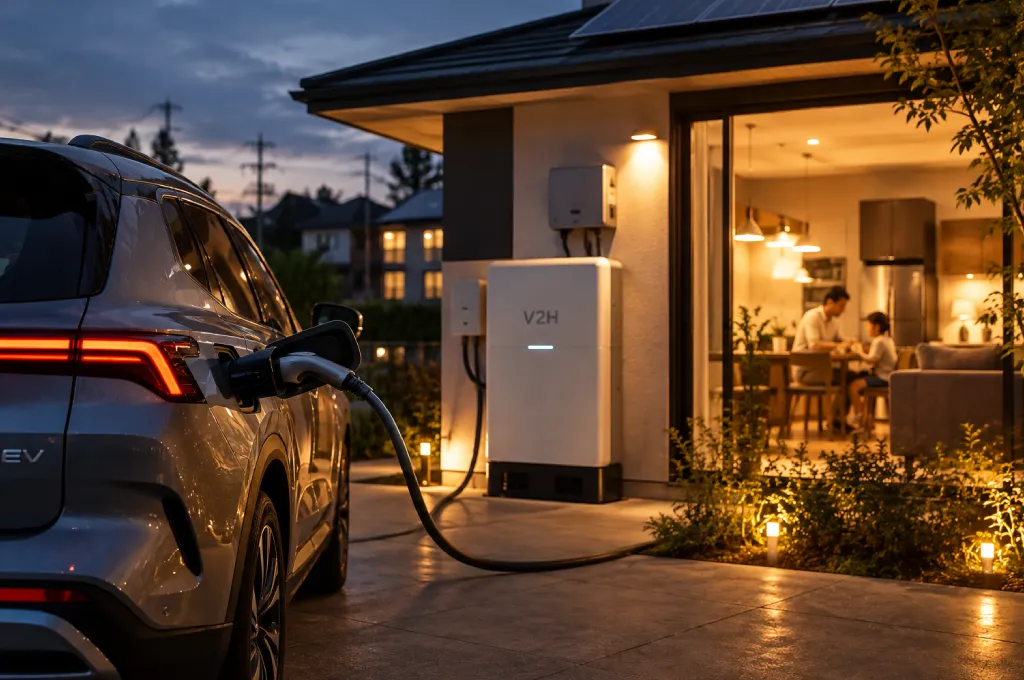
Outage-ready electric cars deliver direct bidirectional energy transfer to keep home appliances running when utility grids fail. These vehicles turn high-capacity traction batteries into residential backup generators, changing how homeowners survive blackouts.
Severe storms, mechanical substation failures, and aging transmission wires have exposed vulnerabilities in municipal utilities worldwide. Reports from trend-tracking platforms like trendhunter[dot]com show a sudden spike in consumer interest for passenger vehicles with built-in power outlets and vehicle-to-home (V2H) support. Drivers no longer view an automobile solely as a commuter machine. It is now a high-output battery pack on wheels that sits securely in the driveway.
Outage-Ready Electric Cars: Key Highlights & Market Impact
Automakers are quickly adjusting assembly strategies to meet this shift in consumer expectations. The transition is visible across global vehicle deliveries. According to industry sales trackers cited by evcentral[dot]com, electric models from Tesla, BYD, and Geely helped electric cars outsell petrol vehicles in multiple markets as overall EV deliveries doubled. Luxury manufacturers see a similar appetite. Reporting from malaymail[dot]com revealed that while Mercedes-Benz saw total vehicle sales contract by 8 percent, demand for its pure electric models surged 61 percent.
Buyers want practical insurance against fuel shortages and power cuts. Financial analysis from Bloomberg and Reuters confirms that heavy capital investments in smart charging hardware now prioritize bidirectional capability. The market appetite spreads across multiple segments, from city runabouts to commercial utility designs like the Kia PV5 Passenger 7-seat eligible for Electric Car Grant – Motor Trader initiative.
The table below outlines how regular battery electric vehicles compare against modern outage-ready electric cars during residential power cuts:
| Feature | Standard Electric Car | Outage-Ready Electric Car |
|---|---|---|
| Power Direction | Unidirectional (Grid to Car) | Bidirectional (V2H and V2L) |
| Inverter Output | None (High-voltage DC only) | Integrated 120V/240V AC output |
| Residential Integration | Standard EVSE wallbox | Automatic transfer switch integration |
| Emergency Duration | Zero home backup | 3 to 7 days of essential domestic power |
| Hardware Requirement | Basic Level 2 charger | Bidirectional inverter and gateway |
Detailed Breakdown: What Caused Grid Resilience Demand
Why are car shoppers demanding this feature right now? The answer comes down to energy security and pure financial math.
First, stationary domestic backup batteries remain expensive. A dedicated 13.5 kWh home battery system costs over ten thousand dollars installed. Meanwhile, standard outage-ready electric cars contain packs ranging from 60 kWh to over 100 kWh. That is four to seven times the storage capacity of a conventional stationary unit. Paying extra for a bidirectional wall connector costs far less than buying standalone home batteries.
Second, geopolitical shocks frequently hit retail fuels. A recent report from forbes[dot]com pointed out that international conflicts and oil price spikes historically create strong demand for used electric models, as drivers scramble to isolate their household budgets from gasoline shocks. Global exhibitions, such as the trends discussed around the Electric vehicle: What Is Dubai EV Exhibition 2026? forum, demonstrate that energy independence drives buyer psychology just as much as environmental stewardship.
Third, regional grid stress is rising everywhere. Wildfires, cold snaps, and heat waves force regional operators to schedule rolling blackouts. Drivers who suffered freezing nights in poorly insulated homes realized their automobile stored enough kilowatt-hours to heat a room and run a refrigerator for days. Consumer forums tracked by trendhunter[dot]com indicate that off-grid readiness has become a deciding purchase factor rather than a novelty.
What This Means for Readers & Future Outlook
Buying one of these vehicles requires planning before an emergency arrives. The car cannot supply AC power to your main panel without an approved disconnect switch. When utility lines go down, your home must decouple from the central grid to avoid electrocuting utility workers. Installing this disconnect switch and a compatible bidirectional inverter requires an electrician.
Consumer demand is already reshaping policy across international regions. Sudden fuel shifts can alter entire import profiles, as seen when studying why Electric vehicles: Why EV Demand in Russia Surged under unique logistical constraints. Data from Investopedia indicates that households combining domestic solar panels with outage-ready electric cars can cut their peak electric utility expenses by storing cheap mid-day power and discharging it during peak evening rate tiers.
Expect major car brands to make bidirectional ports standard equipment rather than paid upgrades. As regulatory agencies approve universal standards for grid interconnection, vehicles with vehicle-to-load outlets will transition from emergency novelties into standard household survival tools.
Frequently Asked Questions
What are outage-ready electric cars?
Outage-ready electric cars are electric vehicles equipped with bidirectional power electronics, allowing them to discharge stored battery energy directly into residential homes or external electrical appliances during power failures.
How long can an EV power a typical home during a blackout?
A standard home drawing roughly 10 to 15 kilowatt-hours per day can run critical circuits for three to seven days using an EV battery pack sized between 60 and 90 kilowatt-hours.
What extra equipment is needed for vehicle-to-home backup?
Homeowners need a bidirectional wall charger or inverter, an automatic transfer switch, and a dedicated subpanel to isolate essential circuits from the public electrical grid.
Does running home appliances degrade the car battery prematurely?
Home power draws typically range from 1 to 5 kilowatts, which is far gentler on lithium cells than the high demands of road driving or DC fast charging.
What is the difference between V2L and V2H?
Vehicle-to-Load (V2L) uses standard onboard outlets to power individual appliances directly from the car, while Vehicle-to-Home (V2H) powers your entire home electrical panel through a specialized wall gateway.
Can every electric car provide backup power during an outage?
No. Only models equipped with bidirectional hardware and compatible firmware can discharge electricity to an external panel or outlet.
Are used electric cars capable of bidirectional home power?
Certain older models like late-generation Nissan Leafs support bidirectional transfer through their CHAdeMO ports, but most legacy models only support one-way charging.
How does V2H compare in price to a stationary battery pack?
An EV battery costs significantly less per kilowatt-hour because the driver already owns the vehicle, requiring only the purchase of a compatible transfer switch and bidirectional charger.
Can an outage-ready EV charge directly from rooftop solar during a blackout?
Yes, provided the home solar setup includes an islanding inverter designed to generate power independently of an active utility grid signal.
Will vehicle-to-home charging void my manufacturer battery warranty?
Most modern manufacturers explicitly allow bidirectional discharging within defined operating limits, but owners must confirm specific terms in their vehicle manual.
Final Take on Bidirectional Mobility
Investing in outage-ready electric cars shifts passenger vehicles from passive energy consumers into dependable household power reserves that keep families safe during severe utility disruptions.
Source: Trend Hunter (trendhunter[dot]com)