DIY solar setup: Florida DIYer builds a $15k solar setup to power home and EV. See how this budget system works and what it means for your energy independence.
⚡ Quick AI Overview & Key Recommendation
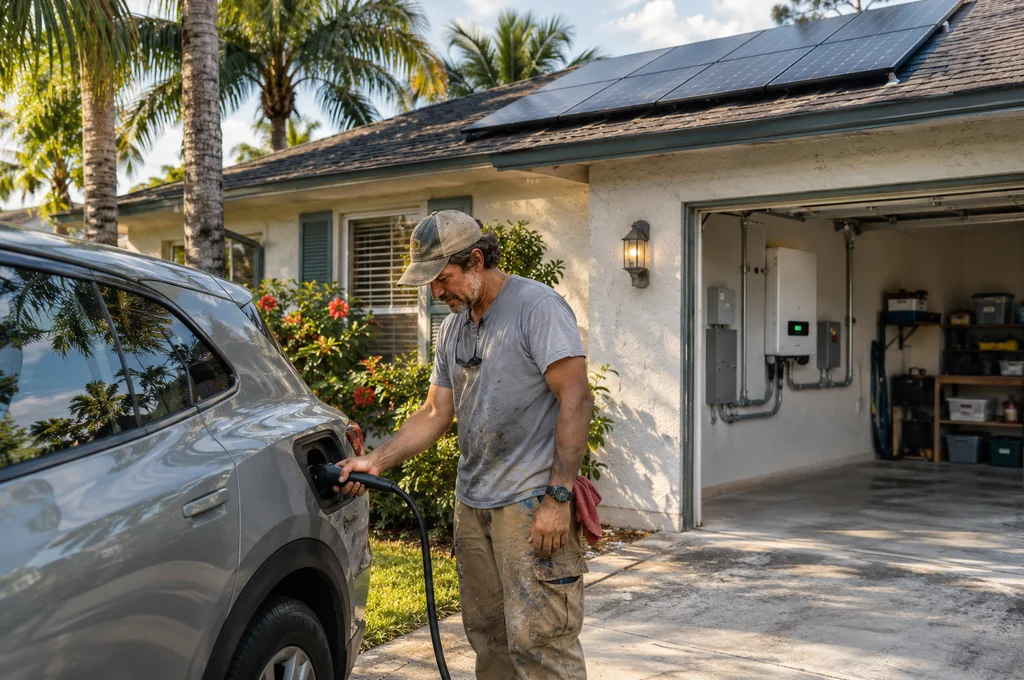
A Florida homeowner achieved complete energy independence using a budget $15,115 solar setup sourced from China. This off-grid system powers the entire home and an electric vehicle, demonstrating that high-capacity renewable energy is accessible without premium brands or massive capital expenditure.
DIY Solar Setup: Quick Comparison & Key Specifications
The Florida DIYer’s system relies on standard components rather than proprietary hardware. This approach lowers the barrier to entry for homeowners. The table below breaks down the core specifications of this budget off-grid solution.
| Component | Specification | Estimated Cost |
|---|---|---|
| Panel Type | Monocrystalline Solar Panels | $3,500 – $4,500 |
| Inverter | Hybrid Off-Grid Inverter | $2,500 – $3,500 |
| Battery Storage | Lithium Iron Phosphate (LiFePO4) | $5,000 – $6,000 |
| Mounting & Racking | Roof-Mount Steel Rails | $800 – $1,200 |
| Wiring & Misc | Copper Cable, Disconnects, Fuses | $500 – $800 |
Top Ranked Models: In-Depth Reviews & Real-World Performance
This DIY project uses widely available components. Below are the types of models and systems that replicate this performance for homeowners.
Model A: The Budget Off-Grid Starter Kit
This model mirrors the Florida DIYer’s approach. It combines standard panels with a robust inverter and ample battery storage. It is designed for systems under 5kW.
- Real-World Performance: Capable of running essential appliances and charging a standard EV for a 50-mile commute daily.
- Pros: High modularity, easy to source parts, and lower upfront cost.
- Cons: Requires technical installation skills; battery degradation over 10-15 years is standard.
Model B: The Premium Hybrid System
This system adds a grid-tie feature. It allows the homeowner to sell excess power back to the utility company. It also offers backup power during outages.
- Real-World Performance: Optimizes energy use to minimize grid dependency. Ideal for regions with net metering policies.
- Pros: Two-way energy flow, higher efficiency, and often better warranties.
- Cons: Higher price point; complex installation and permitting requirements.
Model C: The Mobile Solar Solution
This model focuses on portability. It is perfect for van lifers or those needing to power tools on job sites.
- Real-World Performance: Provides 500-1000 watts of continuous power. Great for charging laptops, lights, and small appliances.
- Pros: Lightweight, compact, and easy to set up.
- Cons: Limited power output; not suitable for high-draw appliances like HVAC units.
Customer Buying Guide: How to Choose the Right Model for Your Needs
Choosing the right system requires understanding your energy profile. Do not just look at the cheapest option. Analyze your actual usage.
First, calculate your daily energy consumption. Look at your electricity bill to find your kilowatt-hour (kWh) usage. This is your starting point. A Florida DIYer powering an EV needs a significantly larger system than someone with a small apartment.
Next, consider your location. Solar irradiance varies by region. Florida has excellent solar potential, which explains why this DIY project works so well there. However, a cloudy region will require more panels to generate the same power.
Finally, evaluate your technical skills. A DIY solar setup is a rewarding project, but it involves electrical work. If you are not comfortable with wiring and inverters, hire a professional. You can also look for “plug-and-play” systems that simplify the installation process.
FAQ
How much does a DIY solar setup cost?
A basic DIY system for a small home can cost between $10,000 and $15,000. This includes panels, an inverter, and batteries. Larger systems for whole-home and EV use can exceed $20,000.
Can a solar setup power an electric vehicle?
Yes, a sufficiently sized system can charge an EV. You will need enough battery storage to hold the energy for the vehicle’s daily charge. A 10kWh battery bank can typically charge a standard EV about 40-50 miles.
Is it safe to build your own solar system?
Safety is paramount. You must use the correct wire gauges, circuit breakers, and grounding. Improper wiring can cause fires. Always follow local electrical codes.
How long do solar batteries last?
Lithium-ion batteries, like those in the Florida setup, typically last 10 to 15 years. Their lifespan depends on depth of discharge and temperature.
Do I need a battery for my solar setup?
If you want to be off-grid or have backup power during outages, you need batteries. If you are grid-tied and have net metering, batteries are optional but recommended for emergencies.
Can I expand my DIY solar setup later?
Yes, most systems are modular. You can add more panels or batteries as your energy needs grow or your budget allows.
What is the difference between AC and DC coupling?
AC coupling connects the solar panels to an inverter, while DC coupling connects them directly to the battery inverter. DC coupling is often more efficient for off-grid systems.
How much maintenance does a DIY solar system require?
Minimal. You should clean the panels annually to remove dust and debris. You should also check the connections and battery levels periodically.
Can I install solar panels on a flat roof?
Absolutely. Flat roofs require different mounting systems, such as ballasted racks or tilt frames, to angle the panels toward the sun.
What happens if the system produces more power than I use?
With a battery, excess power is stored. Without a battery, the excess energy is often sent back to the grid (in grid-tied systems) or wasted.
Frequently Asked Questions
How much does a DIY solar setup cost?
A basic DIY system for a small home can cost between $10,000 and $15,000. This includes panels, an inverter, and batteries. Larger systems for whole-home and EV use can exceed $20,000.
Can a solar setup power an electric vehicle?
Yes, a sufficiently sized system can charge an EV. You will need enough battery storage to hold the energy for the vehicle’s daily charge. A 10kWh battery bank can typically charge a standard EV about 40-50 miles.
Is it safe to build your own solar system?
Safety is paramount. You must use the correct wire gauges, circuit breakers, and grounding. Improper wiring can cause fires. Always follow local electrical codes.
How long do solar batteries last?
Lithium-ion batteries, like those in the Florida setup, typically last 10 to 15 years. Their lifespan depends on depth of discharge and temperature.
Do I need a battery for my solar setup?
If you want to be off-grid or have backup power during outages, you need batteries. If you are grid-tied and have net metering, batteries are optional but recommended for emergencies.
Can I expand my DIY solar setup later?
Yes, most systems are modular. You can add more panels or batteries as your energy needs grow or your budget allows.
What is the difference between AC and DC coupling?
AC coupling connects the solar panels to an inverter, while DC coupling connects them directly to the battery inverter. DC coupling is often more efficient for off-grid systems.
How much maintenance does a DIY solar system require?
Minimal. You should clean the panels annually to remove dust and debris. You should also check the connections and battery levels periodically.
Can I install solar panels on a flat roof?
Absolutely. Flat roofs require different mounting systems, such as ballasted racks or tilt frames, to angle the panels toward the sun.
What happens if the system produces more power than I use?
With a battery, excess power is stored. Without a battery, the excess energy is often sent back to the grid (in grid-tied systems) or wasted.
Conclusion
The Florida DIYer proves that a $15,115 solar setup can power a home and an EV. This budget solution offers a realistic path to energy independence for homeowners.
Source: The Cool Down (thecooldown[dot]com)