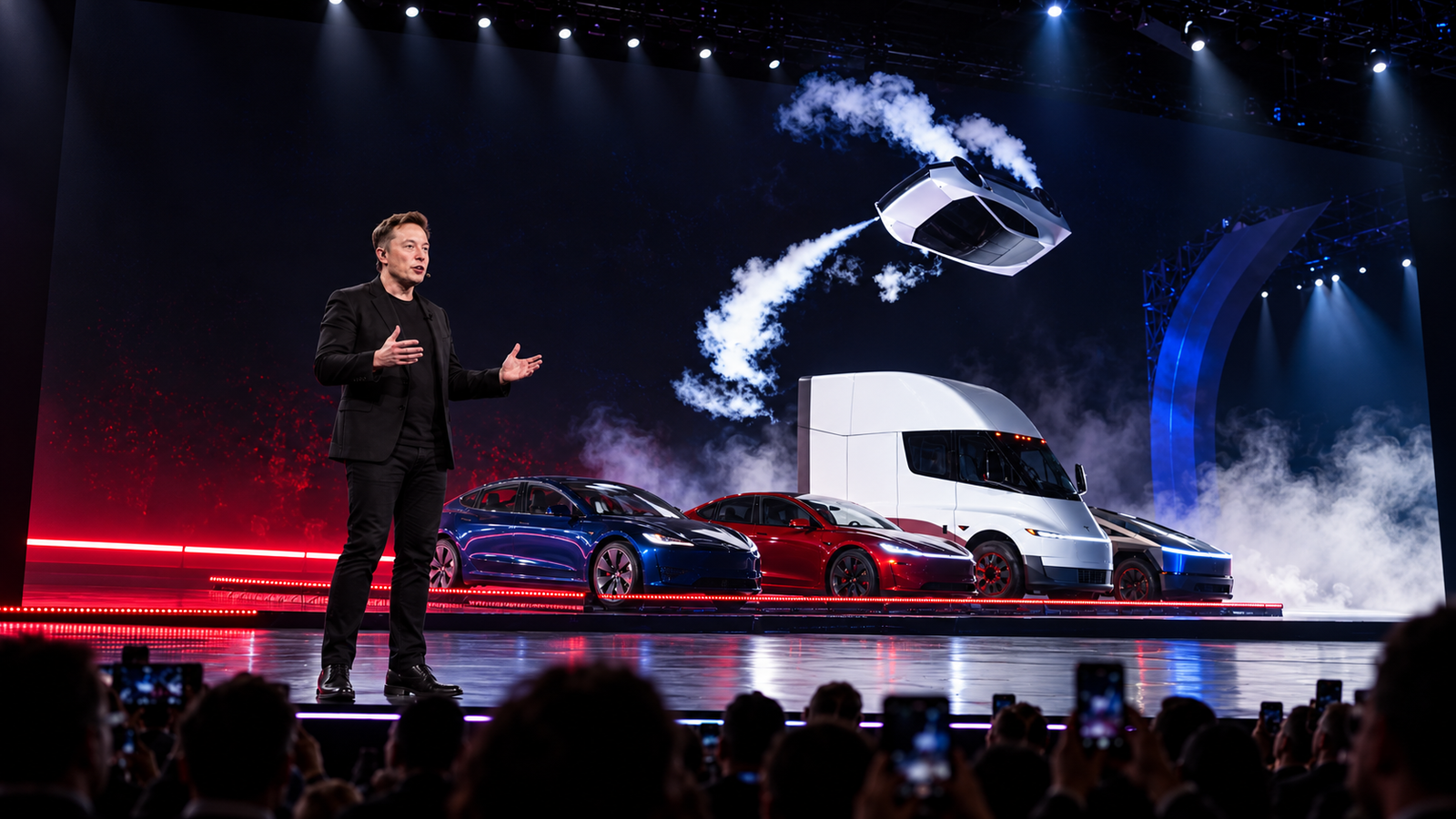
On 15 October 2026, Tesla new flying car finally showed its long-delayed second-generation Roadster. The event was held at a SpaceX test site in McGregor, Texas. A white two-seater drove up a ramp until it was upside down, spun off the top, flipped in the air and landed on its wheels. Later it jumped over a row of parked Teslas. Headlines called it a flying car within minutes.
So is the new Tesla Roadster a real flying car? The short answer is that the demo was real, but the label “flying car” asks more of the footage than it can deliver.
What happened at the Tesla Roadster demo
Fact-checkers have confirmed the videos are genuine. Snopes rated the claim true, noting that Tesla’s footage and clips from people in the crowd matched. The car did what the clips show.
Here is the sequence reported by CNN, Reuters and others:
- The Roadster climbed a steep curved ramp using suction fans and hung upside down.
- It left the ramp, rotated in the air and landed using built-in thrusters.
- It then jumped over a line of Tesla models, including a Cybertruck, a Cybercab and a Model Y.
- It finished with a straight-line run that Tesla claims took it from 0 to 60 mph in 0.81 seconds.
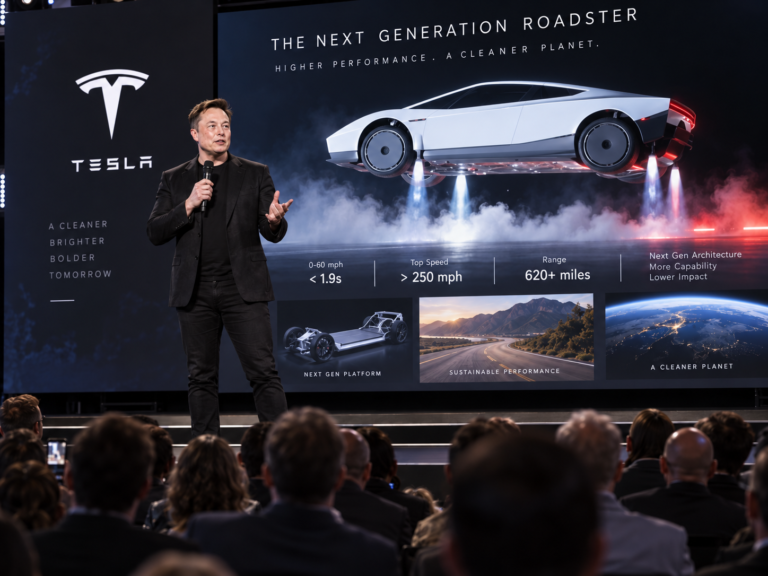
Elon Musk told the crowd it was something “you haven’t seen in any movie.” That part is fair.
| Claim | What the demo showed | Status |
| The Roadster is a flying car | Short jumps and mid-air flips over a ramp and a row of Teslas | Sustained flight not shown |
| It can drive upside down | Climbed a ramp and hung inverted using suction fans | Shown on the day |
| 0 to 60 mph in 0.81 seconds | Straight-line run at the event, timed by Tesla | Tesla claim, no independent test yet |
| It is ready for the road | Run was remote, with no driver, on a closed SpaceX site | Not shown |
| Owners can use the flying features | Reports say the features are not approved for public roads | Not approved |
Table 1: Demo claims against what was shown.
How the Tesla Roadster works: suction fans and cold-gas thrusters
Two systems are doing the work, and neither is a wing or a rotor.
The first is suction. Tesla’s engineering vice president, Lars Moravy, said fans under the car can pull it down with up to 2G, which is twice its own weight. That is what lets it grip a ramp upside down.
The second is the set of cold-gas thrusters developed with SpaceX engineers. Cold-gas thrusters do not burn fuel. They push compressed gas out through nozzles, which gives a sharp burst of force. Tesla says the car carries about 600 litres of compressed air in carbon-fibre-wrapped tanks packed into the body, and that more stored gas means more airtime. Musk says owners will not need special propellant because the car refills its own tanks.
A burst of gas can throw a light car off a ramp and steer it in mid-air. It cannot hold a car up for minutes.
| Ramp climb
Fans grip the ramp |
→ | Inverted
Hangs upside down |
→ | Spin off ramp
Thrusters fire |
→ | Landing
Thrusters land it |
■ Suction system (up to 2G, per Tesla) ■ Cold-gas thrusters (10 on the Rocket version)
Figure 1: The stunt sequence at the Roadster demo, and which system did the work at each stage.
So, can the Tesla Roadster really fly?
Not in the way most people picture a flying car. Three details from the event matter here.
First, there was no driver. Musk said the car ran without one so the team would not risk anyone’s life. Independent coverage describes it as a remote-run stunt car on a closed SpaceX site, timed by Tesla in front of an invited crowd.
Second, there was no sustained flight. Snopes noted that Musk said the car could “fly like a rocket”, but it did not show flight over a longer distance. Whether it “flew” or hopped is, as the fact-check put it, open to interpretation.
Third, Musk himself called it “not necessarily a safety-optimized car” after the stunt.
A fair description is a thrust-assisted stunt car that can jump, flip and boost. That is impressive engineering. It is not an aircraft, and it does not compete with air taxis.
The three Tesla Roadster versions
Tesla plans three versions, and only one is built for the stunts.
| Version | Built for | What it adds | Availability |
| Performance | Road use | Active aerodynamics and a multi-mode suction system | Pricing not announced |
| Thrust | Racing | Rear thrusters for sub-one-second 0-60 mph runs | Pricing not announced |
| Rocket | Stunts and aerial moves | Single seat and 10 cold-gas thrusters around the car | Invite-only |
Table 2: The three planned Roadster versions. Tesla claims about 300 miles of range and speeds above 230 mph for all three; treat these as claims until independent testing confirms them.
Tesla Roadster release date, price and road legality
The Roadster was first shown in 2017, with deliveries promised for 2020. Tesla now says production starts in 2028. For deposit holders, that is another wait of roughly two years.
| Date | Milestone |
| 2017 | Tesla first shows the next-generation Roadster and promises deliveries from 2020 |
| 2020 | Original delivery target passes with no cars |
| 13 September 2026 | Musk announces a 1 October reveal on X |
| 15 October 2026 | Roadster demo held at SpaceX’s McGregor, Texas site |
| 21 October 2026 | Tesla’s third-quarter results, scheduled |
| 2028 | Tesla’s stated start of production |
Table 3: Roadster timeline.
Tesla gave no target price at the event. The only figure on record is the base price of about $200,000 that Tesla quoted nearly a decade ago, and the thruster-equipped versions are unlikely to cost less.
Road legality is the biggest open question. Reports note that the flying features are not approved for public roads, and the Rocket version looks more like a track and event car than something you would park outside a supermarket. Regulators have not yet said how thruster-assisted jumps would be treated.
Tesla Roadster vs eVTOL flying cars
The Roadster is not competing with eVTOL aircraft, the electric vertical take-off and landing vehicles that companies are building for air-taxi services. An eVTOL is designed to stay airborne for a whole trip. The Roadster is designed to drive fast and add short bursts of airtime. Musk has previously said that a sky full of flying cars would be loud and stressful, so a full flying-car push from Tesla would be a reversal.
| Tesla Roadster | eVTOL air taxi | |
| Main job | Fast road car with short bursts of airtime | Carrying passengers through the air |
| How it gets lift | Compressed-gas thrusters, plus suction fans for ramp grip | Electric rotors or propellers |
| Time airborne | Seconds | The whole trip |
| Seen so far | Remote-run stunts at a closed test site | Built for aviation certification and commercial routes |
Table 4: Roadster against an eVTOL air taxi.
Why the Roadster demo matters for Tesla and SpaceX news
The venue was a SpaceX site, the thrusters came from SpaceX, and Musk runs both companies. Some analysts read the event as a signal for a possible Tesla and SpaceX merger. An analyst quoted by Reuters said the event shows why Musk wants to bring the two together.
The timing is also worth watching. Tesla reports third-quarter results on 21 October, and a product event that dominated social media for days helps its story ahead of that report.
What to watch next
- Tesla’s third-quarter earnings call on 21 October, for any update on Roadster timing and costs.
- A confirmed price and deposit terms for each version.
- Independent testing of the 0.81-second and 230 mph claims.
- Any regulator statement on thrusters on public roads.
- A demo with a human driver, which would be a stronger safety signal than a remote-run stunt.
FAQs
Is the Tesla flying car real?
The demo footage is real and has been verified. The car performed flips and jumps using suction fans and cold-gas thrusters. It did not show sustained flight.
When will the new Tesla Roadster be released?
Tesla says production starts in 2028. The car was originally promised for 2020.
How much will the Tesla Roadster cost?
Tesla has not announced pricing. A base price of about $200,000 was quoted years ago.
Is the Tesla Roadster street legal?
The Performance version is meant for the road. The thruster-based flying features are not approved for public roads.
What are cold-gas thrusters?
They release compressed gas through nozzles to create thrust without burning fuel. They are used on spacecraft for small movements and are borrowed here from SpaceX.
How fast is the Tesla Roadster?
Tesla claims 0 to 60 mph in 0.81 seconds and a top speed above 230 mph. These figures have not been independently tested.