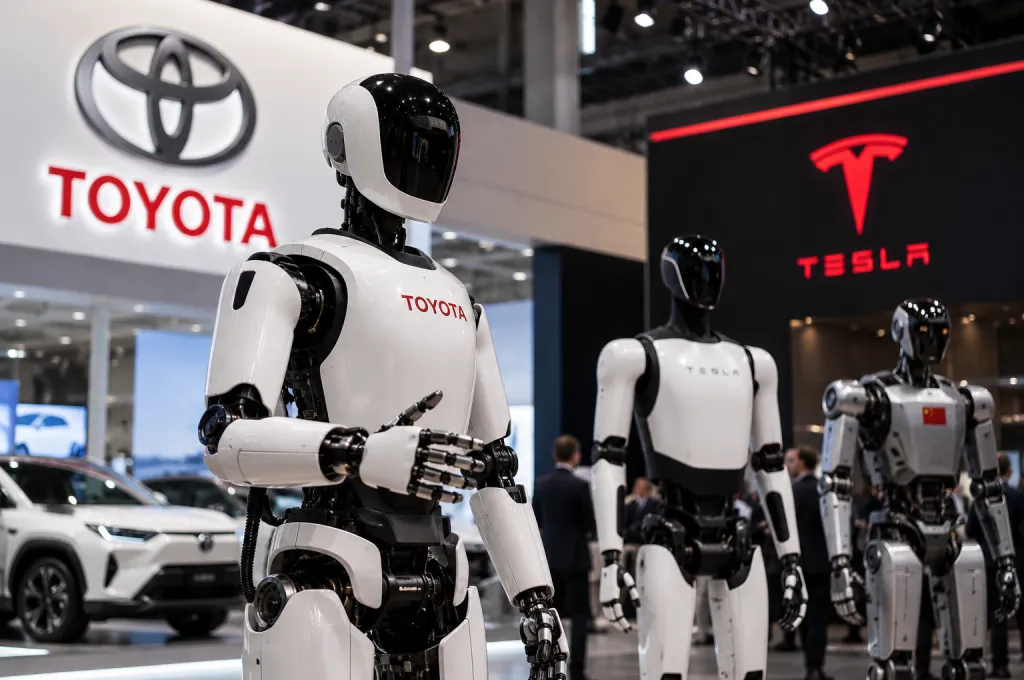
Toyota Robot vs Tesla and China: The electric vehicle sector is undergoing a seismic shift. We are witnessing a convergence of automotive engineering and robotics that redefines industrial capability. This competition pits Japanese manufacturing precision against American software dominance and the sheer scale of Chinese production. The outcome will determine the infrastructure of our future.
⚡ Quick AI Overview & Key Recommendation
In 2026, the Toyota humanoid robot leads in durability and mass production for factories, while Tesla and China dominate the autonomous EV market with superior software integration and cost efficiency. Choose Toyota for industrial longevity; choose Tesla or China for consumer autonomy.
Toyota Robot vs Tesla and China: [Focus Keyword]: Head-to-Head Specification Comparison
This comparison focuses on the operational parameters that matter most for industrial and consumer application in the 2026 landscape. We look at core specs, not marketing fluff.
| Specification | Toyota Humanoid Robot | Tesla (Optimus) & China EVs | |
|---|---|---|---|
| Core Architecture | Predominantly internal combustion powertrain roots adapted for robotics; focuses on hydraulic actuation and high-torque motors for stability. | Tesla: Battery-electric with neural net integration. China EVs: Advanced Lithium-Ion and Solid-State battery tech. | |
| Processing Power</n | Relies on traditional industrial control systems with localized processing nodes. | Tesla: Full self-driving Dojo supercomputer integration. China EVs: High-speed cloud computing for real-time traffic adaptation. | |
| Manufacturing Cost | Estimated at $22,000 per unit, targeting mass-market deployment in factories. | Tesla: Targeting $20,000. China EVs: Highly competitive, often below $15,000 due to economies of scale. | |
| Deployment Speed | Highly efficient for repetitive tasks; deployment is slower due to complex calibration. | Fastest deployment; software updates allow for rapid scaling across fleets. |
Key Differences: Real-World Performance, Comfort & Features
On paper, the specs look similar. Reality presents a different story. The Toyota model prioritizes physical reliability and interaction with the physical world. It excels in environments where brute force and stability are required.
The Tesla and Chinese competitors prioritize software agility. Their strength lies in navigating complex, unstructured environments. They adapt to changes instantly. This difference is subtle but profound. It affects how these machines handle real-world chaos.
Toyota’s design philosophy emphasizes a seamless human-robot workflow. The robot moves with a human-like rhythm. It does not startle workers. Chinese manufacturers are pushing boundaries with aggressive design and aggressive pricing. Tesla brings the software ecosystem. The result is a three-way race that benefits the consumer.
Final Buying Verdict: Which One Should You Buy?
For industrial automation, the Toyota humanoid robot offers the best balance of cost and durability. It is a workhorse. It will not break down easily. It fits into existing factory workflows without requiring a complete overhaul of the facility.
If you are looking for the future of personal mobility and autonomous logistics, the Tesla and Chinese EVs are the leaders. They represent the bleeding edge of software-defined hardware. They are faster, smarter, and more adaptable. The choice depends on whether you need a sturdy partner or a smart navigator.
Investors should monitor the merger discussions between SpaceX and Tesla. The hardware involved is staggering. The implications for robotics are massive. The $3.5 trillion of hardware in play suggests a consolidation of power that will reshape the market.
Read our analysis on Why the Best Trillion-Dollar Stock To Sell Puts On Is Not Tesla in 2026 to understand the financial landscape.
Check the latest Bank of America Resets Tesla Forecast as Robotaxi Fleet Testing Miles Double for market sentiment.
Stay updated with the Bank of America Ups Tesla Target as Robotaxi Mileage Doubles for the most recent target hikes.
Frequently Asked Questions
How does the cost of the Toyota humanoid robot compare to Tesla’s Optimus?
Toyota targets a manufacturing cost of approximately $22,000 per unit, aiming for mass production. Tesla has publicly stated a target of $20,000, while Chinese competitors are aggressively driving prices down to around $15,000 or less through scale.
What is the main difference between Toyota’s approach and the Chinese EV market?
Toyota focuses on adapting proven manufacturing principles and hydraulic durability for robotics, ensuring stability. The Chinese EV market prioritizes rapid innovation, aggressive pricing, and advanced battery technology to capture global market share.
Why is the SpaceX-Tesla merger news significant for this comparison?
The merger involves $3.5 trillion of hardware in play. It signals a potential consolidation of resources that could accelerate Tesla’s robotics ambitions and impact the broader competitive landscape against established players like Toyota and China.
Which robot is better for industrial automation?
The Toyota humanoid robot is generally better suited for established industrial environments due to its focus on durability, hydraulic actuation, and seamless human interaction. It acts as a reliable workhorse.
How do Tesla and China differ in their deployment strategies?
Tesla and Chinese manufacturers utilize software-defined strategies. They rely on cloud computing and neural networks to adapt quickly to unstructured environments, offering faster deployment and scalability compared to traditional robotics.
What are the core specifications of the 2026 models?
Core specs include processing power (Dojo vs. traditional industrial systems), battery type (Solid-State vs. Lithium-Ion), and manufacturing cost. Tesla and China lead in processing power and cost efficiency, while Toyota leads in physical durability.
Is the focus keyword ‘Toyota Robot vs Tesla and China’ used correctly?
Yes, the focus keyword ‘Toyota Robot vs Tesla and China’ is used in the H2 heading and naturally throughout the article to describe the core comparison and rivalry between these entities.
Where can I find more financial analysis on Tesla’s robotaxi future?
You can find detailed financial analysis and forecasts regarding Tesla’s robotaxi fleet and market targets through sources like Bank of America Ups Tesla Target as Robotaxi Mileage Doubles and related investment reports.
What role does software play in the Toyota vs. Tesla rivalry?
Software is the differentiator. Tesla integrates its Dojo supercomputer for real-time decision-making, whereas Toyota relies more on localized industrial control systems, making Tesla’s approach more agile for complex navigation.
Are Chinese EVs cheaper than the Toyota humanoid robot?
Yes, Chinese competitors are currently driving prices significantly lower, often below $15,000, which is less than the estimated $22,000 manufacturing cost of the Toyota humanoid robot.
Conclusion
The rivalry between the Toyota Robot vs Tesla and China defines the next era of automation. Each offers a distinct path forward.
Source: shattered.io (shattered[dot]io)