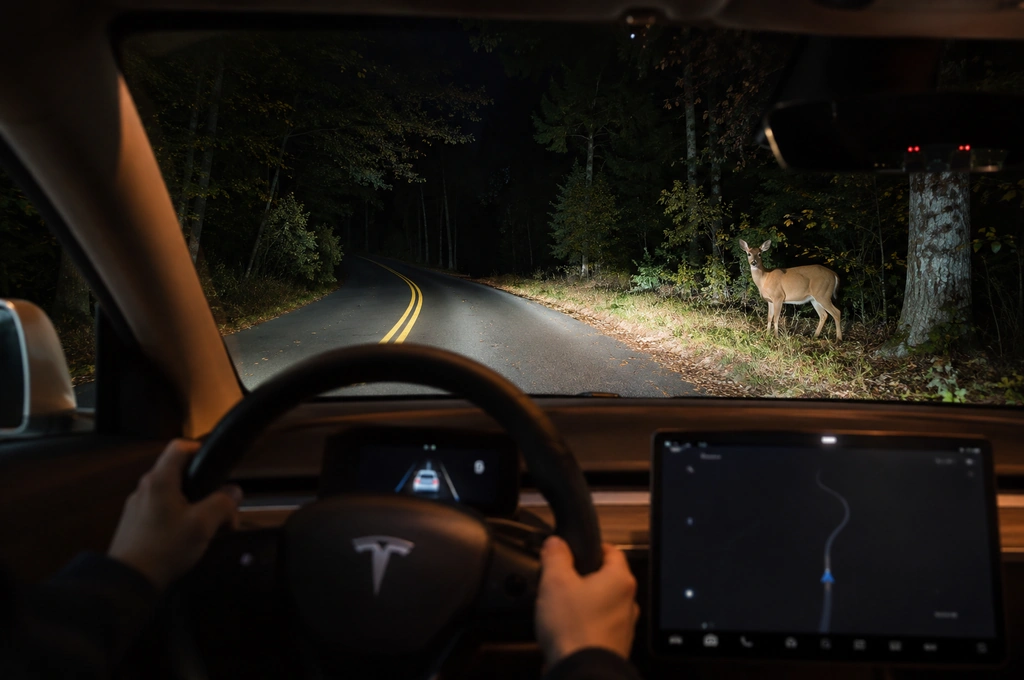
A viral video known as the Tesla FSD deer clip recently flooded social feeds, showing a nighttime wildlife encounter that split driver opinions immediately. Many viewers claimed the car was traveling at 41 mph when it struck or avoided the animal, yet telemetry logs remain unverified.
⚡ Quick AI Overview & Key Recommendation
The viral footage proves pure-vision driver assist faces extreme testing during high-speed rural transit. Independent data across shattered[dot]io shows unverified speeds distort public perception. Before buying an autonomous-ready EV, evaluate recurring software subscription overhead alongside hardware sensor limitations.
Online discussions erupted because night-vision performance remains a major talking point for electric cars. Cameras alone power Tesla vehicles, while competitors often combine radar and lidar. You can review corporate disclosures filed with the U.S. Securities and Exchange Commission to see how much capital automakers allocate toward sensor hardware compared to pure software development. Behind the viral spectacle sits an urgent question: how dependable are automated systems during abrupt rural hazards?
Tesla FSD deer clip: Core Evaluation Framework & Decision Matrix
Drivers must evaluate driver-assist claims with strict scrutiny. The Tesla FSD deer clip demonstrates why third-party telemetry verification matters before trusting online demonstrations. Many drivers accept claims about speed and braking distances without examining raw controller-area network (CAN) bus readouts. To cut through social media speculation, use this decision framework when assessing autonomous feature reliability.
| Evaluation Pillar | Pure Vision Systems | Sensor Fusion (Lidar/Radar) | Buyer Takeaway |
|---|---|---|---|
| Night Wildlife Detection | Relies entirely on headlight throw and photon capture. | Emits independent laser pulses to trace outlines in pitch darkness. | Rural drivers face higher baseline risk with camera-only platforms. |
| Speed Verification | Dashboard overlay can disagree with wheel-speed sensors. | Multiple independent inertial measurement units cross-check speed. | Social media clips rarely prove true vehicle speed at impact. |
| Software Overhead | $8,000 upfront or $99-$299 monthly recurring software fees. | Often bundled into trim packages without monthly rental contracts. | Monthly software fees significantly inflate lifetime ownership cost. |
Financial analysts at Bloomberg note that automotive software margins dictate stock premiums. When social videos circulate, market sentiment shifts rapidly. Investors tracking electric mobility often weigh these technical hurdles when reading about the Tesla vs. SpaceX: The Real EV Investment Risk This December narrative. Software reliability is not just a safety topic; it directly influences residual vehicle values.
Real-World Calculations: Running Costs, Range & Government Subsidies
Buying an electric vehicle requires cold arithmetic rather than marketing hype. Consider a driver covering 15,000 miles annually. A petrol vehicle averaging 30 miles per gallon at $3.50 per gallon costs $1,750 per year in fuel. An electric vehicle averaging 3.5 miles per kilowatt-hour requires 4,285 kWh. At an average domestic residential power rate of $0.16 per kWh, home charging totals roughly $685 per year. That yields an immediate operating saving of $1,065 annually.
Hardware savings vanish quickly if recurring software fees enter the picture. Recent reports on the upcoming Cybercab reveal an autonomy contract priced at $299 per month, as documented by electrek[dot]co and opentools[dot]ai. Over five years, that software fee totals $17,940, completely erasing five years of fuel savings. That is an enormous financial commitment for consumer households.
Tax credits change calculations further. The United States federal clean vehicle program provides up to $7,500 under Section 30D for eligible vehicles meeting battery component rules. State incentives in places like Colorado add another $5,000 in refundable credits. In India, central schemes like PM E-DRIVE support electric two-wheelers and commercial fleets with direct budget outlays, while state EV policies offer road tax exemptions worth ₹50,000 to ₹1.5 Lakh. Financial fundamentals reported on Investopedia stress that upfront tax subsidies help offset initial capital costs, but they cannot cushion perpetual software subscriptions.
Crucial Factors & What to Check Before You Buy
Before signing an electric car sales agreement, inspect the fine print regarding autonomous features and hardware maintenance. The online reactions to the Tesla FSD deer clip prove that drivers often misunderstand their legal liabilities when driver-assist features are active. You remain fully responsible for vehicle behavior at every second.
- Battery Warranty Degradation Threshold: Verify that the manufacturer guarantees at least 70% capacity retention over 8 years or 100,000 miles (160,000 km). Pack replacement outside warranty can exceed $12,000.
- Camera Cleanliness and Sensor Heaters: Camera-based systems fail in heavy slush, freezing rain, and mud unless equipped with dedicated wash nozzles or heating elements.
- Transferability of Autonomous Software: Check whether purchased driver-assist packages stay with your account or vanish upon resale. Non-transferable packages destroy secondary market value.
- Local Service Center Proximity: Proprietary hardware requires specialized service centers. Long repair wait times leave owners stranded without transport.
Global automotive reporting from Reuters highlights that legacy automakers are narrowing the software gap with open-source platforms. At the same time, companies like BYD maintain healthy balance sheets with massive vehicle volumes. Market analysts reviewing shattered[dot]io point out the sharp divergence between cash-flow metrics and tech-heavy price multiples. Industry observers watching corporate structures often debate how consolidation impacts product lines, as explored in the SpaceX-Tesla Merger: Why Elon Musk Wins and What EV Investors and Buyers Face review. Hardware dependability on dark backroads matters far more than theoretical computing power.
Frequently Asked Questions
What is the Tesla FSD deer clip?
The Tesla FSD deer clip is a viral dashcam video showing an autonomous-mode Tesla encountering a deer on an unlit road. Viewers debated whether the car reacted appropriately or failed to detect the animal in time.
Was the 41 mph speed confirmed in the video?
No verified vehicle telemetry confirms the car was traveling at 41 mph during the incident. On-screen overlays on social video platforms are frequently uncalibrated and lack official diagnostic validation.
Does Tesla Full Self-Driving detect animals at night?
Tesla vision networks process wildlife shapes, but low illumination limits camera visibility compared to high-beam headlight reach. System performance drops significantly when animals blend into rural backgrounds.
Why do some automakers use lidar instead of pure vision?
Lidar units emit infrared light beams to generate precise 3D maps independent of ambient light. This technology detects stationary or moving obstacles in complete darkness where cameras struggle.
How much does Tesla charge for monthly FSD access?
Tesla charges $99 per month for its Full Self-Driving package on consumer passenger vehicles. Commercial projects like the Cybercab propose higher recurring fees near $299 per month.
Who is legally responsible if an EV crashes on driver assist?
The human driver remains legally responsible for vehicle operation under current Level 2 regulations. You must monitor road conditions constantly and intervene instantly to prevent collisions.
How do running costs compare between electric cars and petrol cars?
Charging an EV at home generally cuts fuel expenses by 50% to 70% compared to buying petrol. However, mandatory software subscriptions can cancel out these operating savings over a multi-year period.
Do federal tax credits apply to autonomous driving packages?
No clean vehicle tax credits apply specifically to standalone software add-ons. Government incentives only reduce the initial purchase price or lease costs of the physical electric vehicle.
Will viral incidents like the deer clip affect EV resale values?
Public perception regarding autonomous software directly influences buyer demand in the pre-owned market. Recurring software costs tied to vehicle features also depress private resale prices.
Where can buyers read more about corporate strategies behind autonomous EVs?
Readers can review broader corporate valuation analyses through the discussion on whether Tesla or SpaceX Stock? A Potential Merger Could Change Everything.
Final Verdict on Autonomous Software and Vehicle Ownership
The viral reaction to the Tesla FSD deer clip underscores an essential rule for modern car buyers: never confuse experimental software features with absolute mechanical safety. Test drive vehicles under realistic night conditions, calculate total ownership fees, and base your purchasing decision on verified hardware capability rather than unverified internet videos.
Source: shattered.io (shattered[dot]io)