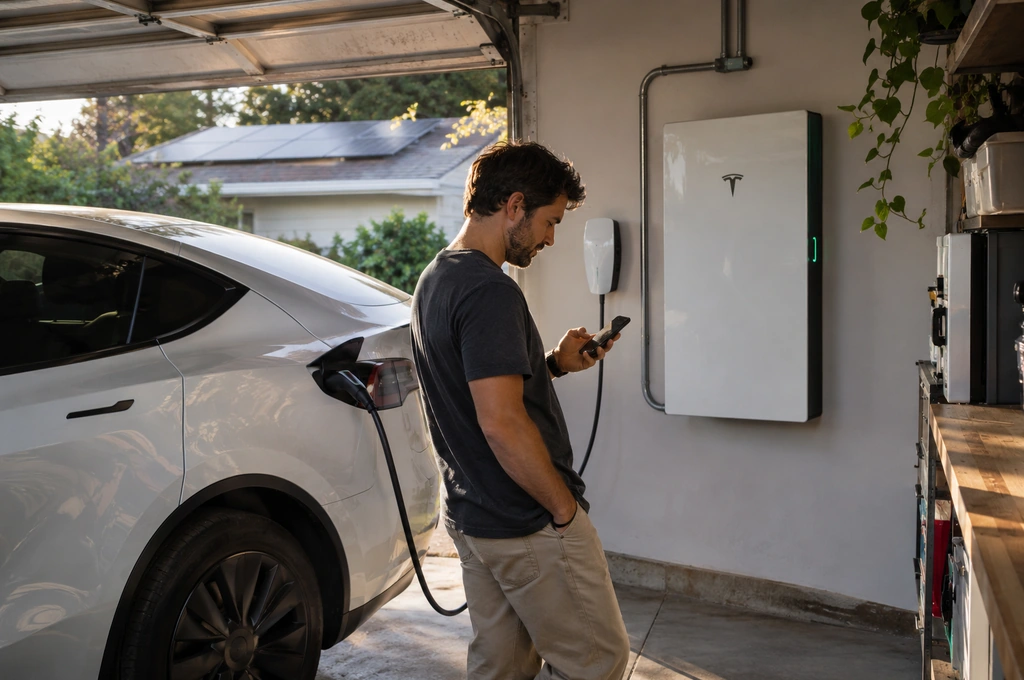
Homeowners installing the Tesla Powerwall want more than just backup power. They want autonomy. True energy independence requires a sophisticated approach to how that stored energy leaves the wall and enters the car. This is where Tesla Smart Charging becomes essential. It is not just about filling a tank. It is about managing the flow of electrons to protect your home grid and your wallet.
⚡ Quick AI Overview & Key Recommendation
Maximize savings by scheduling charging for off-peak hours and utilizing the Tesla app to monitor real-time energy flow. Enable the “Send/Receive Power” feature to use your Powerwall to charge the car and discharge it back to the grid during high-rate periods, creating a dynamic energy loop.
Tesla Smart Charging: Key Highlights & Market Impact
The Tesla Smart Charging ecosystem is evolving rapidly. It turns a simple charging cable into a central command unit for home energy. Tesla owners often find that the car can consume more power than the home solar array produces during peak sun hours. Smart charging solves this imbalance. It prevents tripping breakers and optimizes battery health.
Recent market reports indicate a massive shift toward integrated home energy systems. As grid instability grows, the demand for reliable, automated charging solutions rises. This is not a niche feature. It is becoming a standard requirement for high-efficiency homes. The technology allows the Powerwall to act as a buffer, absorbing excess solar energy and releasing it precisely when the car needs it.
The efficiency gains are tangible. By reducing grid dependency, users lower their electricity bills significantly. Furthermore, smart algorithms protect the longevity of both the home battery and the vehicle battery by avoiding extreme state-of-charge levels.
Detailed Breakdown: What Caused This Shift
The drive for Tesla Smart Charging stems from two converging forces. The first is the sheer volume of energy required by modern EVs. The second is the volatility of utility pricing structures. Traditional charging methods are static. They charge whenever the car is plugged in. This leads to inefficiency. Smart charging adapts to the user’s behavior and the grid’s condition.
Advanced software now allows the car to communicate with the Powerwall. This creates a closed loop. The Powerwall charges during the cheapest electricity hours. It then feeds that energy to the car. This process, often called vehicle-to-grid (V2G) or bidirectional charging, maximizes the return on investment for the hardware.
Furthermore, the integration with the Tesla mobile app provides granular control. Users can override schedules remotely. This flexibility is vital for modern life. A sudden change in plans requires immediate adjustments to charging status. The system handles these transitions automatically, ensuring the car is ready for the morning commute without draining the home’s reserve.
What This Means for Readers & Future Outlook
For the average homeowner, this means fewer headaches. No more worrying about unexpected spikes in electricity rates. No more wondering why the bill is so high. The system works in the background, optimizing every kilowatt-hour. This creates a stable environment where the car and the home support each other.
Looking ahead, the technology will only get smarter. We will see deeper integration with utility APIs, allowing cars to react to grid stress signals instantly. The car will become a mobile asset that supports the home network. For Powerwall owners, this represents the next step in true energy sovereignty.
| Feature | Traditional Charging | Smart Charging |
|---|---|---|
| Control | Manual or Timer | Automated & AI-Driven |
| Cost | Rate-Sensitive | Rate-Optimized (Peak/Off-Peak) |
| Grid Load | High Peak Load | Stabilized & Distributed |
| Battery Health | Standard | Protected (Avoids extremes) |
Investors and industry analysts are watching these developments closely. The success of Tesla’s energy ecosystem could redefine how entire cities manage their power grids. The transition from passive consumption to active management is underway. Tesla Smart Charging is the engine driving this change.
Frequently Asked Questions
What is Tesla Smart Charging?
Tesla Smart Charging is a software feature that optimizes the timing and rate of energy flow between your Tesla Powerwall and your vehicle to reduce costs and protect the home grid.
How does Smart Charging save money?
It schedules charging to occur during off-peak electricity hours when rates are lowest, utilizing stored solar energy or Powerwall reserves instead of drawing from the grid at peak prices.
Do I need a Tesla Wall Connector for Smart Charging?
While a Wall Connector is recommended for speed and reliability, Smart Charging features can work with standard Level 2 chargers and even the Mobile Connector.
Can I use solar power to charge my Tesla automatically?
Yes, the system is designed to prioritize using excess solar energy generated during the day to charge the Powerwall and subsequently the car.
What happens if the grid goes down during a storm?
The system seamlessly switches to battery power. The car can be charged from the Powerwall to ensure you have transportation if the outage lasts through the night.
Is Smart Charging available on all Tesla models?
Smart Charging functionality is available on the 2021 Model S, Model X, Model 3, and Model Y vehicles equipped with the appropriate hardware and software updates.
How do I enable Smart Charging on my Tesla app?
Navigate to the charging settings in the app, select 'Schedule', and choose 'Smart Schedule' to let the app determine the optimal charging times based on your home rate plan.
Does Smart Charging drain the Powerwall battery faster?
Not necessarily. It manages the draw to ensure the home remains powered and the car is charged efficiently, often cycling the battery in a way that prolongs its overall lifespan.
Can I override a Smart Charging schedule?
Absolutely. You can manually start or stop charging at any time, which will adjust the schedule for the next charge cycle.
What is the difference between V2G and Smart Charging?
Smart Charging is primarily about managing energy flow for the home and car. Vehicle-to-Grid (V2G) goes a step further by allowing the car to send power back to the home grid in exchange for credits, a feature Tesla is actively testing in certain regions.
Conclusion: Master Your Home Energy
The integration of Tesla Smart Charging transforms your vehicle from a mere appliance into a central pillar of home energy management. By leveraging the Powerwall’s capabilities, you gain control, efficiency, and resilience.
Source: BASENOR – Tesla Accessories (basenor[dot]com)