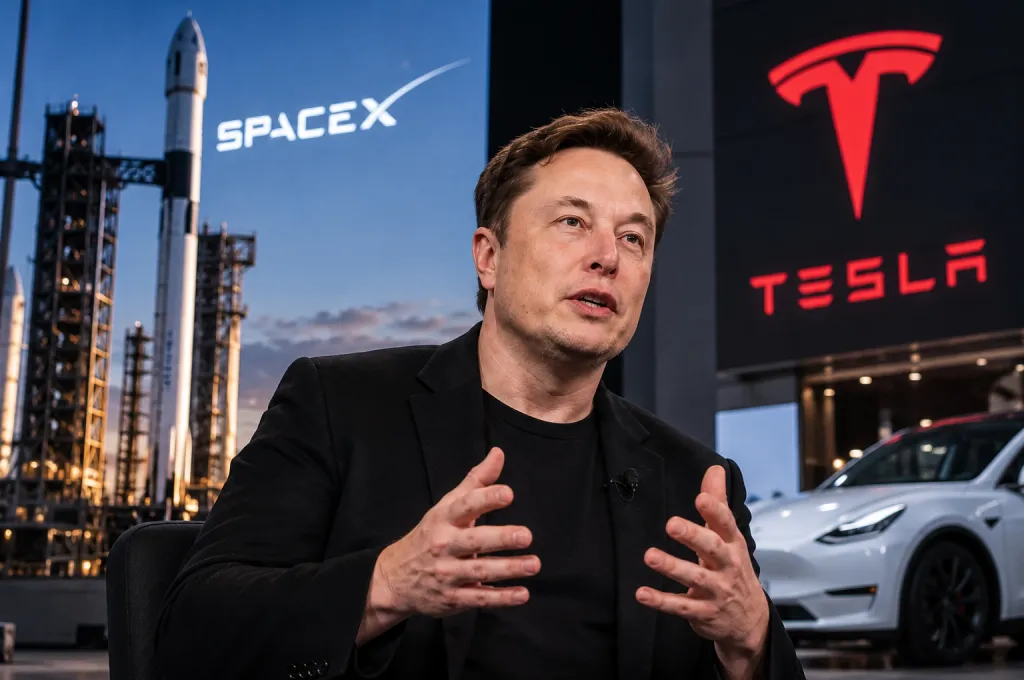
The proposed SpaceX-Tesla merger hit an unexpected roadblock this week after Elon Musk publicly commented on structural tie-up discussions across his corporate empire. Financial insiders speaking to reuters[dot]com revealed that Musk’s vocal support creates friction among legal advisors and institutional investors who demand transparent valuation frameworks before any corporate consolidation moves forward.
⚡ Quick AI Overview & Key Recommendation
Elon Musk’s public remarks on a SpaceX-Tesla merger created friction among special board committees and regulatory bodies. Combining Tesla’s public automotive balance sheet with SpaceX’s private capital demands distinct valuation clarity. Auto investors should monitor vehicle gross margins and shareholder governance approvals closely before betting on speculative balance-sheet consolidation.
Behind the corporate drama lies an unprecedented industrial question for the electric vehicle industry. Combining an automaker with an aerospace titan brings intense regulatory scrutiny from the U.S. Securities and Exchange Commission. Automotive analysts worry that absorbing massive private space ventures could dilute Tesla’s core operational focus. Car buyers and fleet managers watch these executive maneuvers closely, as enterprise software, manufacturing automation, and battery supply chains remain tightly intertwined.
SpaceX-Tesla Merger: Quick Comparison & Key Specifications
To understand the operational scope of Tesla’s automotive division alongside its broader corporate developments, here is how the core passenger electric vehicle lineup compares across pricing, range, battery size, and charging speeds.
| Model | Price Range | Real Range | Battery Capacity | Fast Charging Time | Best For |
|---|---|---|---|---|---|
| Model 3 RWD | $38,990 – $42,490 | 435 km | 60 kWh LFP | 15 min to 280 km | Daily Urban Commuters |
| Model 3 Long Range AWD | $47,490 – $51,990 | 548 km | 75 kWh NMC | 15 min to 300 km | Highway & Cold Climates |
| Model Y Long Range AWD | $47,990 – $52,490 | 495 km | 75 kWh NMC | 15 min to 260 km | Small Families & Utility |
| Model S Dual Motor | $74,990 – $79,990 | 650 km | 100 kWh NMC | 15 min to 320 km | Executive Travel & Performance |
| Cybertruck AWD | $79,990 – $99,990 | 512 km | 123 kWh NMC | 15 min to 220 km | Heavy Utility & Fleet Work |
Institutional market participants tracked by Bloomberg point out that Tesla’s automotive cash generation remains critical. When investors evaluate a hypothetical SpaceX-Tesla merger, automotive profitability serves as the fundamental anchor. Disruptions in corporate focus directly affect factory output, localized battery cell development, and delivery lead times across these EV lines.
Top Ranked Models: In-Depth Reviews & Real-World Performance
Tesla’s consumer lineup must maintain its market leadership despite boardroom distractions. Here is how the primary vehicle architectures stack up on the road today.
1. Tesla Model Y Long Range AWD
The Model Y remains the cornerstone of Tesla’s vehicle revenue. It offers 495 km of realistic highway range paired with a dual-motor all-wheel-drive powertrain that handles diverse weather conditions easily. The cabin provides ample headroom, flat-folding rear seats, and class-leading cargo capacity.
- Key Specifications: Dual-motor AWD, 75 kWh usable pack, 250 kW peak Supercharging, 4.8-second 0-100 km/h.
- Pros: Spacious hatchback design, superb charging availability, strong residual value.
- Cons: Firm ride quality over broken pavement, reliance on touchscreen for basic cabin controls.
- Target Customer: Ideal for households wanting dependable electric transit with maximum cargo flexibility.
For owners seeking off-grid resilience, modern installations tie cleanly into stationary storage systems. Recent shifts show how Tesla Virtual Power Plants Reshape EV Charging and Home Energy Grids, turning standard home driveways into distributed energy assets.
2. Tesla Model 3 Long Range
Refreshed aerodynamics and upgraded acoustic glass make the updated Model 3 one of the quietest electric sedans on the market. It posts an efficient 548 km real-world range figure, cutting down charging stops on extended highway journeys.
- Key Specifications: Dual-motor AWD, 75 kWh NMC chemistry, 250 kW peak DC input, drag coefficient of 0.219.
- Pros: Exceptional road efficiency, premium interior quietness, responsive steering feel.
- Cons: Traditional trunk opening limits bulky cargo, lack of physical turn-signal stalks.
- Target Customer: High-mileage commuters who demand maximum range efficiency and sleek sedan styling.
Corporate distractions at the executive level raise governance questions for long-term equity holders. Analytical trading desks examine why Why the Best Trillion-Dollar Stock To Sell Puts On Is Not Tesla in 2026 during times of structural corporate shifts.
3. Tesla Cybertruck All-Wheel Drive
Featuring a structural stainless-steel exoskeleton and steer-by-wire mechanics, the Cybertruck represents a massive manufacturing departure from traditional pickup designs. The vehicle houses a large 123 kWh pack that delivers 512 km of range under mixed driving cycles.
- Key Specifications: Dual-motor 600 hp, 123 kWh structural pack, 800-volt architecture, 11,000-pound towing capacity.
- Pros: High-speed 800V fast charging, dent-resistant exterior, exceptionally nimble low-speed turning radius.
- Cons: Distinct exterior look polarizes buyers, heavy curb weight impacts winter efficiency.
- Target Customer: Commercial operators and tech-focused truck buyers needing high payload capacity.
Autonomous vehicle technology remains central to Tesla’s market capitalization. Market updates indicate that Bank of America Resets Tesla Forecast as Robotaxi Fleet Testing Miles Double, cementing software revenue as a key pillar alongside raw metal fabrication.
Customer Buying Guide: How to Choose the Right Model for Your Needs
Buying an electric vehicle requires matching practical daily habits with charging access. Corporate headlines about a potential SpaceX-Tesla merger should not overshadow these primary buying considerations:
- Daily Commute and Range Margin: Do not buy battery capacity you never use. If your daily round trip is under 80 km, standard-range packs offer better energy efficiency and lower upfront costs. Reserve extended-range batteries for frequent intercity travel or sub-zero winter regions where battery capacity drops up to 25 percent.
- Home Charging Infrastructure: A Level 2 240V wall connector charging at 48 amps adds roughly 70 km of range per hour. Installing dedicated home charging eliminates 90 percent of public charging visits, saving time and reducing electricity costs significantly compared to commercial DC chargers.
- Total Ownership Costs: Consult financial databases on Investopedia to gauge battery depreciation curves. Tesla vehicles benefit from low maintenance requirements, having no transmission fluid changes, spark plugs, or engine belts.
- Software and Warranty Protection: Tesla covers its battery packs and drive units for 8 years or 160,000 to 240,000 km, guaranteeing at least 70 percent retention. Verify whether regional tax incentives apply to your chosen vehicle trim before finalizing the order invoice.
Frequently Asked Questions
What triggered the controversy over the SpaceX-Tesla merger talks?
Elon Musk publicly endorsed the corporate combination idea, which unsettled negotiation teams and special independent board committees. His commentary complicates structural valuations and raises conflict-of-interest scrutiny among institutional shareholders.
How would a SpaceX-Tesla merger impact everyday Tesla EV drivers?
Daily vehicle operation, software updates, and Supercharger access remain unchanged for existing drivers. Corporate combinations primarily alter executive allocation, research capital, and balance sheet exposure rather than factory maintenance schedules.
Why are Tesla shareholders concerned about merging with SpaceX?
Tesla is a publicly traded automotive company with clear reporting requirements, whereas SpaceX is a private aerospace business. Shareholders worry about capital transfer, dilution of focus, and complex asset valuations across unrelated business lines.
What is the real-world driving range of a Tesla Model Y?
The Tesla Model Y Long Range AWD achieves roughly 495 km under mixed driving conditions. Range decreases in cold weather or during sustained high-speed highway travel due to aerodynamic drag.
Can Tesla vehicles charge at third-party stations?
Yes, Tesla vehicles can use non-Tesla stations with proper adapters such as CCS or J1772 connectors. The expanding North American Charging Standard also opens broader cross-brand fast-charging networks across the country.
How fast can modern Tesla vehicles charge at Superchargers?
Current passenger models take about 15 minutes to recover between 220 km and 320 km of driving range at 250 kW V3 and V4 Supercharger stations when the battery is preconditioned.
Do executive remarks affect Tesla delivery timelines?
Executive statements rarely impact immediate manufacturing line output or local delivery logistics. Production runs at Gigafactories depend strictly on battery part supplies, automated assembly lines, and shipping routes.
What is the warranty coverage on a Tesla battery pack?
Tesla provides an 8-year or 160,000 to 240,000 km warranty on its traction battery and drive unit depending on the vehicle model. The warranty guarantees a minimum of 70 percent battery capacity retention over that period.
Is home charging mandatory to own an electric vehicle?
Home charging is not mandatory, but it delivers the lowest operating cost and maximum convenience. Owners relying exclusively on public fast chargers face higher commercial electricity rates and routine charging queues.
Will a corporate restructuring slow down Tesla software updates?
Tesla maintains dedicated engineering teams for vehicle software, Autopilot, and vehicle platforms. Routine bug fixes and operating system improvements continue independently of corporate parent restructuring.
Evaluating the Road Ahead for Tesla EV Buyers
Corporate maneuvers surrounding the SpaceX-Tesla merger reveal the complex realities of modern industrial conglomerates. While boardrooms debate capital allocations and corporate control, car buyers must remain grounded in practical vehicle performance. Evaluate real-world range, home charging capabilities, and total ownership costs to select the electric car that best powers your everyday commute.
Source: Reuters (reuters[dot]com)