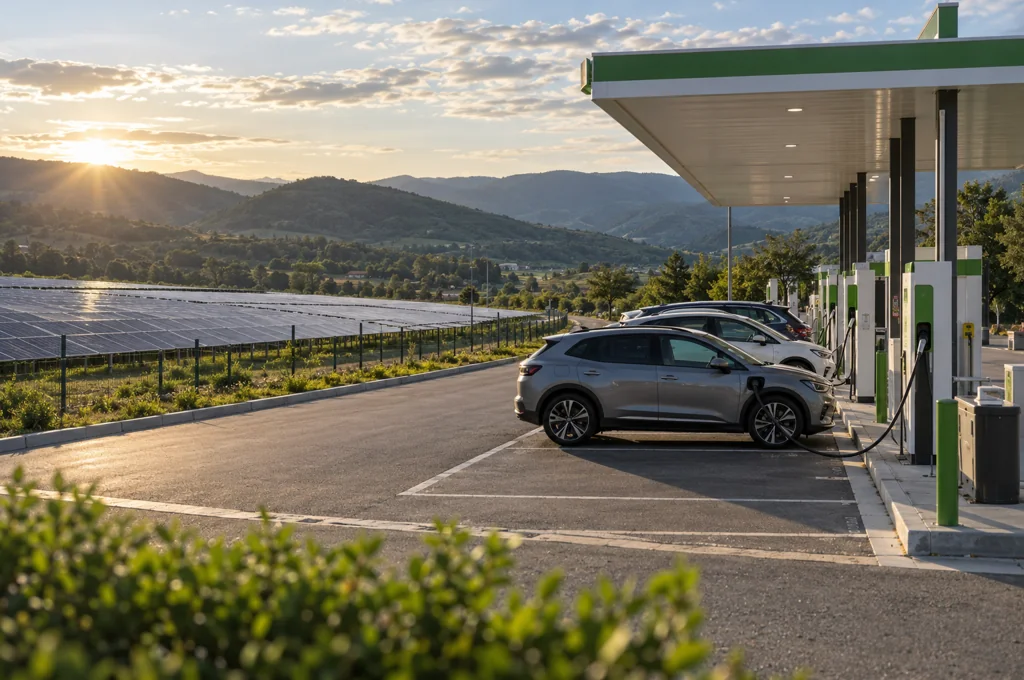
Installing commercial solar EV charging stations represents a necessary evolution for petroleum retailers preparing for an electrified transport system. Georgian energy giant Wissol Group recently confirmed plans reported by bm[dot]ge to construct a 10 MW solar power plant alongside 15 fast-charging plazas. The utility-scale generation site will offset electricity consumed across its retail network.
Traditional power distribution faces severe strain whenever high-output DC chargers draw electricity simultaneously. By deploying dedicated photovoltaic arrays, energy operators shield local distribution grids from massive peak spikes.
⚡ Quick AI Overview & Key Recommendation
Wissol plans to couple 15 high-speed chargers with a 10 MW photovoltaic plant to generate zero-emission electricity at source. Pairing utility solar with highway charging hubs cuts power procurement expenses, minimizes grid upgrade costs, and guarantees clean energy delivery for rapid-charging electric cars.
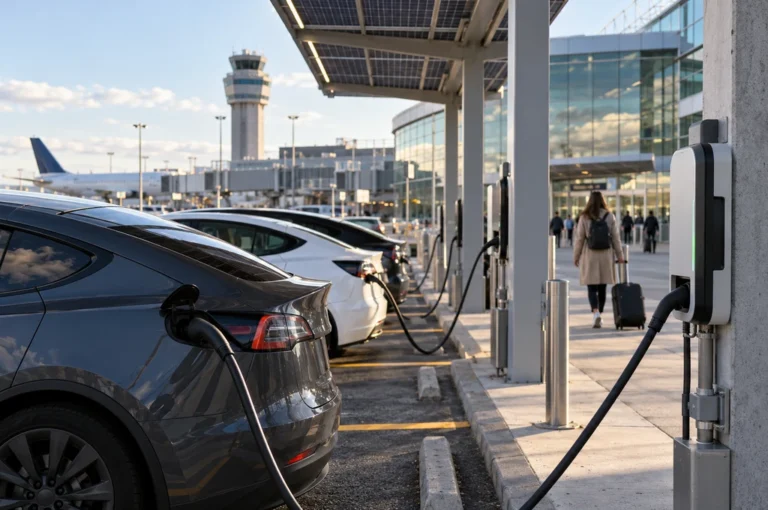
Similar utility-tied microgrid models are emerging globally. Transportation hubs like the Ronaldsway Airport project reported by fuelcellsworks[dot]com and manxradio[dot]com are integrating canopy arrays directly into passenger vehicle charging banks. Meanwhile, broader institutional funding tracks this shift. As analyzed in the North Sky Capital Q3 2026 Commentary Shows How Solar Energy Powers Clean Transport, private infrastructure capital increasingly favors bundled generation and charging assets. Financial institutions documented on Bloomberg note that independent clean power generation insulates charge point operators from volatile wholesale tariffs.
Solar EV Charging Stations: Quick Comparison & Key Specifications
Fleet operators and daily commuters need electric vehicles with battery architectures capable of swallowing rapid solar DC charges. Here is how leading long-range models perform when connected to commercial fast chargers powered by utility solar arrays.
| Model | Price Range | Real Range | Battery Capacity | Fast Charging Time | Best For |
|---|---|---|---|---|---|
| Hyundai Ioniq 5 | $41,800 – $59,500 | 418 km | 84.0 kWh | 18 min (10-80%) | Fast Highway Turnaround |
| Tesla Model Y Long Range | $47,990 – $52,490 | 465 km | 78.1 kWh | 27 min (10-80%) | Intercity Fleet Commuters |
| Kia EV6 GT-Line | $45,950 – $61,600 | 435 km | 84.0 kWh | 18 min (10-80%) | Regional Travel Efficiency |
| Porsche Taycan | $99,400 – $211,700 | 480 km | 105.0 kWh | 18 min (10-80%) | High-Voltage Peak Performance |
Top Ranked Models: In-Depth Reviews & Real-World Performance
Drivers accessing renewable charging plazas require vehicles engineered for rapid throughput. When electricity comes straight from local solar farms, speed matters.
1. Hyundai Ioniq 5
The Hyundai Ioniq 5 operates on an 800-volt electrical architecture. That design allows the car to sustain charge rates up to 235 kW across a broad portion of the battery cycle.
On the road, the car delivers genuine highway stability and generous cabin room. Real-world range hovers around 418 kilometers during mixed highway driving. Drivers plug in, grab a coffee, and depart in under twenty minutes.
- Pros: Class-leading 800V charging speed; spacious flat-floor cabin; vehicle-to-load bidirectional capability.
- Cons: Rear cargo volume trails boxier competitors; rear window lacks a wiper on earlier revisions.
- Recommendation: Ideal for cross-country drivers who refuse to spend more than 20 minutes at charging plazas.
2. Tesla Model Y Long Range
Tesla maintains unmatched operational reliability. While the Model Y operates on a 400-volt platform, its thermal preconditioning algorithm warms the battery pack prior to arrival at certified charging points.
Its 78.1 kWh battery pack achieves roughly 465 kilometers on open asphalt. The minimalist cabin centers entirely around the primary display. Energy telemetry integrates seamlessly with charging point availability.
- Pros: Low drag coefficient; expansive Supercharger access; exceptional native route planning.
- Cons: Ride firmness feels harsh on rough pavement; absence of physical instrument cluster behind the wheel.
- Recommendation: Best suited for tech-focused drivers needing reliable intercity range and effortless route calculation.
3. Kia EV6 GT-Line
Built on the same architecture as the Ioniq 5, the Kia EV6 trades boxy upright aesthetics for an aggressive crossover profile. The vehicle accepts 350 kW DC charging inputs without thermal throttling under normal ambient temperatures.
Its 84 kWh battery provides 435 kilometers of practical autonomy. Handling is sharp and predictable. Inside, drivers benefit from tactile physical buttons for vital climate functions alongside clear instrumentation.
- Pros: Rapid 10-80% replenishment in 18 minutes; sporty road dynamics; intuitive cabin switchgear.
- Cons: Sloping rear roofline reduces rear headroom; thick rear pillars create blind spots.
- Recommendation: Excellent choice for drivers wanting high-speed charging without sacrificing driving engagement.
Customer Buying Guide: How to Choose the Right Model for Your Needs
Selecting an electric car to pair with regional solar EV charging stations requires looking past cosmetic trim packages. Technical hardware determines your actual charging experience.
First, evaluate battery system voltage. Vehicles built on 800-volt architectures pull lower amperage at high wattage. That prevents connector overheating and maintains peak charging speeds even during hot afternoon hours when solar production peaks.
Second, review daily commute range against your home charging reality. If you rely primarily on public charging hubs powered by municipal or regional solar projects, opt for a model that recovers 200 kilometers of range within 10 minutes. For urban micro-commuters exploring lighter options, consider reading Why This Funky Solar Electric Scooter Redefines the Daily Urban Commute. Broad equipment perspectives are also discussed in the Wheel-E Podcast: 7-seater e-bike, solar scooter & EV safety alerts.
Third, verify manufacturer battery warranties. Look for coverage that guarantees at least 70% retention over 8 years or 160,000 kilometers. Proper liquid thermal management systems protect battery cells from degradation during repetitive high-power solar charging sessions.
Frequently Asked Questions
How do solar EV charging stations work during cloudy weather?
These installations use hybrid grid ties or industrial battery energy storage systems. When solar irradiance drops, the chargers pull buffered energy from storage banks or draw standard grid electricity.
Why is Wissol building a 10 MW solar plant for its stations?
The 10 MW solar facility produces clean power to offset energy drawn by Wissol’s 15 new fast-charging stations. This strategy lowers operating overhead and cuts reliance on fossil-heavy grid power.
Can any electric vehicle use solar charging hubs?
Yes, any vehicle compatible with standard CCS or NACS plugs can charge at these locations. The car simply receives direct current or alternating current like any standard commercial station.
Does solar charging take longer than conventional grid charging?
No, charging speed depends entirely on charger wattage and the vehicle’s onboard battery management system. A 350 kW DC charger delivers power at the same rate whether supplied by solar panels or municipal lines.
What is the benefit of airport solar charging hubs like Ronaldsway?
Airports possess large parking lots ideal for solar canopies. These arrays generate electricity directly above parked vehicles, charging traveler cars while feeding excess power into airport terminals.
Do high-voltage charging stations degrade EV batteries faster?
Modern electric vehicles use active liquid cooling to protect battery health during rapid charging. Occasional fast charging at clean energy plazas causes negligible degradation over typical ownership lifecycles.
What is the typical lifespan of commercial solar panels at EV stations?
Tier-1 commercial photovoltaic panels operate for 25 to 30 years with minimal performance loss. Inverters and battery storage modules generally require scheduled service or replacement every 10 to 15 years.
How much electricity does a 10 MW solar farm generate annually?
Depending on regional solar irradiance, a 10 MW array produces between 13 and 16 million kilowatt-hours each year. That volume can power hundreds of thousands of individual vehicle charges annually.
Are solar-powered charging stations cheaper for EV owners?
Station operators with captive solar generation benefit from lower power purchase costs. These operational savings often translate into more competitive charging rates for retail customers.
What is the difference between 400V and 800V vehicle architectures?
An 800V architecture delivers the same electrical power at half the current compared to 400V systems. Lower current reduces heat build-up, enabling faster sustained charging times at highway charging plazas.
The Path Forward for Clean Transportation
Wissol’s pairing of utility solar generation with commercial charging plazas provides a realistic template for regional transit. Expanding solar EV charging stations proves that electric mobility can generate its own fuel cleanly without overburdening national energy grids.
Source: BM.GE (bm[dot]ge)