
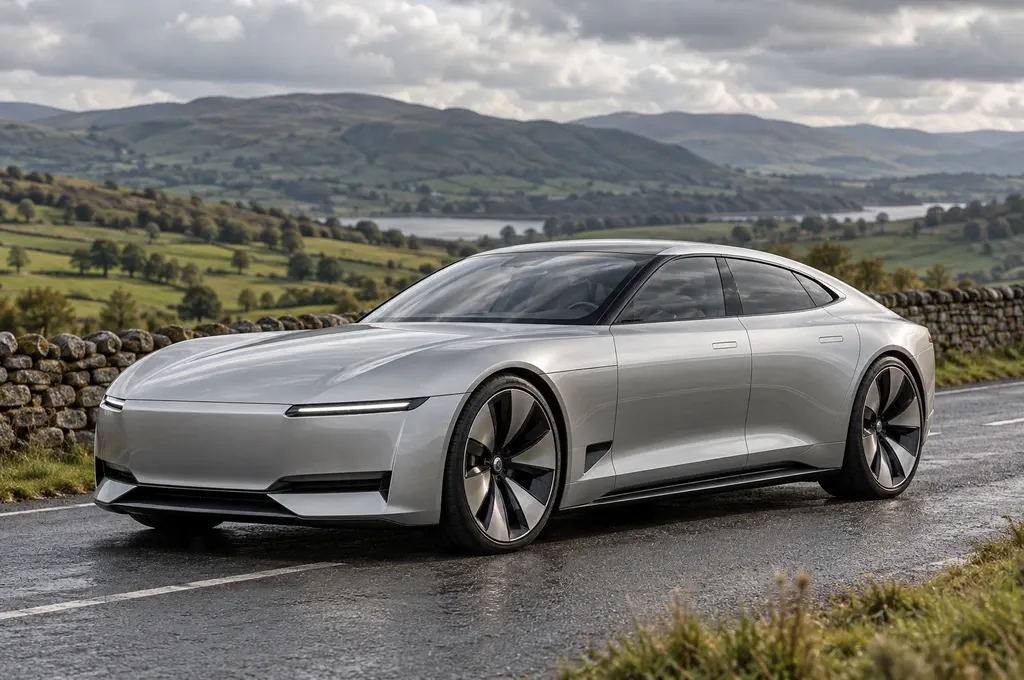
Jaguar’s next electric car represents a clean break from mainstream luxury crossovers, opting instead for an uncompromising four-door grand tourer design. Rather than crowding sister brand Range Rover in the lucrative sport utility market, the British marque wants to challenge Bentley and Porsche in the ultra-luxury tier. The decision resets two decades of chasing volume.
Reports published by autoblog[dot]com reveal that Jaguar designers chose an elongated silhouette with dramatic proportions instead of another upright family hauler. Automotive observers expected another high-riding crossover to replace the aging I-Pace. Jaguar chose differently. Management recognized that building another premium SUV would simply cannibalize Land Rover sales while diluting Jaguar’s performance heritage. According to reporting from cnn[dot]com, the dramatic concept car serves as a high-stakes bet on an assertive design language that discards conventional styling cues.
Jaguar’s Next Electric Car: Key Highlights & Market Impact
Jaguar’s next electric car will carry an estimated starting price above $120,000. It rides on a bespoke electric architecture dubbed JEA (Jaguar Electric Architecture) that shares zero mechanical components with current Land Rover models. JLR intends to build fewer units while extracting vastly higher profit margins per vehicle sold, mirroring modern financial playbooks tracked on Investopedia.
The strategy deliberately isolates Jaguar from the volume EV price war. When executives debuted the new styling direction, public reaction was immediate and polarized. Speaking to theindependent[dot]com, company leadership characterized the intense feedback as ‘very British,’ noting that true luxury products must provoke strong emotions rather than seek broad approval. Here is how the upcoming flagship compares to the existing market:
| Metric | Upcoming Jaguar Electric GT | Current Jaguar I-Pace | Range Rover Electric |
|---|---|---|---|
| Vehicle Style | Low-slung 4-door GT | Compact Crossover | Full-Size Luxury SUV |
| Target Base Price | $120,000+ | $72,000 | $130,000+ |
| Platform | JEA Dedicated EV | D7e Platform | MLA-Flex Platform |
| Market Positioning | Bentley / Porsche Taycan | BMW iX3 / Audi Q8 e-tron | Mercedes-Maybach EQS |
Market dynamics in the luxury sector remain volatile. European automakers face stiff competition and trade debates, as reported by thetelegraph[dot]com regarding prospective tariff actions. Moving upward into six-figure territory protects Jaguar from budget EV competition while carving out clear territorial boundaries inside JLR showrooms.
Detailed Breakdown: What Caused Jaguar’s Radical Design Shift
Why did Jaguar abandon SUVs for this reboot? The explanation comes down to corporate structure and profit discipline. For a decade, Jaguar attempted to compete directly with BMW, Audi, and Mercedes-Benz across entry-level and mid-size categories. That strategy failed. Discounts eroded resale values, and production costs outpaced revenues. Financial analysts on Bloomberg documented how high-volume segments require immense capital expenditure that smaller independent manufacturers struggle to sustain.
Land Rover already dominates the luxury off-road space. Range Rover, Defender, and Discovery generate the overwhelming bulk of JLR profits. If Jaguar launched another large electric SUV, buyers would simply cross-shop it against the Range Rover Sport. That would cannibalize internal profits without capturing new market share. By turning Jaguar’s next electric car into a rakish grand tourer, JLR separates its brands cleanly. Land Rover owns luxury utility; Jaguar claims avant-garde sporting performance.
Technical requirements dictated the rest of the exterior envelope. The JEA platform features an ultra-long wheelbase, short overhangs, and a recessed cabin. Modern battery packs create thick floors, which push rooflines upward. Jaguar engineers avoided the bulbous proportions of many modern sedans by stretching the vehicle length past five meters. The result preserves low frontal area for aerodynamic efficiency on motorways.
What This Means for Readers & Future Outlook
Buyers looking for an electric family crossover from JLR must look exclusively toward Land Rover dealerships. Meanwhile, luxury grand touring enthusiasts gain a genuine alternative to the Porsche Taycan and Audi e-tron GT. As drivers transition to high-voltage vehicles, domestic infrastructure must keep pace. Buyers will need robust charging support, similar to recent regional efforts where On-Street Electric Car Charging to Get Cheaper in Brighton and Hove expands residential access. Additionally, advancements in bidirectional charging detailed in Outage-Ready Electric Cars: How Vehicle-to-Home Power Is Redefining Grid Backup show how high-capacity batteries will protect home energy supplies during power disruptions.
Jaguar’s next electric car marks the start of a three-model portfolio planned through the decade. Every model will share the radical new aesthetic philosophy. The brand halted production of its existing combustion cars to clean out dealer inventory before the electric rebirth begins. Industrial supply chains tracked by Reuters confirm that JLR has already retooled British facilities for the upcoming platform launch.
Frequently Asked Questions
Will Jaguar’s next electric car compete with Range Rover?
No. Jaguar designed its upcoming electric flagship as a low-slung, four-door grand tourer rather than an SUV to prevent internal competition with Range Rover.
What platform does the new electric Jaguar use?
The vehicle rides on the bespoke JEA (Jaguar Electric Architecture) dedicated platform. It shares no mechanical hardware with current Land Rover models.
What is the expected price of Jaguar’s next electric car?
The production model will carry a starting price exceeding $120,000. This places it directly in competition with top-tier grand tourers from Porsche and Bentley.
Why did Jaguar stop selling its previous models?
Jaguar paused production of legacy gasoline models to reset dealer inventories and create a clean boundary before launching its ultra-luxury electric era.
What range can drivers expect from the electric Jaguar?
Jaguar targets an electric driving range of around 430 miles (700 km) on the European WLTP test cycle thanks to its elongated aerodynamic body.
When will customer deliveries begin?
Deliveries for the production grand tourer are scheduled to begin in 2026 following public testing and prototype validation throughout 2025.
How did the public react to the new design concept?
Public response was divided because the design completely departs from classical styling cues. Jaguar executives described the reaction as characteristically British.
Where will the new electric Jaguar be manufactured?
JLR will produce the new electric vehicle at its Solihull manufacturing facility in the United Kingdom following extensive plant upgrades.
Does Jaguar plan to release an electric SUV later?
Jaguar plans two additional electric models following the grand tourer, but none will adopt the traditional boxy proportions of Land Rover SUVs.
Who are the primary competitors for this vehicle?
Primary competitors include the Porsche Taycan, Audi e-tron GT, and high-end luxury electric sedans from Lucid and Mercedes-AMG.
Final Verdict on Jaguar’s Electric Future
By stepping away from the crowded luxury SUV segment, Jaguar makes a calculated gamble. Jaguar’s next electric car abandons volume sales to re-establish the company as an exclusive luxury marque. If the bold styling captures wealthy buyers, JLR will secure two distinct profit engines under one corporate roof.
Source: Autoblog (autoblog[dot]com)