
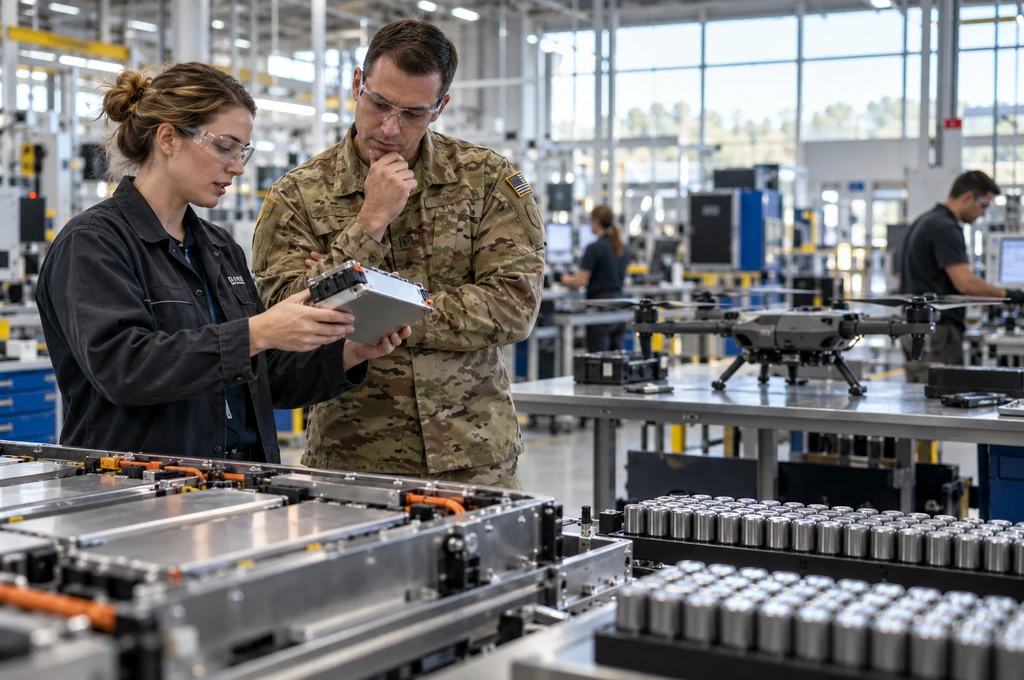
A federal EV battery factory drone grant has officially steered advanced civilian clean-energy manufacturing into defense supply chains. Under a new $75 million award from the Department of Defense, battery manufacturer Amprius Technologies will retrofit a civilian production facility to supply silicon-anode cells for unmanned aerial systems. Military procurement officers want high-energy storage, and commercial electric mobility lines are paying the bill.
Silicon Valley battery developer Amprius Technologies confirmed the award under Title III of the Defense Production Act. The money finances factory equipment to manufacture high-energy-density cells designed for loitering munitions, tactical surveillance aircraft, and autonomous systems. Reporting from electrek[dot]com pointed out the irony immediately: civilian green programs often fight for scrap funding, yet defense coffers remain open.
EV Battery Factory Drone Grant: Key Highlights & Market Impact
Here is why this development matters for automotive investors and defense analysts. Modern drone warfare demands batteries with high energy density by weight. Civilian electric vehicles chase longevity and cycle life, often choosing chemistry setups like those found in LFP vs NMC: which EV battery chemistry should you buy?. Armed drones care mostly about payload weight and flight duration.
The Pentagon needs domestic battery supply. Today, foreign manufacturers control the vast majority of raw materials and finished cell output. By injecting capital through an EV battery factory drone grant, defense planners bypass typical commercial automotive adoption cycles. They buy production capacity directly. Commercial drivers might have to wait while military orders take priority on factory floors.
| Metric | Civilian EV Target | Military Drone Specification |
|---|---|---|
| Energy Density | 250 to 300 Wh/kg | 450+ Wh/kg (Amprius Silicon Anode) |
| Primary Requirement | 10-year cycle longevity, low cost | Maximum flight time, rapid discharge |
| Federal Funding Source | Department of Energy loans | Title III Defense Production Act |
| Supply Chain Focus | Passenger mobility scale | Domestic tactical independence |
Financial records filed with the U.S. Securities and Exchange Commission reveal that Amprius relies heavily on proprietary silicon nanowire anodes. These cells hold significantly more energy per pound than conventional graphite cells. Passenger cars need these cells eventually, but the military will receive them first.
Detailed Breakdown: What Caused The Defense Shift
Conflict in Eastern Europe and the Pacific has completely rewritten warfare doctrine. Small, cheap drones now dominate battlefield airspace. Military planners burned through commercial inventory within months, exposing a massive gap in Western manufacturing capacity. That shortfall prompted emergency spending under defense supply mandates.
Commercial electric vehicle demand also experienced a notable recalibration over the past year. Several automakers slowed expansion schedules, forcing cell suppliers to seek new revenue. As seen when an EV Pioneer Calls for Relaxation of Transition Target, industry leaders know commercial adoption curves are lumpy. For battery producers, defense contracts provide reliable margins, upfront capital, and insulated demand.
Market reporting from Reuters and Bloomberg shows defense procurement taking aggressive steps into battery sovereignty. The military cannot rely on imported lithium packs that might face sudden embargoes. Amprius will use the funds to install automated production lines on American soil, locking down critical manufacturing capability inside domestic borders.
What This Means for Readers & Future Outlook
What does this realignment mean for civilian drivers and everyday car shoppers? First, consumer adoption of advanced silicon-anode cells will face delays. When defense agencies buy out production capacity, automakers remain stuck with older, heavier chemistries. If you plan to assess private vehicles, knowing How to check battery health when buying a used EV remains vital because breakthrough pack designs are heading to military bases instead of family garages.
Second, equity analysts at firms tracked by Investopedia observe a structural shift in dual-use tech investing. Venture capital money previously backed pure clean-tech operations. Today, battery startups pitch dual-use applications to secure government backing. The EV battery factory drone grant shows where public capital actually flows when national security enters the conversation.
Expect more civilian battery plants to add defense lines. It protects factory payrolls during automotive downturns, even if it redirects clean mobility goals toward tactical aerospace hardware.
Frequently Asked Questions
What is the EV battery factory drone grant?
It is a $75 million award from the Department of Defense granted under the Defense Production Act. The funding helps retool commercial battery manufacturing capacity for military unmanned systems.
Which company received the $75 million battery grant?
Amprius Technologies secured the grant. The company specializes in ultra-high-density silicon-anode lithium-ion cells.
Why does the military want civilian EV battery factories?
The Pentagon requires domestic manufacturing lines to build lightweight, high-capacity cells for drones. Repurposing existing domestic facilities saves years of development time.
How do drone batteries differ from electric car batteries?
Drone batteries prioritize high energy density per pound to stay airborne longer. Car batteries focus on lower cost, thermal stability, and thousands of recharge cycles.
Will this defense contract slow down electric car development?
It redirects cutting-edge silicon anode supply away from passenger vehicles toward defense hardware. Mainstream electric vehicles will continue using standard graphite and LFP chemistry.
Where is the Amprius battery factory located?
Amprius operates manufacturing facilities in Colorado and California. The federal funds assist in scaling automated commercial-scale production inside the United States.
What law authorized this battery manufacturing grant?
The award was granted under Title III of the Defense Production Act. The statute gives the executive branch power to finance domestic industrial capacity for national defense.
Can silicon anode batteries be used in consumer drones?
Yes, but they are currently too expensive for mass-market toys. Military contracts absorb the high early manufacturing costs before prices fall for civilian consumers.
Does this contract include drone airframes or just cells?
The grant funds factory equipment and manufacturing capacity exclusively for battery cells and packs. Other defense contractors will integrate the cells into active airframes.
How will this affect public battery stock valuations?
Defense grants provide guaranteed revenue and non-dilutive capital for battery manufacturers. Investors see these contracts as a buffer against volatile electric vehicle sales volumes.
The Strategic Reality Behind Defense Energy Spending
Industrial capacity follows state capital, and this EV battery factory drone grant proves that defense priorities currently outweigh consumer electrification goals. Amprius will build cells for loitering munitions and tactical aircraft long before those batteries reach consumer sedans. Clean energy hardware has found a durable customer in the Pentagon, cementing a permanent bridge between electric mobility and modern warfare.
Source: Electrek (electrek[dot]co)