
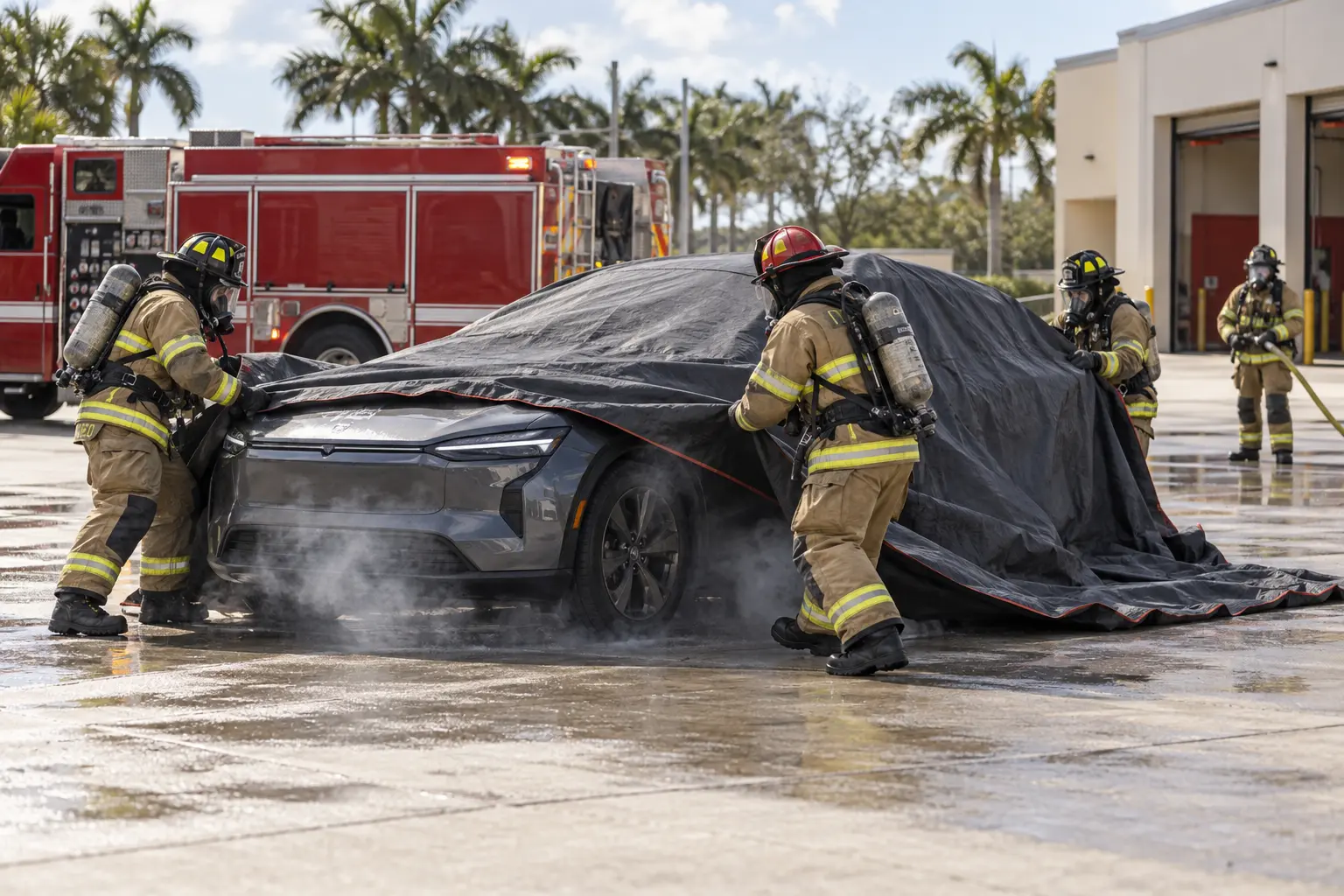
Fighting electric vehicle fires requires a fundamental shift in emergency tactics, and South Florida first responders are taking aggressive steps to modernize their operations. The Coral Springs-Parkland Fire Department introduced specialized equipment designed to penetrate lithium-ion battery packs directly, cutting suppression times and reducing water usage. Local reporting from coralspringstalk[dot]com confirmed the agency acquired this specialized suppression technology to keep pace with growing clean energy transport on public roadways.
Traditional vehicle blazes surrender quickly to standard fire hoses. Lithium-ion batteries behave differently. When a traction pack ruptures during a crash, internal chemical reactions trigger thermal runaway. Temperatures spike past one thousand degrees within seconds. Firefighters historically dumped thousands of gallons of water over many hours just to cool the outer casing. Direct injection systems change that balance by driving water straight into damaged battery cells.
Electric Vehicle Fires: Key Highlights & Market Impact
Departments across the United States face identical challenges as passenger fleets electrify. First responders gathered in Midwest City for intensive practical drills, as documented by koco[dot]com, proving that regional forces share common operational hurdles. Meanwhile, public events like the Madison clean transit showcase covered by channel3000[dot]com demonstrate how fast battery-electric models are entering suburban driveways. Greater consumer adoption inevitably brings more roadside incidents.
Financial institutions tracking infrastructure risk take note of these operational adjustments. Industry analysts at Bloomberg consistently review municipal capital budgets allocated toward specialty municipal response equipment. Modern emergency systems protect municipal budgets by preventing prolonged road closures and avoiding toxic runoff.
| Emergency Metric | Standard Water Application | Direct Battery Injection System |
|---|---|---|
| Water Volume Required | 3,000 to 8,000 Gallons | 500 to 1,500 Gallons |
| Suppression Duration | 2 to 4 Hours | 30 to 60 Minutes |
| Thermal Runaway Risk | High Secondary Reignitions | Suppressed via Internal Cooling |
| Runoff Contamination | Extensive Environmental Runoff | Contained and Greatly Reduced |
Detailed Breakdown: What Caused the Equipment Shift
Battery chemistry dictated this operational pivot. A standard car fire involves burning upholstery, plastics, and gasoline fuels. Firefighters extinguish those flames by cutting off oxygen supplies. In contrast, electric vehicle fires generate their own oxygen through internal chemical breakdown inside individual cells. Smothering blankets or continuous exterior dousing rarely halt the chain reaction occurring deep inside the steel battery chassis.
Thermal runaway jumps from one damaged pouch to adjacent cells. Water sprayed on the exterior bodywork rolls off harmlessly while internal heat climbs. Piercing nozzles and specialized injection lances penetrate the protective undercarriage shield. Once inside, pressurized mist cools the internal modules directly, breaking the heating loop before neighboring cells ignite.
Global fleet transitions bring these safety discussions to cities worldwide. Public transport overhauls mirror passenger vehicle adoption, just as urban planners observed in commercial transit shifts when studying why authorities replaced legacy fleets, detailed in our report on Electric vehicles: Why Lagos Banned Diesel Buses. Every transition demands modernized emergency support.
What This Means for Readers & Future Outlook
For drivers and homeowners, specialized fire equipment brings faster incident clearing and safer public roadways. A burning battery pack previously blocked major highways for half a day while crews monitored flare-ups. Modern injection gear clears lanes faster, limits toxic water runoff into local storm drains, and reduces secondary rekindling at municipal tow yards. Macroeconomic tracking from Reuters underscores how urban resilience depends on adapting public services alongside clean energy growth.
Municipal investments in specialized fire suppression gear also shape insurance risk profiles. Fleet operators monitor equipment rollouts to negotiate lower commercial premiums. When local crews control electric vehicle fires quickly, secondary asset loss drops dramatically. Cities that prepare early protect their communities and demonstrate how to support modern transit infrastructure.
Frequently Asked Questions
Why are electric vehicle fires harder to extinguish than gas fires?
Lithium-ion cells enter thermal runaway when damaged, generating internal oxygen and intense heat. Exterior water streams cannot easily reach the sealed battery core to stop the chain reaction.
How much water does an electric vehicle fire typically require?
Conventional exterior dousing methods often consume several thousand gallons of water over hours. Direct injection tools reduce water consumption significantly by spraying cool mist directly inside the pack.
What is thermal runaway in traction batteries?
Thermal runaway is an uncontrolled self-heating cycle caused by mechanical damage, electrical shorts, or extreme heat. One failing cell releases heat that ruptures neighboring cells sequentially.
Can battery fires rekindle hours after being extinguished?
Yes, residual internal heat can reignite unburned cells hours or days after the initial response. Fire crews use thermal imaging cameras to verify internal pack temperatures drop below hazardous levels.
How do direct battery injection tools work?
The apparatus penetrates the vehicle floor pan or battery enclosure with a high-pressure piercing mechanism. It discharges coolant directly onto modules, stopping the internal chemical reaction.
Are electric vehicles more likely to catch fire than gasoline cars?
Data shows battery electric models catch fire less frequently per mile than combustion vehicles. However, when battery packs do burn, extinguishing them requires specialized training and tactics.
How do fire departments handle toxic runoff from battery fires?
Crews place containment booms and absorbent pads around the vehicle perimeter. Direct cooling systems minimize the total water volume, making hazardous fluid collection much easier.
Do municipal fire crews receive dedicated electric car training?
Fire agencies across the country now conduct hands-on training courses focused on high-voltage cut loops, pack cooling, and proper handling of stranded electrical energy.
What should a driver do if their battery begins smoking?
Pull over immediately away from structures, shut down the ignition, evacuate all passengers, and move at least one hundred feet away before contacting emergency responders.
Can fire blankets extinguish a burning battery pack completely?
Fire blankets suppress exterior flames and contain toxic smoke plumes effectively. They do not halt internal thermal runaway, which still requires direct cell cooling.
Final Thoughts on Municipal Fire Safety
Modern emergency response systems must match the rapid growth of clean transportation. By investing in direct suppression technology, local authorities build a resilient framework capable of controlling electric vehicle fires efficiently while protecting surrounding communities.
Source: Coral Springs Talk (coralspringstalk[dot]com)