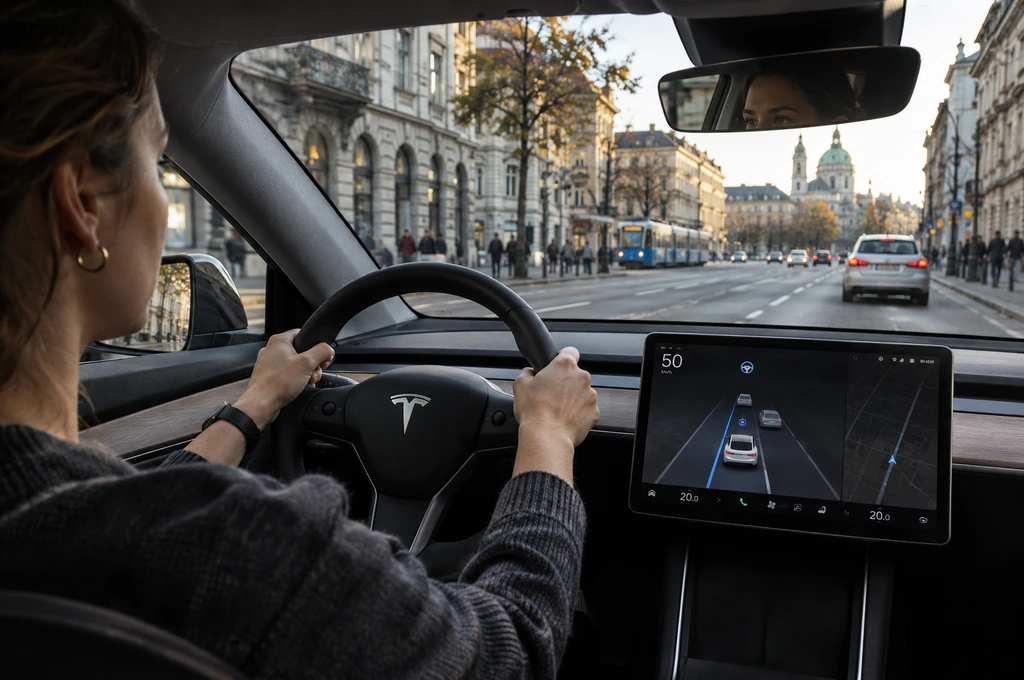
Tesla renames ‘Full Self-Driving’ to ‘Assisted Driving’ in Europe: Europe’s regulatory landscape has just dealt a sharp reality check to Elon Musk’s electric vehicle empire. Tesla has officially updated its software branding in the region, dropping the ‘Full Self-Driving’ moniker for ‘Assisted Driving’. This isn’t a cosmetic change. It is a strategic pivot driven by the European Union’s rigorous safety standards and the ongoing pursuit of regulatory approval for their advanced driver assistance systems.
⚡ Quick AI Overview & Key Recommendation
Tesla renames ‘Full Self-Driving’ to ‘Assisted Driving’ in Europe to align with new EU safety regulations. This move aims to secure software clearance, ensuring drivers understand the system remains a driver-assist feature requiring active supervision.
The decision comes as Tesla fights to get its highly anticipated FSD software cleared by authorities in Brussels. On paper, this sounds clean. In reality, it changes the balance of power between automakers and regulators. It signals that the days of aggressive marketing for Level 4 autonomy are over in Europe. The focus shifts to compliance and safety verification.
Tesla Renames ‘Full Self-Driving’ to ‘Assisted Driving’ in Europe: Core Evaluation Framework & Decision Matrix
The rebranding of Tesla’s Autopilot and FSD packages in Europe forces a fundamental shift in how consumers evaluate these systems. The old terminology implied a level of autonomy that the hardware currently delivers. The new terminology creates a clearer distinction between automation and human control. This distinction is critical for legal liability and safety.
Here is a breakdown of how the evaluation framework has changed for European buyers:
| Evaluation Criteria | Old Framework (FSD) | New Framework (Assisted) |
|---|---|---|
| Consumer Expectation | High expectation of hands-off capability. | Clear expectation of driver supervision. |
| Regulatory Risk | High risk of fines and software bans. | Lower risk, aligning with Level 2 standards. |
| Safety Marketing | Aggressive claims about ‘autonomous’ safety. | Conservative, factual claims about ‘assistance’. |
Understanding this matrix is the first step for any potential buyer. The ‘Assisted Driving’ label is a defensive measure. It protects Tesla from the legal pitfalls of over-promising. It also forces the driver to remain alert. This is a safer path for the automotive industry as a whole.
Real-World Calculations: Running Costs, Range & Government Subsidies
While the software changes are headline-grabbing, the economic reality of owning a Tesla in Europe remains compelling. The shift to ‘Assisted Driving’ does not impact the vehicle’s core efficiency or running costs. For the average owner, the financial math still favors an EV over a combustion engine.
Consider the charging economics. A standard Model 3 can travel roughly 4.5 to 5.5 km per kWh. If electricity costs €0.35 per kWh, running the car costs about €0.08 per km. A comparable petrol car might consume 6 to 7 liters per 100km. At €1.80 per liter, that is roughly €0.11 per km. The EV saves money on fuel, even with the software update.
However, government subsidies play a massive role. The EU is currently rolling out a significant incentive program to phase out internal combustion engines by 2035. This includes direct purchase subsidies and tax breaks for electric vehicles. These incentives make the upfront cost of a Tesla more manageable. The rebranding of the software does not change these subsidy eligibility rules.
Moreover, the cost of ownership extends beyond fuel. Maintenance is significantly lower for EVs. There are no oil changes, spark plugs, or transmission fluid flushes. The regenerative braking system extends the life of the brake pads. These factors contribute to a lower total cost of ownership over the vehicle’s lifespan.
Crucial Factors & What to Check Before You Buy
Purchasing a Tesla, or any advanced EV, requires due diligence. The recent software rebranding highlights the importance of understanding the technology before you sign the papers. Here is what you need to check before making the purchase.
- Battery Warranty: Verify the warranty terms for the battery and drive unit. Most manufacturers offer an 8-year warranty. Ensure it covers degradation below a certain percentage.
- Software Subscription Costs: Check the pricing for the ‘Assisted Driving’ package. In some markets, the cost is a one-time fee. In others, it is a monthly subscription. Understand the total cost of ownership.
- Charging Infrastructure: Assess your access to charging points. Home charging is ideal. Public charging networks vary in reliability and cost. Check the charging connector type used by the vehicle.
- After-Sales Service: Find out where the service centers are located. Tesla’s service model is direct-to-consumer. This means fewer third-party mechanics can service the vehicle. Ensure there is a service center within a reasonable distance.
- Resale Value: Research the current resale value of the model you are considering. EVs are still a relatively new asset class. Resale values can fluctuate based on battery health and software updates.
The market is watching closely. Tesla’s decision to rename the software in Europe sets a precedent. It suggests that other automakers will face similar pressure to be transparent about their automation capabilities. This is a win for consumer protection and a necessary step for the industry’s maturity.
FAQ
Does the ‘Assisted Driving’ update reduce the car’s capabilities?
No. The update only changes the name and the user interface. The underlying software algorithms and hardware capabilities remain the same.
Why did Tesla change the name in Europe?
Tesla changed the name to comply with new European Union regulations. These regulations require clear labeling of driver-assist features to prevent misleading consumers.
Is the ‘Assisted Driving’ feature free?
No. You must purchase the software package to access these features. The cost varies by region and model year.
Does this affect US customers?
Not immediately. The name change is specific to the European market. Tesla may adopt the new name globally in the future.
What is the difference between Autopilot and Full Self-Driving?
Autopilot is the basic driver-assist system. Full Self-Driving (now Assisted) includes additional features like traffic light recognition and navigation on autopilot. Both require active driver supervision.
Will Tesla get fined for the previous name?
Tesla is taking proactive steps to avoid fines. The rebranding is part of their compliance strategy with European authorities.
Is the ‘Assisted Driving’ software legal in Europe?
Tesla is currently seeking regulatory clearance. The rebranding is a step towards securing that approval.
How does this affect my insurance premiums?
Insurance premiums may decrease as the technology becomes more widely accepted and regulated. However, premiums vary by individual risk profile.
Can I still use the car without the software package?
Yes. The base model includes standard driver-assist features. You can drive the car without purchasing the ‘Assisted Driving’ package.
When will the software be available in Europe?
The update has already been rolled out to European users. The rebranding is immediate.
Conclusion
Tesla renames ‘Full Self-Driving’ to ‘Assisted Driving’ in Europe to navigate a complex regulatory environment. This move clarifies the system’s capabilities and ensures compliance with safety laws.
Frequently Asked Questions
Does the ‘Assisted Driving’ update reduce the car’s capabilities?
No. The update only changes the name and the user interface. The underlying software algorithms and hardware capabilities remain the same.
Why did Tesla change the name in Europe?
Tesla changed the name to comply with new European Union regulations. These regulations require clear labeling of driver-assist features to prevent misleading consumers.
Is the ‘Assisted Driving’ feature free?
No. You must purchase the software package to access these features. The cost varies by region and model year.
Does this affect US customers?
Not immediately. The name change is specific to the European market. Tesla may adopt the new name globally in the future.
What is the difference between Autopilot and Full Self-Driving?
Autopilot is the basic driver-assist system. Full Self-Driving (now Assisted) includes additional features like traffic light recognition and navigation on autopilot. Both require active driver supervision.
Will Tesla get fined for the previous name?
Tesla is taking proactive steps to avoid fines. The rebranding is part of their compliance strategy with European authorities.
Is the ‘Assisted Driving’ software legal in Europe?
Tesla is currently seeking regulatory clearance. The rebranding is a step towards securing that approval.
How does this affect my insurance premiums?
Insurance premiums may decrease as the technology becomes more widely accepted and regulated. However, premiums vary by individual risk profile.
Can I still use the car without the software package?
Yes. The base model includes standard driver-assist features. You can drive the car without purchasing the ‘Assisted Driving’ package.
When will the software be available in Europe?
The update has already been rolled out to European users. The rebranding is immediate.
Conclusion
Tesla renames ‘Full Self-Driving’ to ‘Assisted Driving’ in Europe to navigate a complex regulatory environment. This move clarifies the system’s capabilities and ensures compliance with safety laws.
Source: Reuters (reuters[dot]com)