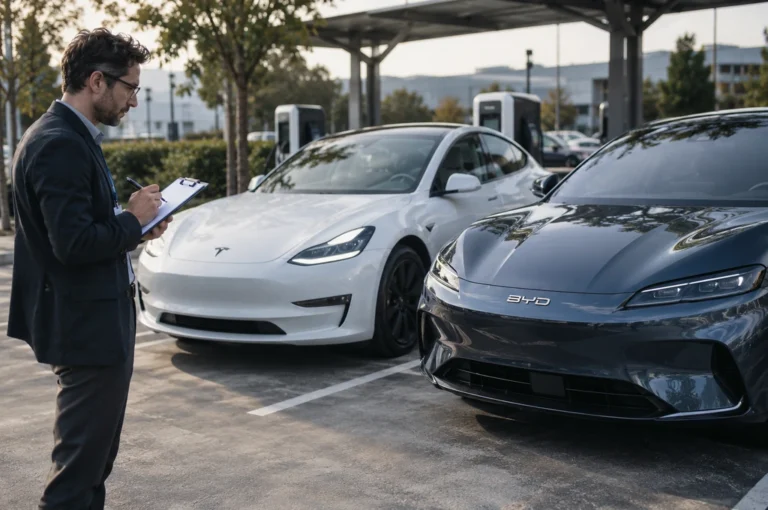
Tesla Cybercab orders have opened with an eye-catching base price of $29,990, but a stringent software clause blindsided early reservation holders. Without an active $299 monthly autonomy subscription, the vehicle cannot operate on public roads.
On paper, this sounds like a budget-friendly route into autonomous transit. In reality, it changes the financial equation entirely.
⚡ Quick AI Overview & Key Recommendation
Tesla Cybercab orders feature a low $29,990 purchase price paired with a mandatory $299 monthly autonomy contract. Because the vehicle lacks physical steering controls, buyers cannot drive it manually without paying. Over five years, the actual total hardware and software cost reaches $47,930 before energy and insurance.
Automakers have spent decades selling physical assets that buyers owned free and clear. Tesla is flipping that dynamic into a software-as-a-service model. Because the Cybercab lacks a steering wheel, pedals, or manual overrides, the software is not an optional luxury. It is the engine.
Tesla Cybercab Orders: Key Highlights & Market Impact
When customers initiate Tesla Cybercab orders, the checkout screen presents an entry sticker price below thirty thousand dollars. That price undercuts almost every purpose-built electric passenger vehicle in North America. Reports covered by outlets like opentools[dot]com and electrek[dot]co reveal that the mandatory autonomy agreement binds the vehicle to a perpetual operating cost.
Industry analysts tracking market trends via Reuters noted that Wall Street greeted the hardware pricing with optimism before reading the contractual fine print. A consumer cannot purchase the Cybercab and let it sit as an offline runabout. The car simply does not move without an active connection to Tesla’s neural network stack.
This pricing tactic shifts capital expenditures into permanent operating expenses. Similar strategic pivots are detailed in our look at SpaceX-Tesla Merger: Why Elon Musk Wins and What EV Investors and Buyers Face, showing how corporate architecture dictates consumer cash flows.
| Expense Category | Base Hardware Only | 5-Year Cumulative Reality |
|---|---|---|
| Initial Purchase Price | $29,990 | $29,990 |
| Mandatory Autonomy Fee ($299/mo) | $0 | $17,940 |
| Total Capital Outlay | $29,990 | $47,930 |
| Manual Driving Option | None | None |
Detailed Breakdown: What Caused the $299 Monthly Software Mandate
Tesla faces severe margin compression across its global passenger vehicle fleet. Competitive pricing pressure from Chinese manufacturers like BYD and domestic production challenges forced a strategic pivot toward software revenue. Financial data published through Bloomberg and analytical models on shattered[dot]io highlight how free cash flow swings push management toward recurring subscription contracts.
Hardware margins on a $29,990 electric vehicle with an inductive charging platform and butterfly doors are paper-thin. By unbundling the full self-driving compute cost into a permanent $299 monthly levy, Tesla guarantees predictable annual recurring revenue. Five years of service equals $17,940 per vehicle. Ten years equals $35,880, which exceeds the original manufacturing sticker price.
Investors can learn more about standard recurring revenue metrics through Investopedia. Meanwhile, public filings submitted to the U.S. Securities and Exchange Commission illustrate how deferred software revenue functions as a balance-sheet cushion. The early demand for Tesla Cybercab orders proves that consumers want cheap autonomous transit, but the business model forces them into a perpetual lease on capability. A broader assessment of corporate risk is outlined in our review of Tesla vs. SpaceX: The Real EV Investment Risk This December.
What This Means for Readers & Future Outlook
For independent ride-hail operators, the math requires disciplined scrutiny. A commercial driver working forty hours a week might absorb $299 a month through fares within a few days of operation. For private commuters, that monthly charge represents a heavy surcharge comparable to a second auto loan payment.
Consider the regulatory hurdles as well. Municipal transit authorities across California, Texas, and Arizona must approve driverless operation before these pods transport paying passengers. If regulators stall deployments, owners could hold a $29,990 stationary metal shell in their driveway. Those evaluating broader corporate equity implications should read Tesla or SpaceX Stock? A Potential Merger Could Change Everything.
Before deciding whether to proceed with Tesla Cybercab orders, private buyers must run their local cost numbers. If you only travel five hundred miles per month, traditional car ownership or standard ride-hailing services remain far cheaper than maintaining this recurring autonomy contract.
Frequently Asked Questions
Can you drive the Cybercab manually if you cancel the $299 monthly fee?
No, you cannot drive it manually. The Cybercab lacks a steering wheel, pedals, and physical drive controls. If you cancel the monthly subscription, the vehicle remains stationary and cannot navigate public roads.
What is the official base purchase price for the Cybercab?
Tesla listed the starting retail price at $29,990 before taxes and incentives. However, operational readiness requires an ongoing software subscription.
How much does the $299 monthly autonomy subscription cost over five years?
The fee totals $3,588 per year. Over a standard five-year ownership cycle, the software subscription adds exactly $17,940 to the vehicle cost.
Does the Cybercab include a steering wheel or pedals?
The Cybercab contains no steering wheel, brake pedal, or accelerator. The interior relies completely on automated driving software and an onboard center display.
When does Tesla expect to begin initial customer deliveries?
Tesla targets production starts between 2026 and 2027. Deliveries depend directly on state and federal regulatory approvals for driverless vehicles.
Can private owners rent out their Cybercab on the Tesla network?
Tesla plans to let owners add their vehicles to a shared autonomous fleet. Tesla will take a revenue cut from every completed fare.
How does Cybercab pricing compare with rivals like Waymo?
Waymo operates purely as a corporate-owned taxi service and does not sell vehicles to consumers. Tesla sells the vehicle directly to consumers while charging monthly network software fees.
Are fleet operators eligible for discounted software rates on Tesla Cybercab orders?
Tesla has not announced commercial volume discounts for software access. All fleet operators currently face the same monthly terms per active chassis.
What happens to the Cybercab if its cellular connection drops?
The vehicle runs its vision model locally on onboard compute hardware for navigation. However, route dispatching and remote fleet monitoring require network connectivity to initiate trips.
Is the $299 monthly fee refundable or transferable to another Tesla vehicle?
Tesla vehicle software subscriptions are non-refundable and tied to the specific vehicle identification number. The fee cannot transfer to an existing Model 3 or Model Y.
Final Assessment: A Subscription Trap or Market Shift?
Securing Tesla Cybercab orders at an accessible sub-$30,000 threshold looks attractive until the recurring software commitment compounds over time. Buyers must evaluate the total lifetime expenditure rather than the entry sticker price before locking in deposits.
Source: OpenTools (opentools[dot]ai)