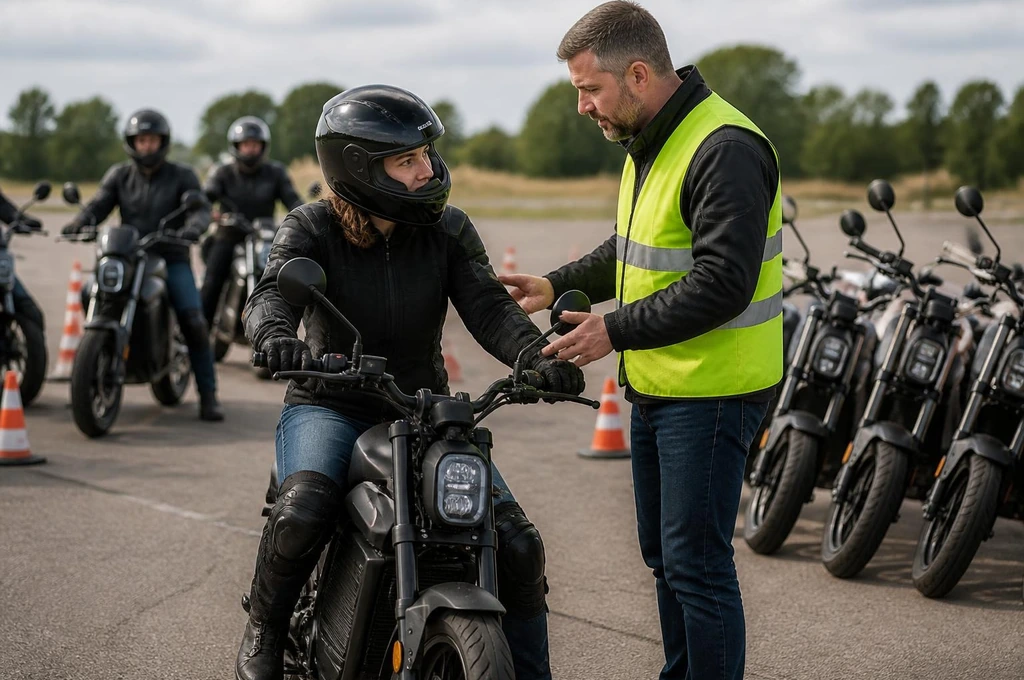
Earning a motorcycle license on an electric bike is now simpler than ever thanks to updated fleet standards in formal rider education. The LiveWire S4 Honcho Street met official criteria set by the Motorcycle Safety Foundation (MSF), which allows certified training schools to offer basic licensing courses on fully electric machinery. Beginners can now secure their road credentials without mastering manual clutches or mechanical gearboxes.
For decades, entry-level rider education relied on small-displacement gasoline bikes like the Honda Rebel 250 or Suzuki TU250X. Students spent their first weekend stalling engines and fighting friction zones. That barrier is dropping fast. According to reporting highlighted on electrek[dot]com, the inclusion of lightweight battery-powered models gives training centers a quiet, twist-and-go alternative.
Motorcycle License on an Electric Bike: Key Highlights & Market Impact
Training academies operate under strict operational guidelines. To qualify for MSF fleets, a motorcycle must meet explicit power, weight, and seat-height thresholds. LiveWire engineered the S4 Honcho Street specifically to fit those parameters. The result gives riders immediate control and stable handling at walking speeds.
Market analysts at Bloomberg track rising interest in urban micro-mobility, but steep licensing curves have long suppressed formal adoption. Qualifying for a motorcycle license on an electric bike removes the friction that turns curious commuters away. Novice riders focus on vision, balance, and emergency braking rather than gear shifts.
The table below outlines the core differences between traditional training fleets and modern electric trainers:
| Training Attribute | Traditional Gas (250cc) | Electric (LiveWire S4) |
|---|---|---|
| Transmission | 5-speed manual with clutch lever | Direct drive, twist-and-go |
| Engine Stalling | Frequent during low-speed drills | Zero risk of mechanical stall |
| Thermal Heat Output | High exhaust pipe heat near ankles | Negligible ambient motor heat |
| Throttle Response | Variable based on RPM and gear | Linear and instant delivery |
| Curriculum Focus | Clutch control and friction zone | Spatial awareness and braking |
Detailed Breakdown: What Caused This Rider Shift
Rider demographics are changing rapidly. Modern commuters want clean transportation for daily errands rather than loud weekend highway cruisers. Testing for your motorcycle license on an electric bike eliminates standard stalling risks, which historically caused high failure rates during weekend parking lot evaluations.
Urban safety statistics show that low-speed maneuverability matters most. Regional police reports, such as incident logs tracked on cleveland[dot]com and local collision briefs on waltrontribune[dot]com, frequently highlight the risks uncertified riders face in dense traffic. While consumer interest in models like Electric bike: Are Rivian’s Delayed E-Bikes Any Good? grows, formal road training remains essential. Licensing ensures that riders learn street survival skills before sharing lanes with commercial traffic.
Legal frameworks are keeping pace as well. In most American jurisdictions, completing an MSF course waives the practical road test at the Department of Motor Vehicles. Some states distinguish between manual and automatic endorsements, but many issue an unrestricted license regardless of the transmission used during testing. You should verify your state bureau rules before enrolling, because how obtaining a motorcycle license on an electric bike affects legal endorsements varies slightly by state.
What This Means for Readers & Future Outlook
Lower barriers to entry bring more riders to the street. Financial data compiled by Investopedia indicates that urban commuters spend thousands annually on fuel and parking. Compact electric two-wheelers cut those expenses to pennies per mile. Supporting infrastructure continues to expand, just as commercial corridors see improvements when United Dairy Farmers Adds EV Charging: A Sweet Ohio Upgrade across regional routes.
Safety advocates maintain that proper education prevents crashes. Serious accidents, such as the situation analyzed in our report on Electric Bike Crash in Indiana Borough: Safety and Liability Issues, prove that basic riding mechanics cannot be ignored. Electric power delivers instant torque from a standstill. Without proper braking and swerving fundamentals, unexpected acceleration creates severe hazards.
For anyone intimidated by manual transmissions, securing a motorcycle license on an electric bike offers a fast path to two-wheel transit. Instructors spend more time coaching path selection and counter-steering when they do not have to restart stalled engines every five minutes. Fleet managers also enjoy lower maintenance overhead with no oil changes, spark plugs, or clutch plates to replace.
Frequently Asked Questions
Can I take the MSF Basic RiderCourse on an electric motorcycle?
Yes. Training schools that add certified electric models like the LiveWire S4 Honcho Street allow students to complete all practical exercises on battery-powered machines.
Does taking the test on an electric bike give me a restricted license?
It depends on your state. Some states apply an automatic-only restriction to your motorcycle endorsement, while others grant a standard, unrestricted license.
Why did the MSF approve the LiveWire S4 Honcho Street?
The bike meets MSF safety thresholds regarding physical weight, power output, and seat geometry. These attributes ensure students stay safe during beginner exercises.
Is it easier to pass the rider course on an electric bike?
Most students find it easier because electric bikes cannot stall. Riders can dedicate their attention entirely to balance, braking, and lane positioning.
Can I ride a manual gas motorcycle later if I learn on an electric bike?
You can legally do so if your state provides an unrestricted license. However, operating a manual bike safely still requires learning clutch and shift techniques.
Do electric training motorcycles run out of battery during class?
No. Typical training sessions involve low-speed drills over short distances. Fleet bikes easily last through standard course hours on a single charge.
Are electric motorcycles safer for beginners than gas bikes?
They eliminate burn risks from hot exhaust pipes and prevent stalling in traffic. Riders still need careful throttle discipline to handle immediate electric torque.
How much does an MSF course typically cost?
Courses generally cost between $150 and $350 depending on the state and training provider. Some state programs subsidize tuition for resident riders.
Do I need my own motorcycle to attend the licensing course?
No. Most MSF training sites provide the motorcycle and helmet for the basic course. You only need to arrive with proper protective riding gear.
What riding gear is mandatory for electric bike licensing courses?
You must wear sturdy over-the-ankle boots, durable long pants, a long-sleeved shirt or jacket, full-fingered gloves, and eye protection.
Closing Perspectives on Electric Rider Training
Qualifying for a motorcycle license on an electric bike modernizes rider safety and removes mechanical anxiety for beginners. As major manufacturers supply approved electric trainers to schools nationwide, two-wheel mobility becomes accessible to a far wider audience.
Source: Electrek (electrek[dot]co)