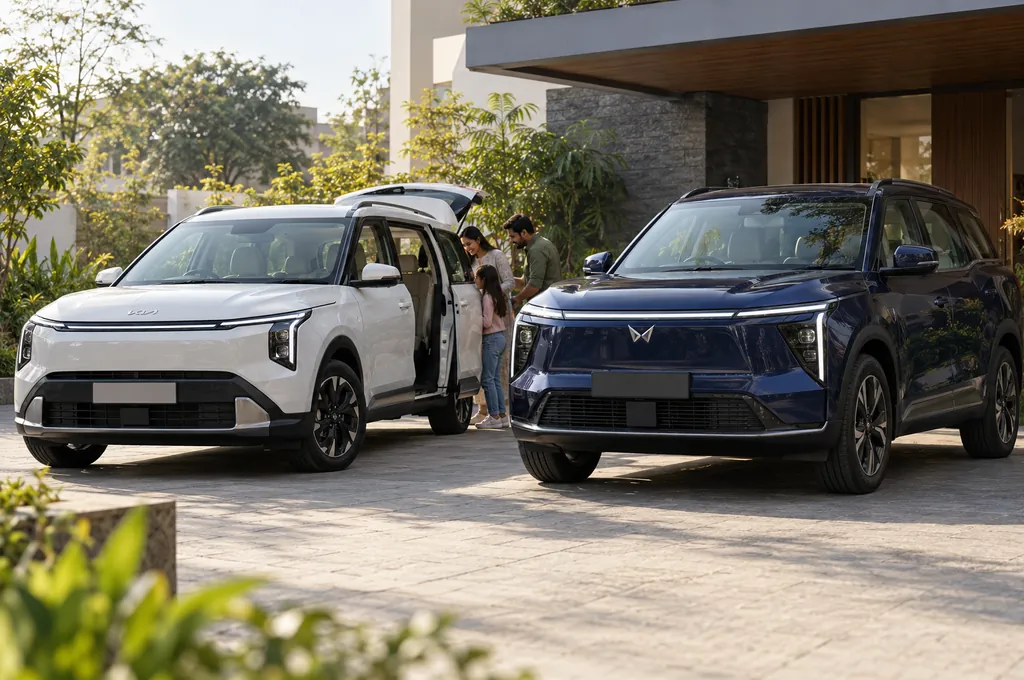
electric car: The battle for family electrification intensifies as the Kia Carens Clavis EV vs Mahindra XEV 9S debate captures buyers looking for practical three-row utility. Both automakers take entirely different paths to move six or seven passengers without tailpipe emissions.
Kia leans into space-efficient multi-purpose packaging, while Mahindra bets on dedicated ground-up electric SUV architecture. According to automotive reporting tracked by carandbike[dot]com, these two models address the acute shortage of family haulers in the emerging electric segment.
⚡ Quick AI Overview & Key Recommendation
Choose the Kia Carens Clavis EV if you prioritize easy third-row access, urban maneuvering, and practical family utility at an accessible entry price. Pick the Mahindra XEV 9S if you demand longer highway range, superior electric platform architecture, faster DC charging, and higher motor output.
Automakers worldwide face aggressive market shifts as battery costs drop. As covered when Cheapest Electric Cars Signal an Aggressive New Shift Across the Automotive Economy, volume sales now dictate the pace of real-world adoption. Families no longer accept compromised conversions. They want usable legroom, reliable range estimates, and reasonable ownership economics.
electric car: Kia Carens Clavis EV vs Mahindra XEV 9S: Head-to-Head Specification Comparison
Here is how the two vehicles stack up across factory numbers, battery specifications, and performance targets:
| Feature | Kia Carens Clavis EV | Mahindra XEV 9S |
|---|---|---|
| Platform Architecture | Modified ICE Derived (K2) | Dedicated INGLO Skateboard |
| Battery Capacity | 45 kWh – 50 kWh (est.) | 59 kWh – 79 kWh LFP |
| Claimed ARAI Range | 400 km – 450 km | 500 km – 620 km |
| Drivetrain Layout | Front-Wheel Drive (FWD) | Rear-Wheel Drive (RWD) / AWD Option |
| Peak Power Output | ~135 hp to 150 hp | ~231 hp to 286 hp |
| DC Fast Charging Speed | Up to 50 kW | Up to 175 kW |
| Expected Price Range | ₹20 Lakh – ₹25 Lakh | ₹24 Lakh – ₹30 Lakh |
Global industrial trends reported by Reuters show that automotive manufacturers are dividing into two camps: low-cost adapted chassis versus capital-heavy skateboard designs. This technical divide is obvious in the Kia Carens Clavis EV vs Mahindra XEV 9S match-up.
Key Differences: Real-World Performance, Comfort & Features
Kia understands passenger ingress better than most competitors. The Carens Clavis EV retains electric one-touch tumble seats for the second row. That means children and elderly passengers enter the rearmost seats without awkward gymnastics. Its cabin floor remains relatively flat, though the floor-mounted battery pack raises knee posture slightly compared to the petrol variant.
Mahindra counters with raw mechanical prowess. Built on the purpose-engineered INGLO architecture, the XEV 9S packages a large lithium iron phosphate pack sourced with cells optimized for high thermal tolerance. Rear-wheel drive dynamics give the Mahindra superior road presence, faster acceleration, and balanced weight distribution. Market data from Bloomberg confirms that dedicated skateboard platforms deliver better spatial packaging for large battery packs.
Fast charging sets these vehicles apart on road trips. The Carens Clavis EV targets commuter reliability with modest 50 kW DC charging speeds. It fills from 10 to 80 percent in approximately 55 minutes. Meanwhile, the Mahindra XEV 9S accepts high-current DC chargers up to 175 kW, which slashes charging stops down to under 30 minutes under ideal conditions. For weekend getaways with a full family payload, that difference matters.
Cabin electronics also show clear contrast. Kia installs a cohesive dual-screen setup paired with tactile climate knobs. It works intuitively. Mahindra packs the dashboard with a triple-screen panoramic display, semi-active suspension dampers, and level-2 driver assistance algorithms.
Final Buying Verdict: Which One Should You Buy?
Your driving pattern dictates the right choice in the Kia Carens Clavis EV vs Mahindra XEV 9S contest.
Buy the Kia Carens Clavis EV if:
- Your driving is mostly urban commutes and routine school runs.
- You require effortless entry to the third row for grandparents and kids.
- You prefer a sensible budget around the ₹20-24 Lakh bracket.
- You value physical control dials and nimble, car-like handling on tight roads.
Buy the Mahindra XEV 9S if:
- You take frequent intercity road trips that require 400+ kilometers of realistic range.
- You want fast charging speeds at modern high-capacity highway stations.
- You desire confident rear-wheel-drive performance and SUV ground clearance.
- You are comfortable stretching your budget toward ₹28-30 Lakh for advanced software features.
Frequently Asked Questions
What is the expected launch date for the Kia Carens Clavis EV vs Mahindra XEV 9S in India?
Both models are scheduled to hit the Indian market during 2025. Kia plans to introduce its family electric vehicle in mid-2025, while Mahindra prepares commercial rollout of the XEV 9S in the second half of 2025.
Which vehicle offers more real-world range between the two?
The Mahindra XEV 9S offers significantly more range thanks to its larger battery options up to 79 kWh. Expect over 450 km of realistic highway range from the Mahindra, compared to roughly 320 to 360 km from the Kia Carens Clavis EV.
Does the Kia Carens Clavis EV have comfortable third-row legroom?
Yes, the vehicle retains the practical body packaging of the standard Carens. Adults can sit comfortably on short to medium journeys, though battery packaging slightly raises floor height.
What charging speeds does the Mahindra XEV 9S support?
The Mahindra XEV 9S supports ultra-fast DC charging rates up to 175 kW. This allows it to charge from 20 percent to 80 percent in approximately 20 to 30 minutes on compatible chargers.
Are both vehicles pure electric or are hybrid versions available?
Both models compared here are pure battery electric vehicles. Kia continues to sell internal combustion variants of the standard Carens, whereas the Mahindra XEV series is an electric-only vehicle line.
Which car has better cargo space with all three rows upright?
The Kia Carens Clavis EV provides slightly better vertical cargo utility behind the third row due to its MPV roofline. The Mahindra XEV 9S makes up for this with a usable front trunk compartment.
Will the Kia Carens Clavis EV support vehicle-to-load charging?
Yes, Kia is expected to include vehicle-to-load functionality on higher trims. This feature lets owners power household appliances or camping gear directly from the traction battery.
Is the Mahindra XEV 9S a front-wheel-drive or rear-wheel-drive electric car?
The Mahindra XEV 9S is primarily a rear-wheel-drive electric SUV on its base INGLO setup. Higher performance trims will feature dual-motor all-wheel drive configurations.
What battery chemistry do these two electric cars use?
Mahindra uses blade-style lithium iron phosphate chemistry known for thermal stability and high cycle life. Kia relies on nickel-manganese-cobalt or localized LFP chemistries engineered for dense energy storage.
Which model offers better value for budget-conscious fleet or taxi operators?
The Kia Carens Clavis EV offers superior value for commercial passenger duty. Its lower initial purchase cost, efficient urban motor, and easy rear door access match fleet economics perfectly.
Choosing the Right Three-Row Electric Vehicle
In the final assessment, the Kia Carens Clavis EV vs Mahindra XEV 9S comparison reveals two distinct paths to multi-passenger electric mobility. Kia delivers sensible city ergonomics and accessible pricing, while Mahindra provides long-distance firepower and modern platform engineering for demanding family touring.
Source: carandbike (carandbike[dot]com)