

Buying an electric two-wheeler or car is a five to eight year relationship, not a one-day transaction. The dealer you pick handles your service, warranty claims, spare parts and charging queries long after the invoice is printed. Get this wrong and a battery fault that should take three days to sort drags into three weeks. This checklist walks you through what to actually verify before you pay a booking amount.
What to check before you choose an EV dealer in India
To choose the right EV dealer in India, confirm they are an authorised sales-and-service outlet for the brand, have an in-house service centre with trained EV technicians, help with RTO registration and subsidy paperwork, and hold genuine spare parts in stock. Price matters less than proximity and after-sales reliability.
A showroom that only sells and sends you 40 km away for every service is a poor choice, even if the on-road price is ₹5,000 lower. EVs need fewer routine services than petrol vehicles, but battery and motor issues, when they come, need the manufacturer’s diagnostic tools and firmware access. Only an authorised dealer has those.
Verify authorisation, service capacity and stock
Start by confirming the dealer is on the manufacturer’s official dealer list, not a multi-brand reseller pretending to be authorised. Every major brand, from Tata and MG to Ather, Ola and Bajaj, publishes verified dealer locations on its website. Cross-check the address and phone number against what the showroom tells you.
Then look at their service side:
- An in-house service bay, not a promise to “tie up with a garage nearby”
- Technicians trained on high-voltage battery systems (ask directly how many)
- Genuine spare parts in stock, including brake pads, tyres and controller units
- A loaner or pickup-drop policy for warranty repairs that take days
Say you buy an electric scooter and the onboard charger fails in month seven. An authorised dealer with stock swaps the part under warranty in two to three days. A weak dealer orders it from the manufacturer, waits two weeks, and you lose your daily commute in between.
Ask to see the workshop before booking. A clean, equipped bay tells you more than any sales pitch.
Get the warranty and battery terms in writing
The battery is 30 to 40 percent of an EV’s cost, so its warranty is the single most important document you sign. Most Indian EV makers offer a battery warranty of 3 years or roughly 30,000 km on two-wheelers, and 8 years or 1,60,000 km on cars, but the exact terms vary by model and even by manufacturing batch.
Read these clauses carefully:
- What counts as a covered failure versus “normal degradation”
- The minimum guaranteed capacity (often 70 percent) below which the battery is replaced
- Whether the warranty transfers to a second owner, and the process to do it
- Charging conditions that void cover, such as using a non-approved fast charger
A good dealer explains these before you ask. If the salesperson waves off warranty questions with “don’t worry, it’s fully covered”, treat that as a warning. Get the specific terms on the sale document, not a verbal assurance.
Confirm they handle RTO, FAME and state subsidy paperwork
A competent dealer files your RTO registration and claims your subsidies for you, so the discount reflects in the on-road price rather than becoming your paperwork headache. Under the central government’s incentive schemes and state EV policies, the subsidy is usually passed to the buyer upfront by the dealer, who then claims it back.
Ask exactly which incentives apply to your model and state. Delhi, Maharashtra, Gujarat and others run their own EV subsidy and road-tax waiver schemes on top of any central benefit, and the amounts change. You can check the current central scheme details on the Ministry of Heavy Industries EV portal before you sit down to negotiate.
Confirm in writing:
- The ex-showroom price, the subsidy deducted, and the final on-road figure
- Road tax and registration charges (many states waive road tax on EVs)
- Who files the RTO documents and how long registration takes
- GST invoice with the correct HSN code, so the tax is clean if you claim it as a business
If a dealer asks you to chase the subsidy yourself, factor in weeks of follow-up and the risk of a rejected claim.
Test the after-sales reality, not the sales promise
After-sales support is where most EV buyers get burned. Judge a dealer on how they treat existing customers, not new ones. Read reviews about service delays, warranty disputes and spare-part waits on Google Maps, model-specific owner groups and forums like Team-BHP.
Then do two quick checks. Call the service number as if you already own the vehicle and see how long it takes to reach a person. Ask a current owner in the waiting area how their last service went. Real owners tell you the truth in thirty seconds.
Charging support matters too. A dealer worth choosing helps you plan home charging, tells you the real charging time on a 15A socket versus a fast charger, and points you to nearby public chargers. If you are still deciding between models, comparing options at a multi-brand advisor like Electric One can save you from a mismatch before you ever reach a single-brand showroom.
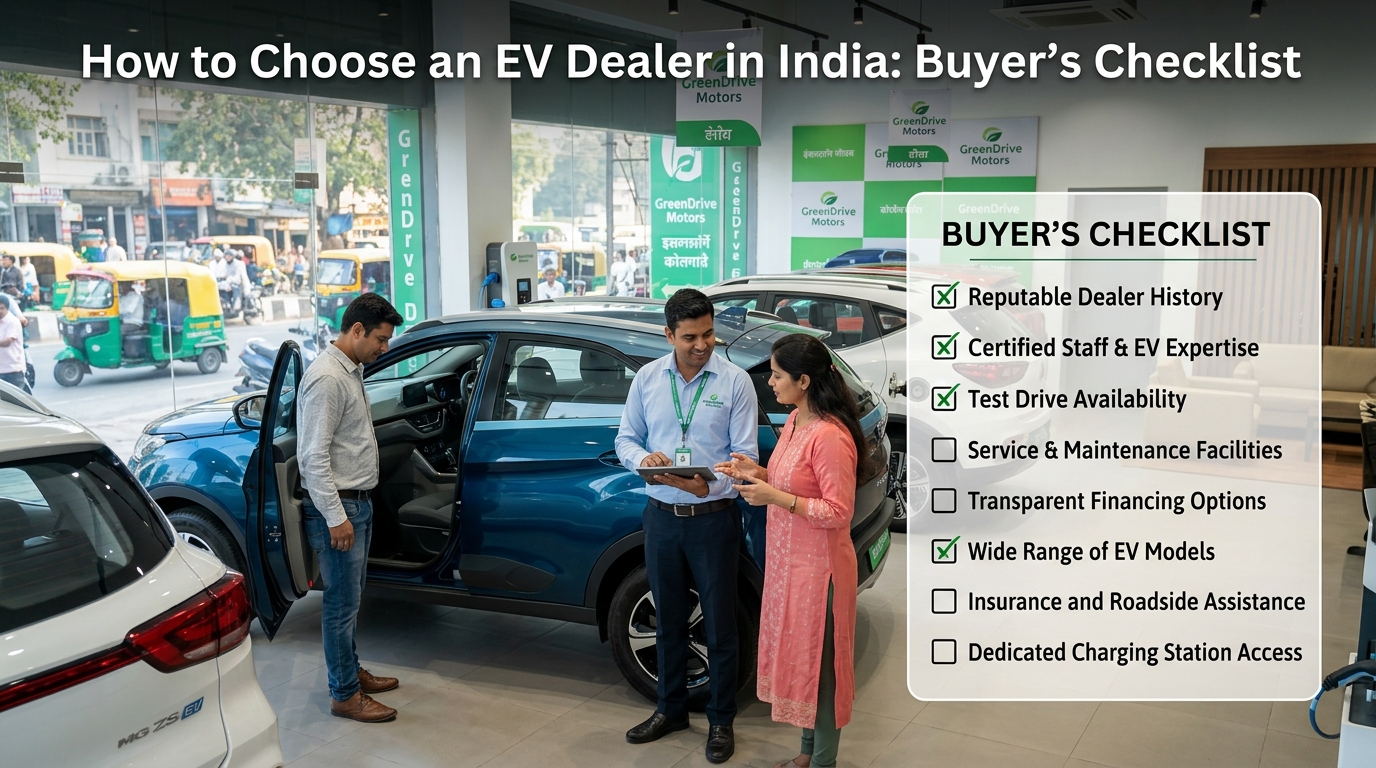
Run this checklist before your next visit:
- Authorised dealer confirmed on the brand’s official site
- In-house service bay with trained EV technicians
- Genuine spare parts in stock
- Full battery warranty terms in writing
- Subsidy and RTO paperwork handled by the dealer
- On-road price broken down line by line
- Recent owner reviews on service and warranty read
- Charging setup and support explained
Pick the dealer who answers hard questions plainly and shows you the workshop. That is the one who will still pick up the phone in year four.
Frequently asked questions
Can I buy an EV from a dealer in a different city and service it near my home?
Yes, if both showrooms are authorised outlets of the same brand. Warranty and service are honoured across any authorised service centre in India, not just where you bought. Confirm your nearest centre is authorised before buying elsewhere for a lower price, and keep your original invoice and warranty card for every claim.
Does the EV subsidy come as a cash refund or a price discount?
For most Indian EVs, the dealer deducts the eligible subsidy upfront from the on-road price and claims it back from the government later. You should never pay the full price and wait for a refund yourself. Ask the dealer to show the subsidy deducted as a line item on your booking and final invoice.
Is it safe to buy an EV from a multi-brand dealer instead of an authorised one?
Multi-brand or unauthorised sellers can quote lower prices but usually cannot access manufacturer diagnostic tools, genuine parts or warranty claims. Battery and motor faults then become expensive out-of-pocket repairs. For test rides and comparison, a multi-brand advisor is useful, but buy and service through an authorised dealer of your chosen brand.
What happens to my warranty if I use a third-party fast charger?
Many EV warranties list charging conditions, and using an unapproved or faulty fast charger can void battery cover if it damages the pack. Check the warranty document for approved charger specifications before using public or cheap aftermarket chargers. When in doubt, ask the dealer which chargers the manufacturer certifies for your model.
How do I confirm a dealer is genuinely authorised by the manufacturer?
Check the brand’s official website for its dealer locator and match the exact showroom name, address and phone number. Call the manufacturer’s customer care to verify if unsure. An authorised dealer issues invoices in the brand’s system and can register your vehicle for the official warranty, which a reseller cannot.
Do I need to register the EV myself or does the dealer do it?
A good dealer handles RTO registration, high-security number plate and road-tax formalities for you and includes these in the on-road price. Some smaller outlets ask you to do it yourself. Confirm before booking, because self-registration means multiple RTO visits and the risk of errors that delay your delivery.
Why is the on-road price higher than the ex-showroom price advertised?
Ex-showroom price excludes RTO registration, road tax, insurance and any handling or logistics charges. On-road price adds these. For EVs, many states waive road tax, which lowers the gap. Always ask for a written breakdown so you can spot inflated handling fees or unnecessary add-ons the dealer bundles in.
Can the battery warranty transfer to a second owner if I sell the EV?
It depends on the manufacturer. Some transfer the remaining battery warranty to a second owner with a small fee and a form; others do not. This directly affects resale value. Ask the dealer for the exact transfer process in writing before buying, especially if you plan to sell within three to four years.
How long does an EV warranty repair usually take at a dealer?
A part in stock is often replaced in two to three days. If the dealer has to order from the manufacturer, it can stretch to two weeks or more. Ask the dealer their average turnaround for battery and controller issues, and whether they offer a loaner or pickup-drop while your vehicle is in the workshop.
Should I pay a booking amount before finalising the dealer?
Only after you have verified authorisation, seen the service bay and read the warranty terms. Booking amounts are usually refundable, but recovering them can involve follow-up. Get the refund policy in writing and avoid paying large advances just to hold a price the dealer says will expire soon.
